
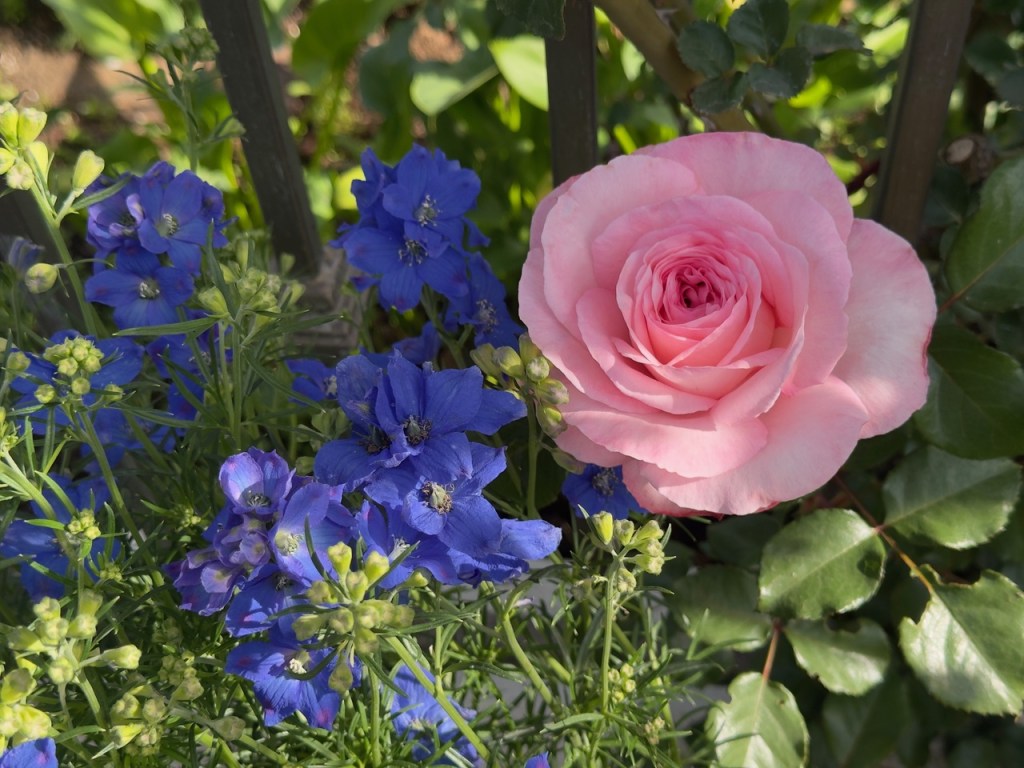
For The Union-Tribune
I like to grow roses and I like to bake. At first glance, they seem to have little in common, but recently — while watching the charming “The Great British Baking Show” — I realized they share the same underlying principle: Good results depend on respecting the fundamentals.
Ignore a key ingredient or technique, and in baking you risk “stodgy,” or “claggy” results — or even the dreaded “soggy bottom.”
In the garden, the parallels are just as clear: Neglect good rose culture, and you invite puny, unattractive blooms, weak growth and disease. Whether baking or gardening, success begins with understanding and following essential principles.
Still, following rules doesn’t mean becoming mechanical. Between “anything goes” and “never deviate” lies a wide middle space where good judgment lives. It is in that space that both baking and rose growing take on a distinctly personal flair. Contestants on the baking show are complimented on their creativity of flavors and textures while preserving the bake’s essential features. Gardeners, meanwhile, must honor the needs of roses but can make imaginative choices in planting, planning and design.
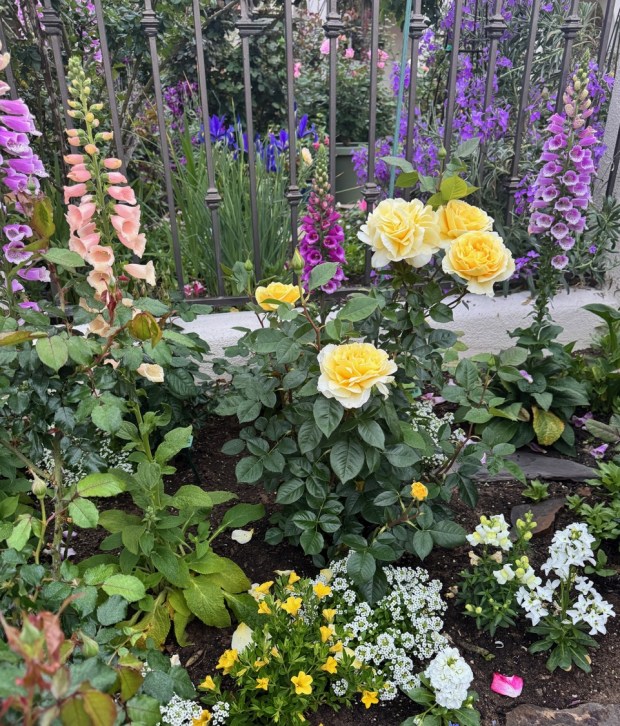 Foxgloves, stock, delphinium, sweet alyssum and iris provide company to ‘Quest for Zest’ in the garden. (Rita Perwich)
Don’t deviate from these basics
• Before experimenting, it helps to be clear about the non-negotiables.
• Plant roses in the sun; avoid shade.
• Water deeply, allowing the soil to dry at least 2 inches below the surface before rewatering.
• Use organic fertilizer several times during the growing season.
• Mulch with organic compost or small wood chips to conserve moisture, suppress weeds and improve soil health.
• Prune annually to promote vigor, airflow and basal growth.
• Deadhead to encourage repeat blooming.
• Avoid monoculture — interplant with diverse companions to reduce pests and disease.
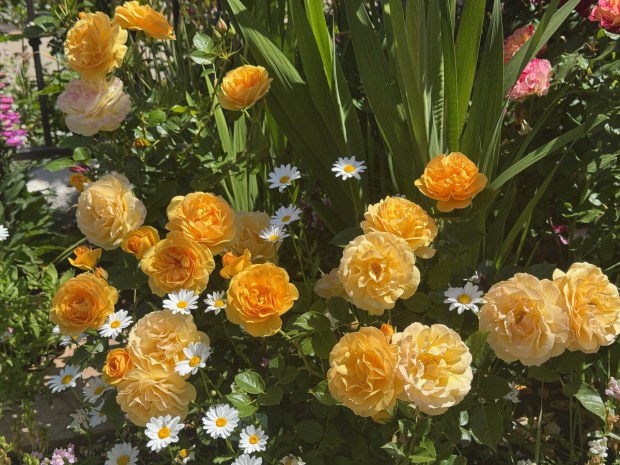 Daisies enhance the beauty of the floribunda ‘Julia Child.’ (Rita Perwich)
Different schools of thought
Even with these shared fundamentals, there are many approaches to growing roses. My own approach is firmly rooted in natural, organic and sustainable practices. Rather than relying on pesticides, fungicides or complex fertilizer routines, I work with the natural processes already at work in the garden — building healthy soil, encouraging beneficial insects to assist me in my garden and selecting rose varieties suited to my region.
I don’t see gardening as a battle against nature, but as a collaboration with it. Lady beetles, lacewings, syrphid flies, spiders and birds all play their part in my garden. They are my pest control service and provide the level of pest management that meets my needs. A garden that is alive, balanced and imperfect feels far more satisfying to me.
Some gardeners strive for formality and perfection: unblemished petals, ideal form, and exhibition-quality blooms. While that pursuit may appeal to those who exhibit roses, it has the potential to create unintended consequences. In both baking and gardening, the pursuit of perfection can come at a cost. Just as a baker may focus solely on richness and indulgence without considering the excess fats and sugar required to create their foods, a gardener may prioritize flawless blooms at the expense of soil health and ecological balance.
Overfertilization with chemical fertilizers can deliver rapid growth and bigger blooms, but over time it will negatively impact soil health. Similarly, routine reliance on pesticides and fungicides disrupt beneficial insect populations and upset the broader garden ecosystem. For example, spider mites often flourish when pesticides have eliminated the very insects that would otherwise keep them in check. Healthy roses grown in living soil require fewer interventions and provide more sustainable beauty over time.
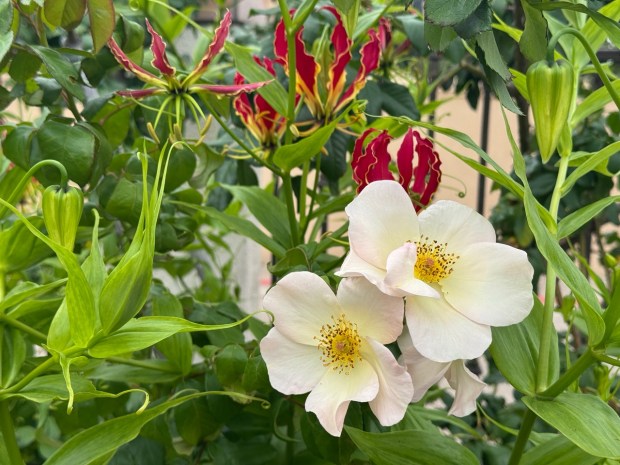 Gloriosa lilies, also known as flame lilies, flower amidst ‘Sally Holmes.’ (Rita Perwich)
Thoughtful experimentation
Mycorrhizae are beneficial fungi that can form symbiotic relationships with plants’ roots, helping them access water and nutrients beyond their immediate root zone. In my garden, I don’t add mycorrhizae, as studies suggest they often provide little benefit in soils (like mine) that are well-amended and adequately watered. This is because when a plant senses that its tissues or the soil contains enough water and nutrients, it becomes less receptive to infection by mycorrhizal spores as it no longer needs its mycorrhizal partner.
However, many respected rosarians do use them. Some add it to the soil, and others dust the roots of bare-root roses at planting.
How do we decide whether to spend the money and time to add mycorrhizae when there are differing opinions on the subject? As in baking, when experts disagree, the answer is simple: Test it — thoughtfully. Plant two similar roses (ideally the same variety) in comparable soil and sunlight. Treat one with mycorrhizae and leave the other untreated. Keep all other variables consistent — watering, mulching, fertilizing — and observe the results over a growing season. Note differences in vigor, foliage, bloom production and stress tolerance. A good experiment does not require a laboratory; careful observation over time is often the most reliable teacher.
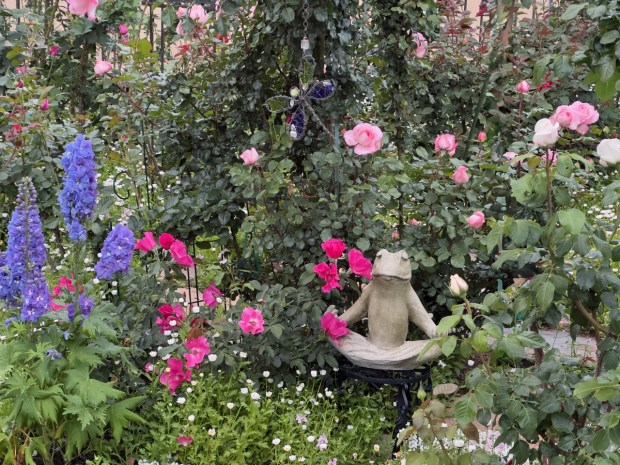 A setting of blue delphiniums, daisies, fuschia pink ‘Playgirl’ blooms and light pink ‘Savannah’ blooms is a perfect spot for this frog to meditate. (Rita Perwich)
Care and creativity in our garden
While we must provide for the basic cultural needs of our plants, there is ample room for experimentation and creative expression in our garden. Just as bakers on “The Great British Baking Show” build on recipes with their own flavors and signatures, gardeners can bring their own vision to life through companion planting, color choices and thoughtful design. The fundamentals guide us, experimentation teaches us, and personal creativity and preferences shape the result.
Author and gardener Louise Beebe Wilder wrote in her 1918 book, “Colour in My Garden,” “In his garden every man may be his own artist without apology or explanation.” That sentiment rings true. Our gardens are creative sanctuaries — places where, beyond meeting the basic needs of healthy roses, we are free to shape and design according to our own vision, taste and aesthetic.
In a healthy garden, a gardener’s palette extends well beyond roses. A wide array of plants offers shapes, colors and textures that both complement and enhance their beauty. Foxgloves, delphiniums, snapdragons, lupins, stock, lavender, sage and penstemon provide vertical accents that contrast with and highlight the roses’ round blooms. At the same time, the delicate, tiny flowers of sweet alyssum and nemesia — and the bold, dinner-plate blooms of certain dahlias and sunflowers — create striking variation in scale, adding depth and visual interest.
Several years ago, I planted a few six-packs of daisies, nemesia, sweet alyssum and stock. I also planted a few gloriosa lily tubers and some alstroemeria. Over time, volunteer nasturtiums found their way into the mix. Now these plants return each year like old friends. Some gardeners might regret such exuberant, free-spirited and rambunctious choices — but I do not! I love them, as do the bees, pollinators and beneficial insects. Even the presence of pest insects feels less troubling when there are companion plants that serve as a natural diversion, drawing the pests’ attention away from my roses.
Early in the season, before my pruned roses begin to bloom, the daisies, nemesia, sweet alyssum, stock (usually an annual, though a perennial in my garden) and nasturtiums provide essential pollen and nectar for beneficial insects and pollinators. Later, during the lull between bloom cycles, the gloriosa lilies take center stage, filling the garden with their vibrant red-and-yellow exotic beauty. The alstroemerias provide constant color and dependability throughout the year. I cannot take full credit for this evolving combination. They are a gift from the garden itself. Together, these types of elements give each of our gardens its own distinctive flavor, like a well-loved recipe that becomes uniquely our own over time.
In the end, growing roses — like baking — is not about choosing between rules and creativity. It is about understanding the fundamentals well enough to use both wisely. From there, observation, experience, experimentation and imagination allow each gardener to create something beautiful and distinctly their own.
Book news
I hope readers of my column will enjoy my forthcoming book, “Natural Rose Gardening: An Organic Guide to Amazing Blooms” (Chelsea Green Publishing). It offers practical, earth-friendly guidance on the basic rules of good rose culture along with advice on choosing rose varieties and companion plants and creating a garden with personal character and creative vision. It also includes recipes using organically grown roses and plants. Available for pre-order now; release in October 2026 at penguinrandomhouse.com/books/827874/natural-rose-gardening-by-rita-perwich.
Perwich is a member of the San Diego Rose Society, a Consulting Rosarian and a Master Gardener with UC Cooperative Extension. For more information and advice, visit rose-harmony.com.