
LOS ANGELES — Dave Roberts knew what he was seeing from Roki Sasaki. After all, the Los Angeles Dodgers’ manager had seen it before, on video from when Sasaki dominated the conversation from halfway around the world.
Few Japanese pitchers have enjoyed the kind of fame Sasaki commanded before even throwing a big-league pitch, in part because of Sasaki’s dominance with an electrifying fastball. Few pitchers have flummoxed evaluators more than Sasaki did in his first few months with the Dodgers, as he tried to figure out what was missing.
The Sasaki of old appears to have arrived stateside. He punctuated that further Friday night, delivering seven scoreless innings while striking out an MLB career-best 10 hitters against a paltry Los Angeles Angels lineup in an eventual 1-0 walk-off win.
“This is the guy that we saw on video in Japan and that we hoped to get,” Roberts said.
“It’s not what I would say we expected,” said Freddie Freeman, who hit the game-winning home run. “It’s what we heard.”
Báilalo Roki! pic.twitter.com/eaIUHIxNIS
— Los Angeles Dodgers (@Dodgers) June 6, 2026
Sasaki has been searching for this version of himself since before he even made the move to the majors at age 23. He exited an injury-plagued final season in Japan with a homework assignment for prospective big-league clubs, asking them to help him rediscover his fastball velocity and recapture what had made him great. The ensuing process challenged his own confidence, he admitted earlier this season. He did not point to a single thing that has brought him back. Instead, he alluded to a series of mechanical tweaks, each aligning like the numbers on a padlock.
“Everything is kind of coming together now,” Sasaki said through interpreter Kensuke Okubo.
He hit 100.4 mph a week ago against the Philadelphia Phillies, reaching triple digits as a starter for the first time since his MLB debut. He hit 100.6 mph Friday, averaging 98.3 mph with his fastball.
As he’s thrown harder, it seems he has been able to locate the pitch more consistently for strikes, too.
That has made the rest of Sasaki’s adjustments sing in harmony. He shifted away from his signature forkball in favor of a harder splitter; the velocity gap between that and his fastball plays off each other better, and he’s able to control this version more. Rather than seeing the forkball out of his hand, hitters have to respect his splitter more.
“It makes it a little bit harder for hitters to check off it,” catcher Will Smith said. Sasaki used the split to record six of his 10 strikeouts Friday night.
Sasaki shelved his old slider over the winter and returned with a reshaped version. Now, it is more than just a third pitch to keep opposing hitters honest; it is instead a legitimate offering in its own right. Entering Friday, opponents were hitting .182 against the pitch.
Roberts also sees something else that stood out on video.
“Just the way he’s carrying himself, there’s just no more doubt and uncertainty,” he said. “Hitters can sniff it out when a pitcher is not confident.”
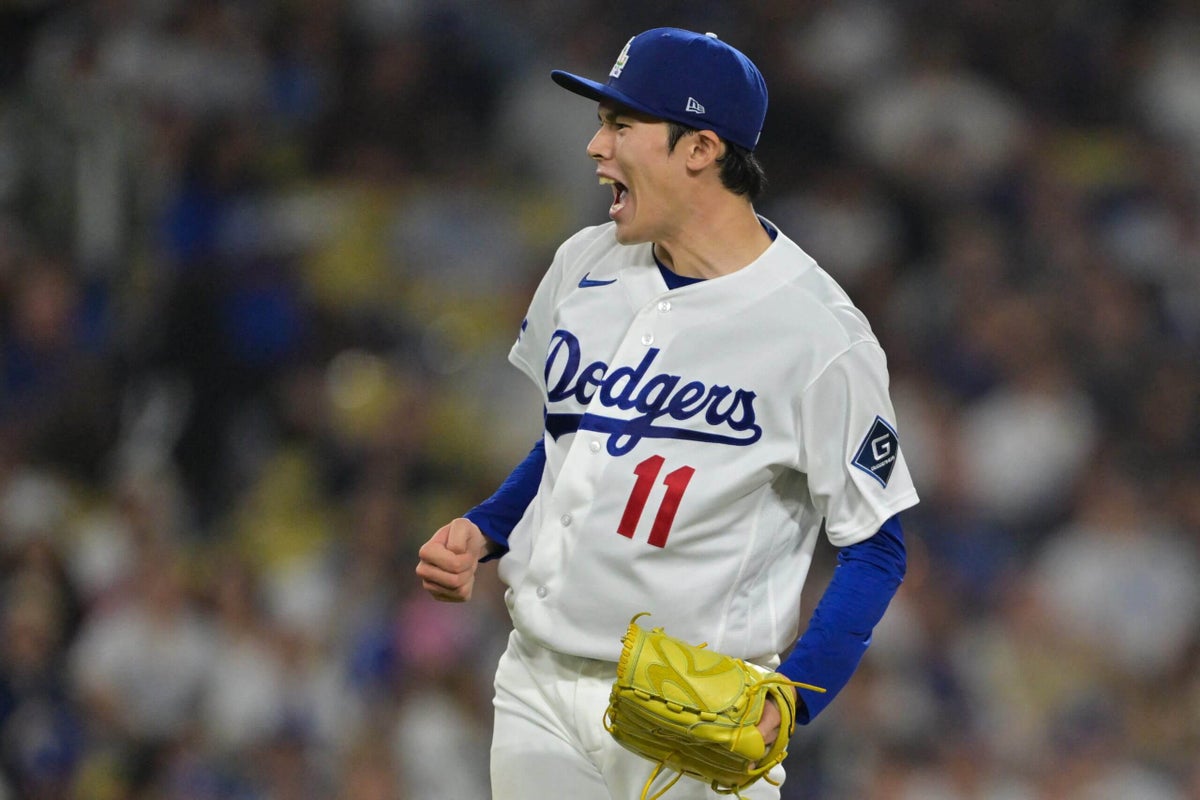
Sasaki touched 99.8 mph in the first inning to three-time MVP Mike Trout, then followed it two pitches later with a splitter that dove into the dirt at 92.8 mph. He bullied Logan O’Hoppe, striking out the Angels catcher on three straight sliders in the second inning. When he dotted a 99 mph pitch right on the edge of the plate to strike out Donovan Walton and end the fourth inning, he kicked his leg out in satisfaction. When the Angels finally made him sweat in the fifth, he got out of the jam with a dastardly splitter that Adam Frazier couldn’t help but swing at, and pumped his fist as he came off the mound.
This was the Sasaki the Dodgers have been waiting to see.
“I think that we were all guilty of expecting it to be seamless,” Roberts said. “Certainly unfair to Roki, not appreciating that there has to be some transition period. He went through some tough times and some doubts, but he’s gotten to the other side.”
Roberts wanted to be sure. So he pushed his young starter. There was no conversation when Sasaki completed his sixth scoreless inning of the night, even with his pitch count at 86 pitches in a scoreless tie. The manager sent Sasaki back out to face the heart of the Angels’ order a third time. Sasaki responded with a quick inning, striking out Walton and Nick Madrigal to tally double-digit strikeouts for the first time since he was in Japan.
Sasaki lowered his ERA to 4.03. Since the start of May, in 35 1/3 innings, it’s a 2.55 ERA. The Dodgers are no longer bracing for each outing to collapse. Instead, they’re watching him blossom.
There had been flashes of his old brilliance last year. He found some short-term success in a postseason relief role during the club’s World Series run, but didn’t find any long-term answers to fix what had given him a 4.72 ERA as a starter. Now, he says he feels he can maintain it.
His belief might be as important as anything. That’s when Sasaki has always been at his best.
“We saw it (last year) where it was, really, we all felt sorry for him and sad for him,” Roberts said. “Now, he’s arrived as an adult and a major-league player and a real confident player.”