
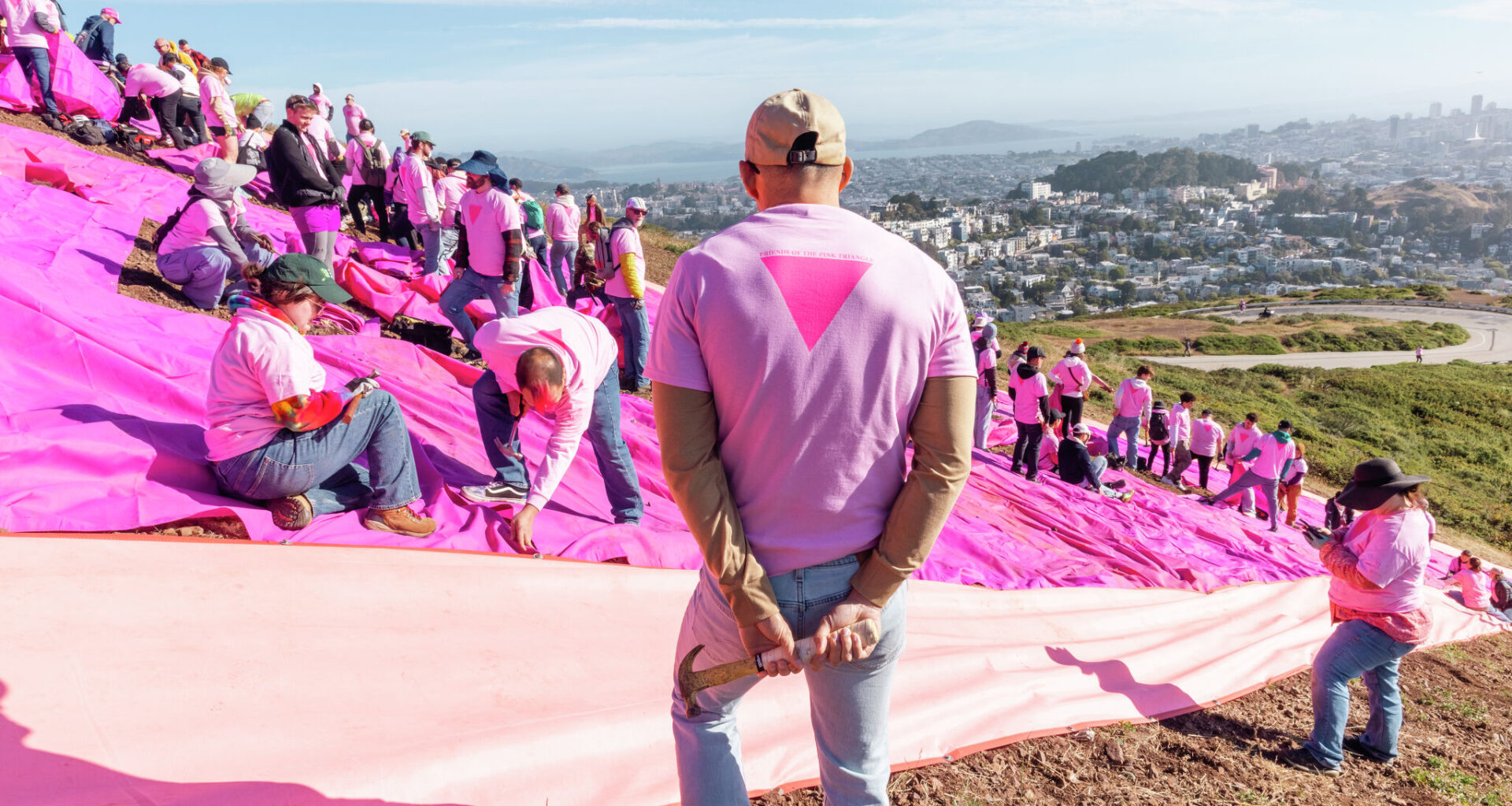
Volunteers help assemble the Pink Triangle, a symbol of gay pride and resistance, in its 31st year on top of San Francisco’s Twin Peaks on Saturday. Pink triangles were forced on homosexuals in Nazi Germany but are now a symbol of resistance for the LGBTQ community.
Lizzy Montana Myers/For the S.F. Chronicle
A sign describes the history of the Pink Triangle on Twin Peaks in San Francisco.
Lizzy Montana Myers/For the S.F. Chronicle
Volunteers help assemble the Pink Triangle, a symbol of gay pride and resistance, in its 31st year on top of Twin Peaks in San Francisco.
Lizzy Montana Myers/For the S.F. Chronicle
Leads volunteer Chrissy Cronin holds his work gloves while assembling the Pink Triangle on Twin Peaks.
Lizzy Montana Myers/For the S.F. Chronicle
Patrick Carney, creator and co-founder of the Pink Triangle, carries balloons to the ceremony.
Lizzy Montana Myers/For the S.F. Chronicle
Dirty Carol, the reigning Foxy Mary of San Francisco, attends the Pink Triangle installation celebration on Twin Peaks.
Lizzy Montana Myers/For the S.F. Chronicle
Patrick Carney, creator and co-founder of the Pink Triangle, speaks during the 31st annual celebration and installation in San Francisco.
Lizzy Montana Myers/For the S.F. Chronicle
On a remarkably clear and sunny morning on Twin Peaks, the Sisters of Perpetual Indulgence trekked through brush along the side of the hill, their pink veils flowing in the wind. Though the climb was steep, the sisters were cheered on by several onlookers who sat along the slope, hammers in hand.
“She’s hiking in drag at 9:30 in the morning!” one quipped. “Girl.”
The Sisters and their supporters were working to install — and celebrate — the famous, bright Pink Triangle that glows over San Francisco through June. Starting at 7 a.m., an estimated 800 volunteers of all ages spent their morning transforming 175 pink canvasses into the iconic symbol. Dressed in matching Pink Triangle T-shirts and decked out in sparkly, rainbow-flecked accessories, they created a chorus of “clink-clink-clinks” as they secured the tarps into place with 5,000 steel spikes.
Article continues below this ad
Volunteers help assemble the Pink Triangle, a symbol of gay pride and resistance, in its 31st year on top of Twin Peaks in San Francisco.
Lizzy Montana Myers/For the S.F. Chronicle
The Pink Triangle, which began as a renegade installation put up in the cover of night 31 years ago, has doubled in size four times since then. Now, it takes up a large swath of the hillside — “big enough to see from space,” as Sisters of Perpetual Indulgence member Sister Roma put it.
“There’s no room for subtlety during Pride Month,” said Patrick Carney, the founder of the tradition, wearing his signature bedazzled pink visor for the event.
San Francisco Chronicle Logo
Make us a Preferred Source to get more of our news when you search.
Add Preferred Source
Though it’s now a symbol of pride, the Pink Triangle comes from a dark history. Gay people in Nazi Germany were forced to wear a pink triangle on their pockets in the concentration camps to identify them as homosexual, one of the regime’s categories of “undesirables.” While the symbol has been reclaimed as a beacon of hope by the LGBTQ community, it also represents what it has been through.
Article continues below this ad
Volunteers help assemble the Pink Triangle, which began as a renegade installation on Twin Peaks 31 years ago.
Lizzy Montana Myers/For the S.F. Chronicle
“It’s a giant reminder and warning of what can happen,” Carney said. “Hate rages on, and so that’s why we’re up here.”
Remembering the past — and being vigilant not to repeat it — was a throughline in the speeches given during the annual commemoration ceremony, which began after the Pink Triangle was fully installed.
State Sen. Scott Wiener, standing in front of a California flag, an American flag and a rainbow Pride flag, reminded the attendees that Adolf Hitler was elected before he seized power, and that the concentration camps didn’t just happen all of a sudden.
Volunteers hold flags at the Pink Triangle celebration on Twin Peaks.
Lizzy Montana Myers/For the S.F. Chronicle
“It took decades of the normalization of hate,” Wiener said. With that in mind, he said, the increasingly violent language aimed at minorities including the LGBTQ community in the U.S. today should not be brushed off as “just rhetoric.”
Article continues below this ad
“No, it’s not just rhetoric. It is, step by step, the normalization of dehumanizing members of our community, our neighbors, our family members, our friends,” he said. “So let’s always remember that we have to push back. … It won’t just go away. We have to make it go away.”
Mayor Daniel Lurie noted that the Pink Triangle, visible to residents across the city and to tourists landing at San Francisco International Airport, has for decades shown that in this city, “you are seen, you are welcome, and you are free.”
Mayor Daniel Lurie presents an proclamation to Patrick Carney declaring June 6 as Pink Triangle Day in San Francisco.
Lizzy Montana Myers/For the S.F. Chronicle
Though he was briefly heckled over budget cuts that threatened to reduce funding to LGBTQ-serving nonprofits, Lurie emphasized that San Francisco as a city will continue to champion the openness that the Pink Triangle conveys.
“The federal government is targeting trans healthcare, gutting HIV and AIDS funding and turning its back on our communities,” he said. “San Francisco is sending a different message. We will not be silent.”
Article continues below this ad
Suzanne Ford, executive director of San Francisco Pride, struck a more defiant tone. While for the past few years she has focused on how trans people are facing challenges similar to those of the 1930s, she said this year she wanted to focus on how the community has continued to build itself up.
Sister Roma speaks at the 31st annual Pink Triangle installation and celebration Saturday morning on San Francisco’s Twin Peaks. Pink triangles were forced on homosexuals in Nazi Germany but are now a symbol of resistance for the gay community.
Lizzy Montana Myers/For the S.F. Chronicle
“As a trans person in this city, I’m damn tired of talking about trans people surviving,” she said, eliciting cheers of support from the audience. “I want you to look around today. Look behind me. Look at this fierce trans woman up here. I’m not surviving. I am thriving.
“I want to invite you to show up for Pride this month with the knowledge that we’re not going to survive this bulls—. We’re going to build and thrive,” she continued.
Before the Pink Triangle was christened with Champagne, it was blessed by the Sisters of Perpetual Indulgence, who have been a part of the tradition for decades.
Article continues below this ad
“Blessed be all those who came before us, who stood up and fought,” prayed Sister Vina Sinfurs. “We stand on the shoulders of brave people who put up with a lot of despicable crap to get us on this mountaintop today.”
Sister H( . )( . )PSIE Daisy, one of the Sisters of Perpetual Indulgence, attends the Pink Triangle installation on Twin Peaks.
Lizzy Montana Myers/For the S.F. Chronicle
She added: “The struggle is ongoing, so let us find our joy in the struggle. … For ours is the love, the community and the power, as long as we demand it.”