
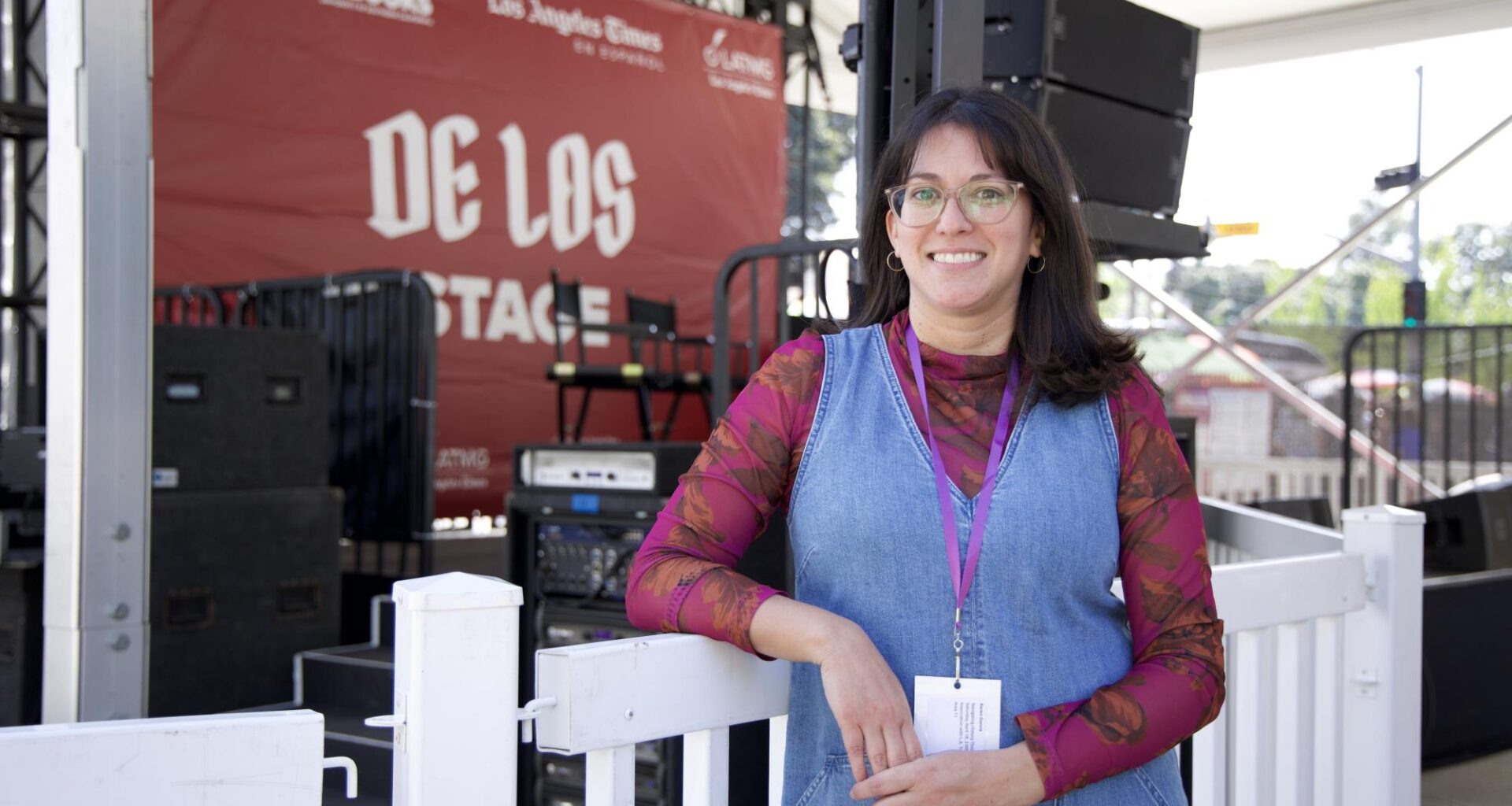
Karen Garcia gets the facts, fast.
From The Union’s newsroom at El Camino College to the breaking news desk at the Los Angeles Times, Garcia has over a decade’s worth of bylines — and even more stories behind the story.
She started at Torrance High School’s student paper before joining the staff, writing stories and becoming an online news editor. During her last semester, she became The Union’s best reporter, as engraved on the Jolene Combs Memorial plaque.
Graduating from El Camino in 2013, she transferred to California Polytechnic State University, San Luis Obispo, where she reported for the Mustang News and earned a bachelor’s in journalism.
Before joining the Times in 2021, Garcia was a writer, worked for local newspapers and did radio. Now, she’s one of 15 reporters on the Times’ Fast Break Desk covering everything from weather and politics to crime and disease outbreaks.
Warrior Life met with Garcia, a bilingual journalist, for an interview at the 2026 L.A. Times Festival of Books, where she moderated the panel “Navigating History Through Memoir” on the De Los stage.
 Los Angeles Times reporter Karen Garcia, 33, leans on a tree near the De Los Stage where she moderated the panel, “Navigating History Through Memoir,” during the 2026 L.A. Times Festival of Books at the University of Southern California on Saturday, April 18. (Nikki Yunker | Warrior Life)
Q: What inspired you to become a journalist?
A: “I’ve always been interested in stories. I’m a big talker, but I’m also, I feel, a very good listener. And that starts in listening with even just my family stories — my mom [was] always telling us about our family’s history or the experiences that she had that were obviously starkly different than mine.”
Q: What’s it like working at the Times?
A: “The L.A. Times is a really fun, crazy, fast changing place. I’m lucky enough to be on the breaking news team and I can say that I do a bit of everything. There’s no like beat per se that I have, but I also have really great editors that welcome a lot of different ideas. And I do any kind of daily story. I do explanatory reporting. I also do videos with my video journalist colleagues. … It’s just that environment fosters a lot of good reporting, repackaging, and it’s also given me great opportunities like moderating this panel today.”
Garcia also said she had the opportunity to interview one of her favorite artists, Carla Morrison, on the topic of mental health.
“I wouldn’t have been able to do any of that without being a part of the LA Times newsroom.”
Q: How was your experience at El Camino?
A: “I worked with [professor] Kate McLaughlin and she was a really great mentor and guide on understanding who I was as a reporter. I had really great teammates. I think that was a space that was really supportive and we championed each other, big or small — whatever the assignment was, and that’s really helpful too. Journalism is hard, and it is a really tough industry and when you have folks who are very supportive, that helps boost your morale.”
Q: What should people do in a breaking news situation?
A: “If you are seeing something happening in real time, maybe you [safely] took a video of it or maybe you just are remembering a description of the event … If you share it on X, formerly known as Twitter, or Instagram and we are searching for that, those first person accounts we might see that, contact, and have a conversation. … It’s a great way to kind of work together with the community and piece together a story.”
Q: What does being a bilingual journalist mean to you?
A: “I think it’s given me a lot of perspective and empathy when it comes to speaking with not just Latino but other immigrant or vulnerable communities. It really has shaped me as a reporter in terms of having patience, empathy, grace and wanting to really build trust with the community that I serve.”
Q: What stories do you like covering most?
A: “I love covering cultural mental health. I also love covering just public health in general. I feel like we have a lot of misunderstandings about communicable disease and it’s really interesting to write it in this form — like explainers — that really break down and answer people’s questions. I feel like that that resonates with the audience and it’s a great way to connect because then I’ll get an email that’s like, ‘Great you answered all these questions, but I have one more,’ and I’m like, ‘Why didn’t I think of that?’ and then I get to update the story with that.”
Q: What are the most challenging stories to cover?
A: “It really depends because sometimes when we go out into the field let’s say like for fire coverage you kind of have to be alert, ready to go, not just find people and answer questions, make sure you’re in a safe space, make sure the person you’re interviewing is also safe. I think like when we write about lawsuits or court cases, you got to make sure that you’re taking everyone into account, that you are attributing correctly.”
Garcia said that helping underserved and underprivileged communities understand the newsgathering process is important, including explaining how interviews are on the record and that it’s OK to stop answering questions if uncomfortable.
“It’s a challenge to balance making sure you take the time … that the person you’re interviewing understands what their thoughts are or the conversation you’re going to have is going to end up being publicized, because again people don’t interact with journalists on the day-to-day.”
Q: What’s next for you?
A: “I was hired as an [L.A. Times] utility journalism reporter, which is explanatory reporting and guides. And then when that team dissolved in ’23, I was put onto the breaking news desk and I was nervous because I thought I hadn’t had prior experience as a breaking news reporter. But I’ve learned a lot. I’ve grown a lot and I just think like wherever the wind blows me next, ‘Hey, I’ll take it.’ I’ll take that ride.”
Karen Garcia’s advice for aspiring journalists:
“Rejection is hard but don’t take it personally because it’ll come from the community, your editor, but really it’s just an opportunity to grow. It’s an opportunity maybe even to understand, ‘Maybe I’m asking that question incorrectly,’ or “Maybe I’m approaching [in] not the best way.’”
“Be as adaptable as you can. The journalism industry and how we deliver news is changing constantly. So, it could be overwhelming, but you know, it’s okay to follow up, to also ask for help.”
“Maybe find a mentor. I don’t want to say like early on, but find a mentor that you can bounce ideas off of, that you can reach out to for help.”
“This industry can be cutthroat. It can be hard, but it’s not impossible. So, if you love to tell stories, if you love to listen, if you love to do research, and you love to try to find different ways to get stories out to different audiences, journalism is for you. Just don’t give up.”
“Imposter syndrome is real. Anxiety is real. … But you know, you’re at the end of the day doing a public service and you’re giving voices to people who otherwise probably wouldn’t have been heard by their public leaders or whomever. So it’s an important job and people should seek it.”
“You might go into it thinking you want to do one thing, but be open to the possibilities.”