
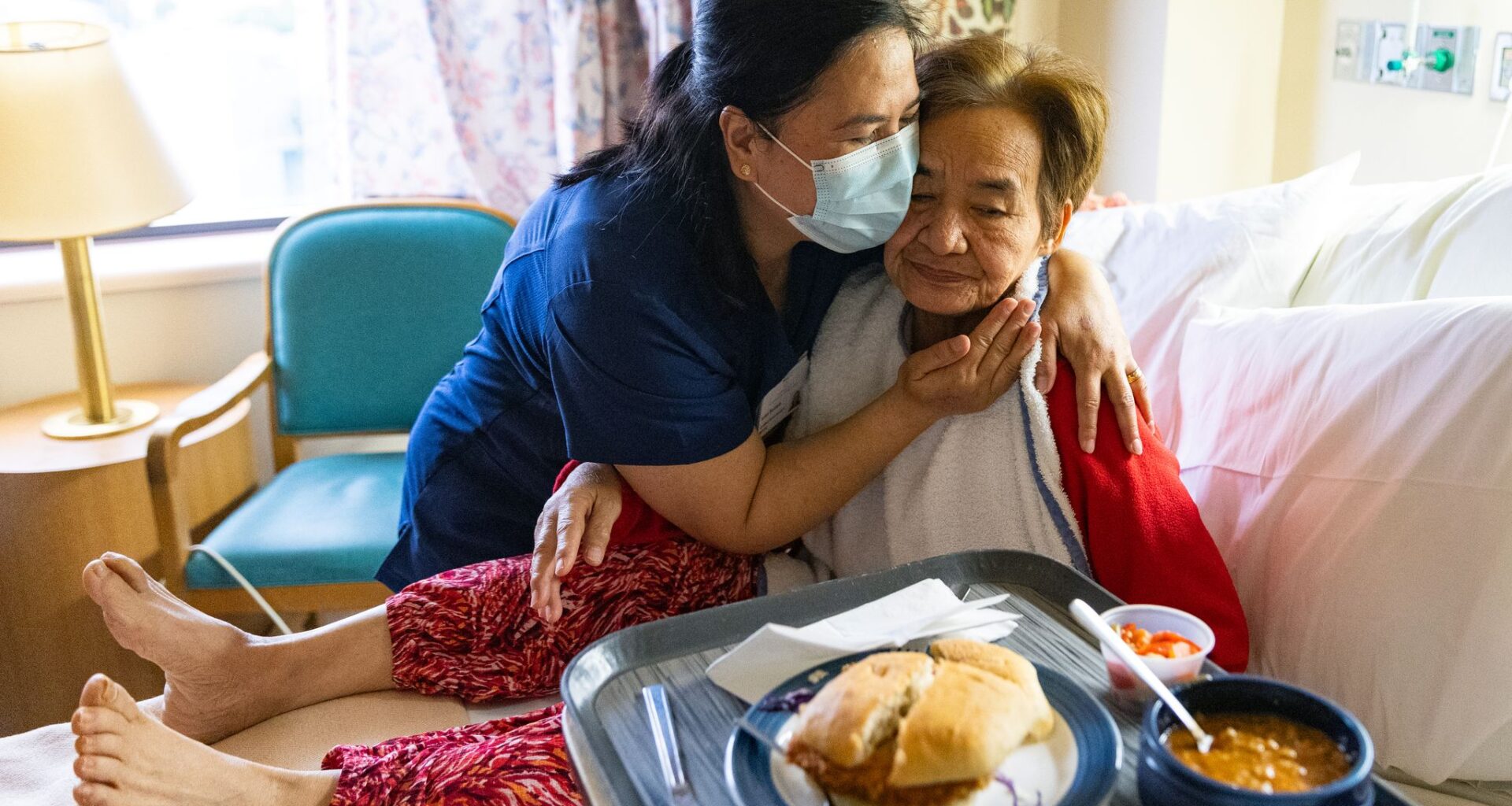
Juliet Ramos, a newly certified nursing assistant, embraces resident Estrellita Lavarias in Lavarias’ room at the San Francisco Campus for Jewish Living in San Francisco. Ramos got to know Lavarias while completing the facility’s tuition-free CNA training program.
Jana Ašenbrennerová/For the S.F. Chronicle
One of California’s largest senior living facilities has a new solution to the growing shortage of certified nursing assistants, who provide basic care to older patients.
When Analynn Mausisa learned in January that her employer, the San Francisco Campus for Jewish Living, was offering workers like her free tuition to become a CNA, she jumped at the chance.
At the time, Mausisa had been working for about a year as a safety monitor at SFCJL, helping residents get to and from doctor’s appointments. But she had no direct patient care experience, which she knew she needed to advance in the health care field.
Article continues below this ad
“I wanted to improve myself professionally and create better opportunities for me and my family, to provide better income,” said Mausisa, 50.
Newly certified nursing assistants Analynn Mausisa, left, Arnold Pabalate, center, and Juliet Ramos talk at the San Francisco Campus for Jewish Living in San Francisco.
Jana Ašenbrennerová/For the S.F. Chronicle
Mausisa is one of 13 newly certified nursing assistants in SFCJL’s first cohort to complete the 200-hour training and pass state certification exams in May. SFCJL paid for the training and exam fees, which otherwise would have cost about $2,000 to $2,500, as part of an effort to get more CNAs in the workforce.
San Francisco Chronicle Logo
Make us a Preferred Source to get more of our news when you search.
Add Preferred Source
The shortage is largely driven by demographics: The number of U.S. adults 65 and older is growing rapidly, while the caregiver workforce has high turnover, especially after COVID. California is projected to face a direct care worker shortage of 600,000 to 3.2 million by 2030, according to the state’s Master Plan on Aging. The effects will be acute in the Bay Area, one of the fastest-aging metropolitan areas in the country.
Article continues below this ad
Skilled nursing and assisted living facilities have been grappling with the shortage for years and experimenting with ways to incentivize more caregivers to enter and stay in the field.Many of those efforts focus on CNAs, as more than half of CNAs in California serve older adults in nursing or community-based settings.
A note thanking certified nursing assistants hangs inside the San Francisco Campus for Jewish Living in San Francisco.
Jana Ašenbrennerová/For the S.F. Chronicle
“There aren’t enough people to fill these roles, and high turnover,” said SFCJL CEO Dr. Adrienne Green. Many similar organizations have opened their own schools, she said. “The idea is people go through a training program, get a CNA certificate and there’s a guaranteed job at the end of it as a way to help people launch their careers.”
Green hopes that the program will help maintain staffing, and that many will stay on and progress to become licensed vocational nurses or registered nurses, which require more training.
SFCJL’s free CNA training program is the latest, but not the only, initiative to try to bolster the caregiver workforce, which has historically been plagued by low wages and demanding physical and emotional work.
Article continues below this ad
In 2022, LeadingAge California, a Sacramento advocacy group that represents aging services providers, launched a three-year program to recruit, train and employ new CNAs and home health aides in California.The program covered full tuition fees for students and was funded by $35 million in grants from the state Department of Health Care Access and Information and Department of Aging.
Newly certified nursing assistants Analynn Mausisa, left, Arnold Pabalate, center, and Juliet Ramos demonstrate a care technique with a mannequin used during their training at the San Francisco Campus for Jewish Living in San Francisco.
Jana Ašenbrennerová/For the S.F. Chronicle
The program, which ended in July 2025, trained 6,200 people. About 3,500 passed the CNA certification exam. It also offered bonuses to graduates to stay at a caregiver job for one month, six months and a year.
The organization has the infrastructure and capacity to continue the program, but does not have enough state or private funding to relaunch it.
“We’ve got a long way to go to make sure there are sufficient workers to care for older adults,” said LeadingAge California President and CEO Jeannee Parker Martin.
Article continues below this ad
CNA training includes learning how to help residents with activities of daily living, such as bathing, getting dressed and going to the bathroom. For SFCJL’s program, the classes and clinical components, like learning how to operate lifts to transfer residents from their bed to a wheelchair, were all done on-site at the SFCJL.
Funding for the tuition came from donors and a grant from the California Association of Health Facilities, a nonprofit trade group that represents skilled nursing facilities.
Newly certified nursing assistants Analynn Mausisa, left, and Juliet Ramos help resident Kenny Gallo set up lunch in Gallo’s room at the San Francisco Campus for Jewish Living in San Francisco.
Jana Ašenbrennerová/For the S.F. Chronicle
Mausisa had already been thinking about starting a CNA training program, but kept putting it off because the prospect of going to school on top of her job felt daunting. Having the training on-site and being paid for her time — she continued to earn her security monitor salary during CNA training — helped make it more convenient.
Article continues below this ad
“It helped me financially because it’s free and it saved time,” Mausisa said. “I get significant benefits for my career and I have a secure job.”