
West Marin, with its rugged and mist-shrouded landscape, proudly embraces the enigmatic.
Locals swap theories about the huge stones that stretch in a mysterious line on Tomales Point. In downtown Point Reyes Station, a loudspeaker issues a daily “moo” at noon, while a shaggy “town prophet” perplexes tourists with cryptic wisdom and twirling dance moves.
But when a giant geometric pattern was suddenly dug into the hillside of Point Reyes Vineyards last month, even old-timers were mystified. Was it a racetrack? An alien crop circle? Should someone call the Coastal Commission to report a violation?
In fact, it was just the latest head-turning move from Chris Hulls. A native son who made his fortune with Life360, a publicly traded family safety app with a market value of nearly $4 billion, Hulls has returned home on a buying spree meant to protect the region’s heritage — placing key buildings under nonprofit ownership with a controversial plan to sell shares to locals.
Article continues below this ad
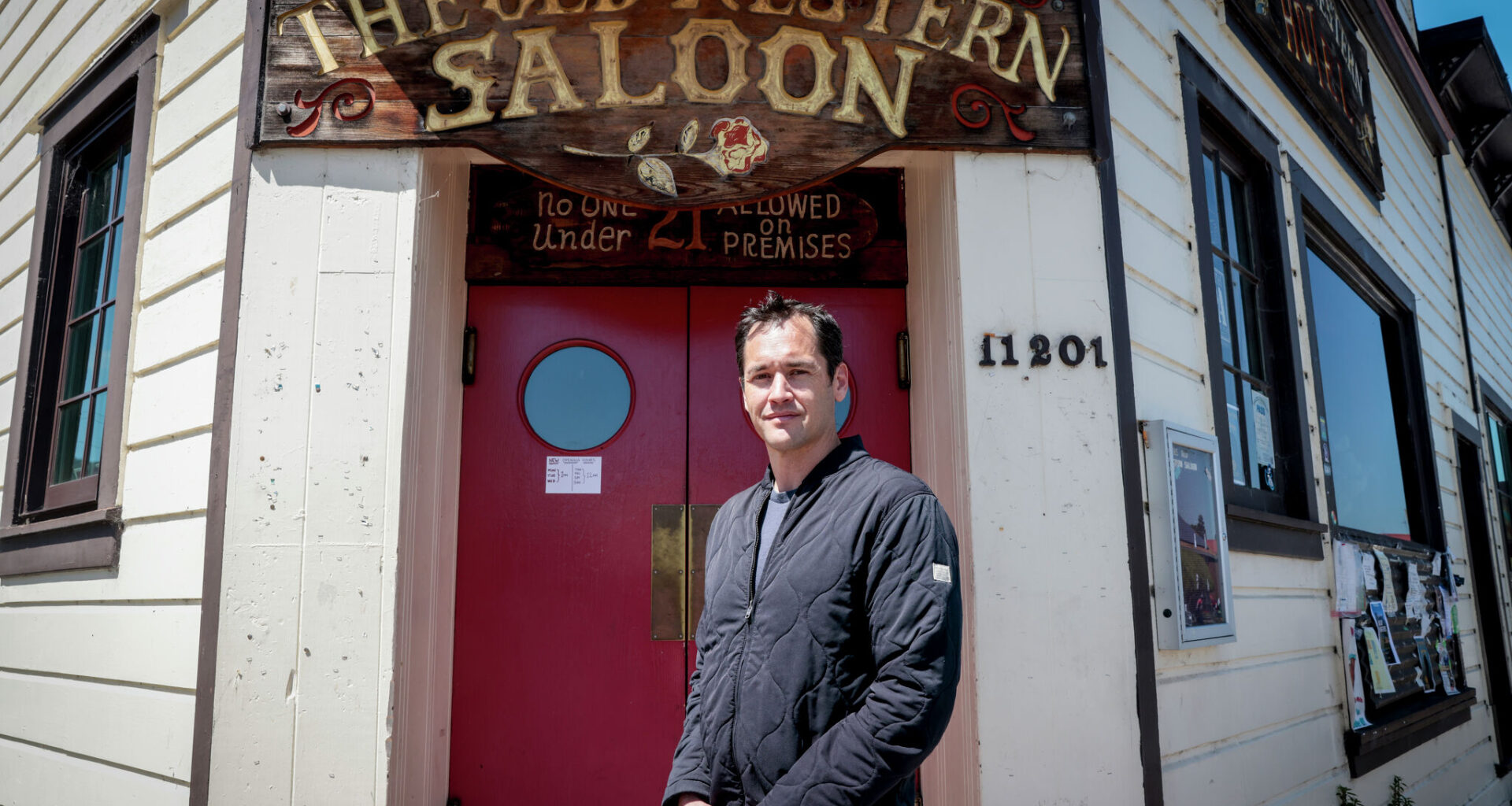
It started last spring with his surprise purchase of the weary Old Western Saloon in Point Reyes Station for $1.91 million. Next he bought the former home of the Station House Cafe for $1.8 million. Then it was the vacant pink-and-green Vladimir’s Czech Restaurant in nearby Inverness for about $800,000.
San Francisco Chronicle Logo
Make us a Preferred Source to get more of our news when you search.
Add Preferred Source
Hulls and friends also purchased the vineyards, carving the swirling logo for Life360 on the hillside. The symbol is a landscaping project, Hulls told neighbors, and was later planted with saplings and a geometric pattern of straw.
“The shape is just a way of thinking about the winding paths people take through life and how time unfolds,” explained Hulls, who as a boy worked in the vineyard spraying grapes.
Article continues below this ad
To Hulls, the beloved but beleaguered places he’s buying are ghostly reminders of what’s been lost in West Marin since his childhood, when Vladimir’s sponsored the boys’ soccer team and served free apple strudel after games on a field surrounded by Holsteins and Angus.
Hulls, 42, hopes to steward his new buildings for generations to come, running them through a nonprofit called the Good Luck Fund, started with $15 million of his own money, and seeking community investment.
“Own a real piece of the town you love,” is how Hulls puts it. “It’s about holding on to something that’s easy to lose and hard to rebuild.”
Locals, who will fill the streets Sunday in cowboy hats and boots to celebrate the annual Western Weekend parade, are inspired but anxious. Can one wealthy benefactor, they wonder, really restore West Marin to an idealized past? What if people lose money, or Hulls simply loses interest?
Hulls insists that won’t happen.
Article continues below this ad
Point Reyes Station, with a population of 895, was founded as a train depot in the late 1800s and grew into a hub for railroad men, ranchers and excursionists from San Francisco.
Brontë Wittpenn/S.F. Chronicle
“This town gave me this very strong sense of home,” he said recently at the new Station House Cafe over a lunch of chili, grilled asparagus, coffee and a Coke. The business moved down the street in 2020 after a 300% rent hike — exactly what Hulls vows to avoid. Restlessly, he scanned the room; another meeting was pending. His new Rivian pickup truck waited outside, loaded with his daughters’ bicycles.
Elsewhere, he said, “there’s this great homogenization. Same gas station. Same Sonic burger. Same Walmart. But here, every corner is unique.”
To lay out his vision for skeptical neighbors, Hulls held a community meeting last year at the old Station House. A crowd of about 250 packed under the wooden rafters, extending out to the courtyard.
Hulls, tall and slender in a T-shirt with a name tag, laid out his plan, which he describes as “co-investment.” It relies on two pools of funding: Donor capital — say, from other Bay Area millionaires like him — will buy and restore the buildings. Investor capital — from local residents, starting at $1,000 each — will be sought after each building is up and running, with modest appreciation if the region grows and rents rise.
Article continues below this ad
Permanent use restrictions will be placed on each building. Only long-term, locally focused businesses, offering discounts to locals, will be considered as tenants. Rents will stay reasonable. The fund will do all the work; investors won’t get a vote in property management.
And the buildings will never, ever be sold.
Top left: The former Vladimir’s Restaurant in Inverness is one of the spaces Chris Hulls has purchased with plans to revive. Top right: A mural at Palace Market in Point Reyes Station. Above left: Toby’s Feed Barn in Point Reyes Station. Above right: The old Station House cafe building in Point Reyes Station.
Brontë Wittpenn/S.F. Chronicle
Top: The former Vladimir’s Restaurant in Inverness is one of the spaces Chris Hulls has purchased with plans to revive. Second: A mural at Palace Market in Point Reyes Station. Third: Toby’s Feed Barn in Point Reyes Station. Above: The old Station House cafe building in Point Reyes Station.
Brontë Wittpenn/S.F. Chronicle
Questions remain. “The goals sound great, and we would all like to see them succeed,” said Pamela Wright, the former board president of the Community Land Trust Association of West Marin, who has three decades of experience in commercial real estate. “But restoring, leasing and maintaining 100-year-old buildings is challenging and expensive, so it will take time to see how it all works out.”
Most locals agree that the villages of West Marin could use a boost.
Article continues below this ad
A winding 75-minute drive north of San Francisco, isolated by steep ridges and wild creeks, the communities seem cut and pasted from the 19th century. On the edge of the Pacific, they’re surrounded by grasslands, pristine beaches and old bishop pine forests.
Point Reyes Station (population 895), founded as a train depot in the late 1800s, grew into a hub for railroad men, ranchers and excursionists from San Francisco. Inverness (population 1,379), once a woodsy summer resort for Berkeley families, is scattered with quaint cabins and fine homes designed by Bernard Maybeck and Julia Morgan.
Today, the towns are reeling from the departure of historic ranches in the national seashore in the wake of a 2025 legal settlement. Last year, neighbors revolted when the charming Point Reyes gas station was sold to an Idaho-based conglomerate, which will turn its quaint 215-square-foot cashier’s stand into a 1,700-square-foot convenience store.
In a time when many of the Bay Area’s tech elite are buying exotic vacations and luxury ski cabins, some residents are heartened that Hulls cares about downtown buildings with peeling paint.
“When I see young people who really appreciate the beauty of this place, it gives me hope in the future,” said Point Reyes resident Chris Desser, a land-use attorney and former chair of the Marin County Planning Commission. “I appreciate his intention — that he wants to maintain the sort of community character of the place where he grew up.”
But along with gratitude comes apprehension.
A logo carved by Chris Hulls can be seen on a hilltop in West Marin at the former Point Reyes Vineyards. The mysterious symbol confused locals, who didn’t know the property had recently been purchased by Hulls.
Brontë Wittpenn/S.F. Chronicle
At the meeting, residents asked: Who’s in charge? Where’s the expertise? Will locals have a voice?
“I’m an entrepreneur, and I’m pretty good at that,” Hulls said, clutching a microphone in one hand and a beer bottle in the other. “My motto is, you jump off a cliff, and you build the plane on the way down. We really don’t have too much of a plan.”
Hulls was an adventurous child. His mother was a teacher, his father a “tinkerer.” While the family had some money when he was a child, times were tight by the time he reached high school. His sister Tessa, who won this year’s Pulitzer Prize for memoir or autobiography for her graphic novel “Feeding Ghosts,” was absorbed in the town’s tiny library.
Hulls spent weekends with friends roaming the windswept A Ranch, an 866-acre dairy farm on the foggy tip of the Point Reyes peninsula.
Omar Padilla, a close friend who grew up on the ranch, remembered the day they excavated a swimming pool in Hulls’ backyard, shoveling until their backs ached. There was the night they arrived at Mount Tamalpais on their bicycles, in the dark, after a spirited 20-mile ride. Friends marveled at Hulls’ model airplanes, which could do tricks.
Once Hulls announced a plan to build a rubber dinghy and catch halibut on Tomales Bay. They didn’t have life vests, and Padilla couldn’t swim. “We could have exploded the dinghy with one of the hooks,” Padilla said, laughing, “but it never happened.” Neither did they catch any fish.
“Chris would get bored, and he’d be, like, ‘OK, let’s start another project,’” Padilla said. “He wasn’t afraid to try different things, even if they failed.”
Left: The Old Western Saloon in Point Reyes Station. Right: Chris Hulls meets with Allie Rucker and Jeremy D’Antonio at the Old Western Saloon.
Brontë Wittpenn/S.F. Chronicle
Top: The Old Western Saloon in Point Reyes Station. Above: Chris Hulls meets with Allie Rucker and Jeremy D’Antonio at the Old Western Saloon.
Brontë Wittpenn/S.F. Chronicle
At age 11, Hulls went to Kenya by himself, living on a remote farm with a local family. Once back home, he struggled in school due to restlessness and impulsivity. After being politely expelled from St. Rita Catholic School in Fairfax, he landed at rural Tomales High.
But he didn’t fit in with the Future Farmers of America, the float contest, or the prom at the Peacock Gap Golf and Country Club. He was happier exploring AOL. To earn cash, he sold Beanie Babies and installed Dish Network receivers.
“He was on another level,” Padilla said, “off-the-charts smart. But he was always so humble, and he didn’t really care about that.”
Hulls graduated in three years and joined the Air Force at 17, serving out of Qatar. That also was a bad fit. “I don’t like people telling you how to think,” he said.
Home again, Hulls enrolled at the College of Marin to study accounting and economics, where his potential was recognized by teacher Robert Kennedy. “He just stood out, crystal clear,” Kennedy told Marin Magazine in 2009.
He also earned his pilot’s license, thrilling his friends with a maiden flight over the Point Reyes Lighthouse.
“I was scared, but I trusted him with my life,” Padilla said.
Hulls later transferred to UC Berkeley and spent a summer in investment banking at Goldman Sachs. The firm wanted him to stay on, but instead, he landed a job as a dishwasher at the South Pole Research Station.
“If I have an idea, I just jump,” he said. “I start infinite projects.”
The former Station House Cafe building is seen from the Old Western Hotel in Point Reyes Station. Previous owners of the building hiked the rent on the restaurant, which moved to a nearby space.
Brontë Wittpenn/S.F. Chronicle
Before he could leave, however, Hulls had a health scare: a thyroid tumor, which he had removed. He stayed home to receive medical treatment, focusing on a school project. He called it Life360, a family locator and safety app that enables GPS tracking of friends and family on a private map and sends alerts when loved ones arrive at or leave home, school or work.
Accepted by Harvard Business School, he deferred enrollment four times while building his company.
Life360, which went public in 2024, now has 98 million monthly users in 170 countries. Last year, he resigned as CEO to become executive chair, saying he wanted to slow down, exploring personal interests such as meditation and psychedelics. It was during a trip on mushrooms, he said, that he came up with the idea for the Good Luck Fund.
While his family lives in San Anselmo, he’s spending more time in Point Reyes, where he bought a modest house on the same block as his childhood home.
In West Marin, he said, “I can do something that’s very, very high leverage.”
Shared property ownership ideas like the Good Luck Fund have a long history in the U.S., going back to 19th century agricultural cooperatives and utopian and intentional communities.
The movement has picked up steam over the past 20 years, said Gretchen Beesing of the Center for Community Investment.
The vacant Vladimir’s Restaurant in Inverness is one of the properties purchased by Chris Hulls. As a child, he remembers when Vladimir’s sponsored the boys’ soccer team and served free apple strudel after games.
Brontë Wittpenn/S.F. Chronicle
Most community land trusts are structured to close the racial wealth gap by selling shares of commercial real estate to low-income residents, helping them build wealth. Successful examples include the East Portland Community Investment Trust, Market Creek Plaza in San Diego, and Sky Without Limits Cooperative in Minneapolis.
“Democratizing ownership is a good thing,” said Brett Theodos of the Urban Institute.
“This is what it is going to take to protect small businesses and have the type of community we want to have,” Theodos said. “There is a value to places being distinct and having a historical legacy.”
Hulls said his goal isn’t to create the next Carmel, with upscale hotels, two-hour parking and $16 cocktails.
Instead, he wants things to stay the same — but with a playful, provocative, profitable spin, restoring a buzz to enliven the sleepy community.
Already, his influence is everywhere.
The Old Western Saloon has a younger, hipper vibe, managed by a songwriter and acoustic guitar player with the Phil Lesh Terrapin Crossroads collaboration. Cash-only, it’s still “the last true blue-collar holdout,” Hulls said, marinated in nostalgia with a polished wood bar and antique cash register.
But it now meets county building codes, with improved lighting, cleaner restrooms and other upgrades. The backyard, emptied of trash, has party lights. Entertainment ranges from hootchy-kootchy burlesque to shows by the Haggards, which describes itself as the only rock band “comprised entirely of the illegitimate children of Merle Haggard.”
Upstairs is the headquarters of the Point Reyes Reality Investigation Center, with monthly “Eccentric Circle” meetups “dedicated to preserving and curating the weirdness of West Marin County.”
Point Reyes Station in West Marin is still reeling from the departure of historic ranches in the national seashore in the wake of a 2025 legal settlement.
Brontë Wittpenn/S.F. Chronicle
When Latino farmworkers lost their homes and jobs on the seashore ranches, Hulls’ fund raised about $150,000 to help them stay in the community. It underwrote the production of a 16 mm Kodak documentary film starring the so-called town prophet, a man named Flyn, and hosted a free public screening.
It’s paying for a study of every building in Point Reyes Station, which will be submitted to the California Office of Historic Preservation for potential designation of historic significance. “It does not mean that your house is encased in amber,” said town historian Dewey Livingston. “But we’ll have a determination of what’s most important in the town.”
Hulls’ group is remodeling the West Marin Pharmacy and Provisions, with a private room for acupuncture and other services. The only place to get medicine across a vast rural stretch, it had been slated to close due to license violations until Hulls stepped in and took over the long-term lease.
Extensive renovation is also underway at the old Station House Cafe. Local woodworkers have been hired to design, mill and finish the space, which will become a seafood restaurant called Bar Auklet, run by local chef Shannon Gregory, owner of the beloved Marshall Store on Tomales Bay.
Even the long-struggling Point Reyes Vineyards, perched in the hills above Highway 1, have a new future. Renamed High Castle Vineyard in apparent reference to Philip K. Dick, Hulls, who bought it separately from the Good Luck Fund, will host events that explore psychedelics, the paranormal, meditation and other “mind expansion” experiences. He bills it as a “cyberpunk Esalen, where weirdos and wine intersect.”
It’s all a bit of a whirlwind for some locals, who see the sudden carvings on the vineyard hillside as a warning.
“More transparency … would help build more community trust,” said Wright, the former Community Land Trust board president.
The commercial real estate business is complex — and if his idea fails, people could be hurt, said Point Reyes Station resident Doree Friedman, a contractor for more than four decades and former CEO of San Francisco-based FineLine Construction. A better and simpler approach, she asserts, would be to solicit donations.
“He’s basically saying: ‘Invest your money, because I have a great idea,’” she said. “It might work. It might not work.”
Greater detail is essential, Friedman said. “This is put forth without an understanding of what experience the Good Luck Fund has to run and manage properties into perpetuity — and its consequential impact on investors.”
“Show us the structure. Show us the business plan,” she said. “How does it work?”
For now, Hulls is focused on urgent practical concerns: A big septic rebuild at Vladimir’s, which he hopes to lease and reopen by next summer; the renovation at Bar Auklet; a new mural outside the Old Western Saloon; and the lagging retail business at West Marin Pharmacy. He’s also eyeing more properties, including the 147-year-old William Tell House, a once-bustling social hub that has languished, vacant and shabby, for four years.
But first there’s revelry. This summer, Hulls and friends are hosting monthly block parties, closing a downtown street Saturday afternoon for live music, vendors and a food truck. And on Sunday, he’ll join the Western Weekend parade with the Good Luck Fund’s rusty vintage flatbed truck, carrying garlands of flowers and the raucous Hot Rods and Honky Tonk All Stars Band.
“I got blessed with some good fortune,” he said, “so I’m giving it back.”