
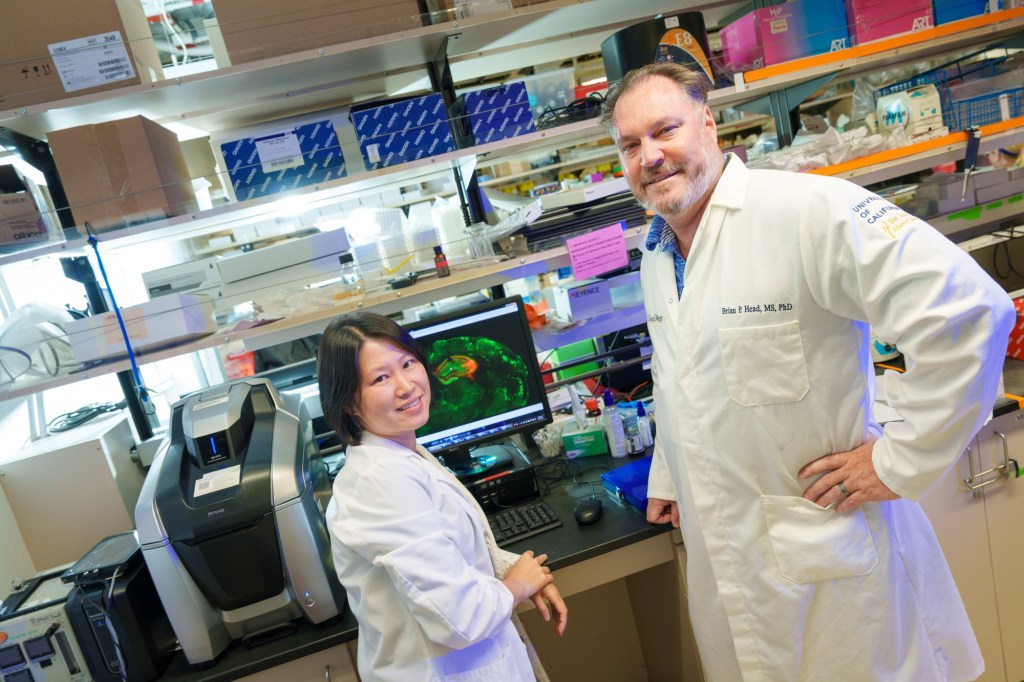
An experimental gene therapy developed by a group of UC San Diego scientists seeks to fight in a unique way a destructive protein called TDP-43, which is linked to diseases such as ALS and Alzheimer’s.
While most gene therapies target the removal of toxic proteins through injections to brain and spinal cord tissues, the new approach from scientists led by Brian Head, a professor of anesthesiology in the UCSD School of Medicine in La Jolla, uses a modified, harmless virus to systematically bring a gene therapy called SynCav1 to brain cells by increasing the expression of the neuroprotective protein caveolin-1.
Head is the senior author of a new study published May 26 in Alzheimer’s & Dementia: The Journal of the Alzheimer’s Association.
“The main gist of this paper is that with a lot of these neurodegenerative diseases, most therapies are trying to target a known genetic cause of the disease … and you try to remove it,” Head, who also is a research scientist for the Veterans Affairs San Diego Healthcare System, told the La Jolla Light.
“In this case, and in most of the work we’ve done with this gene therapy, we’re not trying to remove the toxic protein. We’re just trying to protect the neurons, regardless of the presence of the toxic protein.”
Head used the metaphor of a diseased tree to describe the approach — fortifying the soil to help fight toxins and regrow the roots.
“The soil was toxic, but we’re not removing the toxins from the soil,” he said. “We’re just giving something back that helps the roots resprout.”
The study reported the following findings through research on mice:
• The new gene therapy boosted expression of caveolin-1 in neurons across the brain and spinal cord.
• SynCav1 preserved learning and memory, as well as levels of TDP-43 in the cortex and hippocampus — areas responsible for high cognitive function, social behavior and voluntary movements.
• Benefits were observed such as protecting the mitochondria and membrane lipid rafts, the former of which allows for cell communication.
Beyond examining the therapy as a treatment option, Dr. Shanshan Wang, an assistant professor of anesthesiology and a co-author of the study, said it gives a better idea of the mechanics of the brain during neurodegeneration.
“We found that TDP-43 is not only accumulating in the wrong subcellular compartments [such as membrane lipid rafts], but also disrupts cellular processes that are essential for neurons to communicate with one another,” Wang said in a statement. “SynCav1 appears to help preserve this molecular machinery and subcellular localization.”
The study builds on ideas that Head and his lab have been exploring for nearly 20 years. During that time, he has researched caveolin’s function, studied it with cells in a dish and injected SynCav1 into different regions of the brain and spinal cord, with promising results.
The goal, he says, is to buy time.
“The most precious thing we do have is time,” he said. “So if you can buy people five or 10 years of life extension, it buys time for a better approach than even what this is. With something like ALS [amyotrophic lateral sclerosis] or FTD [frontotemporal dementia], where it’s so devastating and so fast … you’re just asking for more time to find the better intervention. … There’s so much evolution in medicine and technology that that extra time is really priceless.”
This is the latest of several UC San Diego studies with a focus on Alzheimer’s disease and other forms of dementia. Among those findings are that women are more vulnerable to many dementia risks; that a potential molecular “switch,” Chromogranin A, may determine whether Alzheimer’s-like brain changes lead to memory loss; and that a particular protein, plasma phosphorylated tau 217, can provide early warning signs that someone is at elevated risk of developing dementia later in life. ♦