
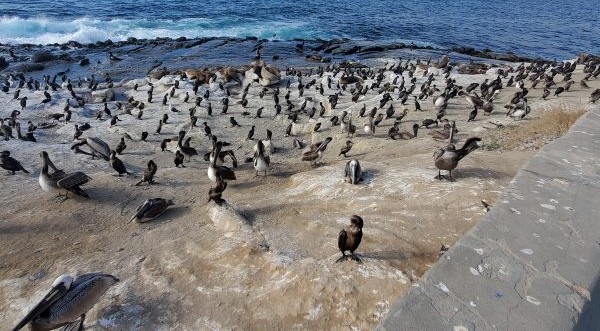
A project at UC San Diego’s Scripps Institution of Oceanography is looking to create a first-of-its-kind dataset on seabirds around La Jolla Cove that can influence future conservation efforts.
The work, led by graduate student and self-proclaimed “bird nerd” Alex Rubenstein, is collecting baseline data on the species of birds there.
“La Jolla Cove is such an important habitat for seabirds,” Rubenstein said. “The Cove became this focal point because it is an important resting site for so many different kinds of species and marine life. It is also an important place for visitors and tourism, so there is that intersection where people can come close to and appreciate wildlife, but they also need to respect that human/sea life relationship.”
The seabirds that rest and raise their young at and near The Cove play an important role in the ecosystem, he added.
“Seabirds are sentinels of environmental change,” Rubenstein said. “They are … an active reflection when change can be amiss in the marine environment. They are also apex predators, so when something is wrong with the food web or prey availability, they are an immediate reflection that something is wrong.”
Seabirds also help regulate other species, and their guano has been shown to have “substantial and significant sources of nutrients … for all kinds of marine ecosystems,” Rubenstein said. “They are an important part of that cycle.”
However, little baseline data has been collected on the seabirds at La Jolla Cove in particular, he said.
Thus, Rubenstein’s work has included walking with students in the UC San Diego Bird Club from the Children’s Pool to Goldfish Point every two weeks since October to count the species of birds, their nests and eggs, how many in the species there are and how those numbers change throughout the year.
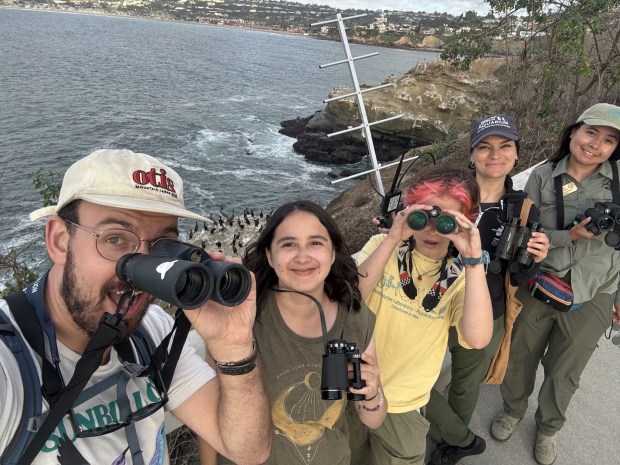 Scripps Institution of Oceanography graduate student Alex Rubenstein (left) gathers with the citizen scientists who are helping with his work to collect baseline information about seabirds around La Jolla Cove. (Provided by Alex Rubenstein)
“This is the first time we are collecting that information, so it’s a baseline for us to continue counting year after year to track the change and understand why the habitat is important and how things change,” Rubenstein said. “It’s important to have long-term data collection because when it comes to climate change, we need a lot of data to understand what the norm is.”
An “exciting part of the project” has been counting the nests and eggs, he said. The team mapped cormorants’ nests in the cliffs above La Jolla Cove and saw the first eggs of the year in January. The intent is to watch the eggs as they hatch into chicks and follow the chicks’ growth until they leave the nest.
“This is an important area that hasn’t been studied, so there isn’t as much data as to how well these cormorants are doing and how their breeding is going and how it compares to other colonies,” Rubenstein said. “So we hope to do this for years to come, because as environmental change, habitat loss and other climate change factors affect the distribution of these birds, The Cove is going to become more important for wildlife.”
Among early findings of the study, he said, are that some species of seabirds near The Cove — specifically cormorants — have a slightly lower success rate in breeding than in other colonies.
“We have an average of around three eggs per nest, which is in the normal range, but the survival rate is a little lower than I was hoping,” Rubenstein said. “These rates fall into the lower range of breeding success.”
However, he added that younger birds tend to have a lower success rate for breeding than older birds, and it isn’t yet known whether that is a factor at La Jolla Cove. He also said nests on the edge of a colony tend to underperform, and that has not yet been evaluated at The Cove.
“It’s hard to know how much of the lower breeding success rate is connected to environmental conditions as well, so we will need to look at water temperatures and whether there is an impact on the survival of chicks,” Rubenstein said. “Cormorants are very resilient and feed on a variety of fishes and prey, but ocean warming and climate change affects the abundance of prey.”
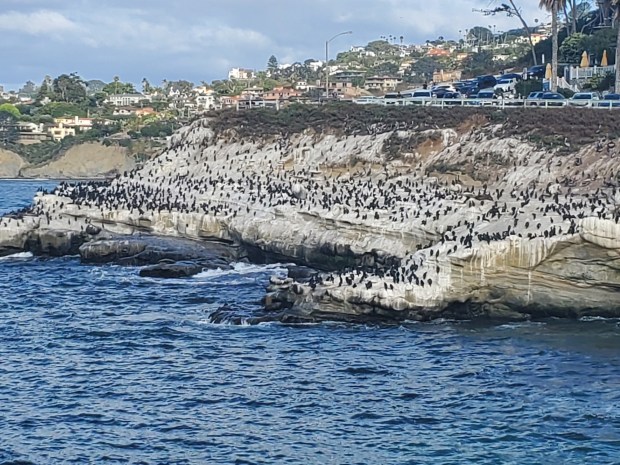 Seabirds flock to the bluffs near La Jolla Cove. (Ashley Mackin-Solomon)
In addition to the research — which Rubenstein said he plans to write up for publication — his team is considering working to add signs at The Cove to inform visitors about the seabirds there.
“We realized there is an opportunity to improve environmental education and science communication,” he said. “I felt there was an opportunity to explain the ecosystem The Cove provides and something bird-focused, because there seems to be a lack of seabird-focused communication at The Cove, and seabirds are just as important a part of the ecosystem as marine mammals and people.
“I thought it would be a good chance to work with stakeholder groups … and see what opportunities there are to work on some of that science and contribute to communicating that science.”
When people understand why conservation measures are in place or why access to something is temporarily restricted or unavailable, they tend to appreciate it, Rubenstein said. Thus, new signs could help communicate that, he said.
“Yes, there are going to be people that harass and get too close to the wildlife,” he added. “So at the bare minimum, having signs and park rangers there to help mitigate harassment is really important.”
Rubenstein spoke at a recent La Jolla Parks & Beaches meeting and plans to continue working with the board to explore sign options. ♦