
You don’t have to be a beer nerd or even a drinker to recognize that David Keene, the founder of San Francisco’s Toronado, is a trailblazer. Keene, 70, built the internationally renowned craft beer bar on nearly four decades of his own curiosity and physical labor.

Keene opened Toronado in the Lower Haight in 1987 before most Northern California breweries were in the draft business. To get their beers into his taps, he drove his Honda hatchback to them — in Marin, Contra Costa and Mendocino counties — filling soda syrup canisters he’d rigged into kegs and effectively launching what would become the region’s craft beer movement.
“He was a pioneer of that business model,” Natalie Cilurzo, co-owner of Russian River Brewing Company and Keene’s friend, told SFGATE. “He was super smart and genuinely went on these hunts to share interesting beers with his customers at what is basically a dive bar. All these years later, whenever we have a new or limited-release beer, Toronado is the first place we call.”
Article continues below this ad
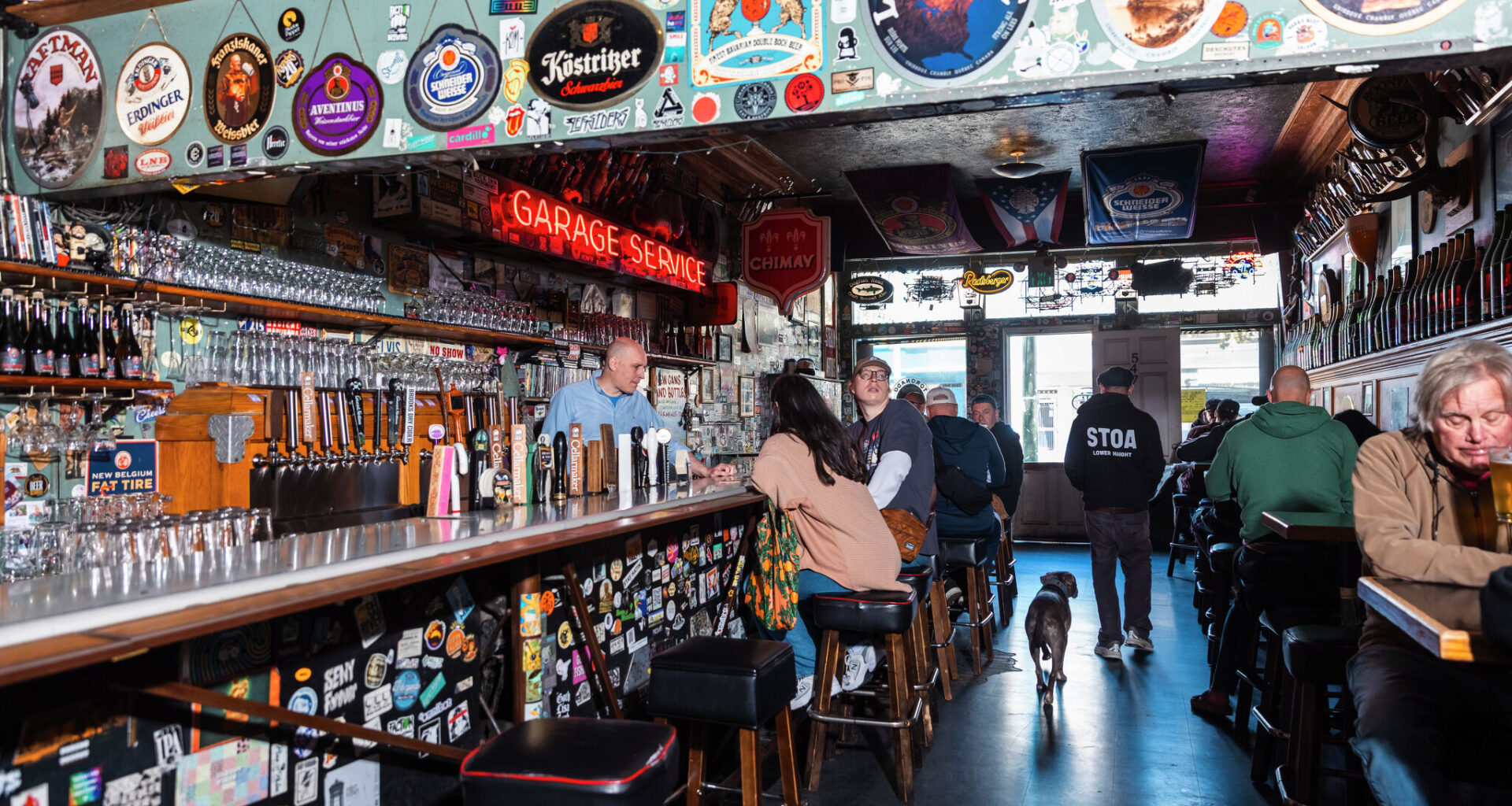
An interior view of Toronado, San Francisco’s legendary craft beer institution, in the lower Haight in San Francisco on May 8, 2026.
Lizzy Myers/For SFGATE
An exterior view of Toronado bar in the lower Haight in San Francisco on May 8, 2026. The bar recently changed ownership from Dave Keene, who owned the bar for 39 years, to longtime patron Bill Lewis.
Lizzy Myers/For SFGATE
By the late 1990s, beer drinkers across California and beyond had caught on, converging on Toronado’s Dutch door to step inside and sample interesting imports and local crafts in one place. Keene stepped away from day-to-day operations 10 years ago, and now, after a long search that included a contested sale to a cryptocurrency investor, he is officially handing over the beloved, cash-only bar to someone he trusts — Bill Lewis, a San Francisco resident of three decades and a regular of the bar.
As the transfer of ownership nears, Keene is holed up in the Sierra Nevada just days away from closing the biggest chapter of his life.
Article continues below this ad
DJs and a hair salon
As the steward of one of SF’s most famous bars, you might expect Keene to be an open book. He’s not. He is guarded, even elusive. For the past several years, Keene has lived in a small town in Tuolumne County with his wife, Jennifer. He’s funny and easy to talk to, once you earn his trust, but even then he won’t share his phone number or email with you.
Toronado owner David Keene is pictured outside his home in Tuolumne County, Calif., on Thursday, May 21, 2026.
Charles Russo/SFGATE
His friends know him as Big Daddy, a music buff and dog whisperer — he has rescued and rehabilitated at least five pit bulls, including one named Uki that was known to jump up on the stools at Toronado and sit with customers.
Article continues below this ad
Cilurzo, who has known Keene for over 25 years, calls him a teddy bear.
“There’s a sense of entitlement when it comes to beer bar owners, especially those who carry a lot of unique, highly sought-after beers,” Cilurzo said. “Dave has always been humble. He never expects anything. He wants to make sure that you’re happy.”
A native of Ohio, Keene came out to San Francisco to visit a friend in 1979 and never left. He slept on his buddy’s floor for six months and got a job at a TV and video store at the corner of Scott and Lombard in the Marina. He managed another video store, eventually joining some Japanese friends in the car trading business.
Article continues below this ad
A photo from Toronado in 1987 shows the bar with bare walls and minimal decor.
Courtesy of David Keene
It was those friends who convinced Keene to open a bar with them in 1987 in a former hair salon. Keene named it after his favorite 1966 Oldsmobile and managed it from the start. But the bar at 547 Haight St. was hardly the sticker-covered, jukebox-centric dive it is today. The walls were bare, and its DJs and dance floor catered to a bridge and tunnel crowd.
“We had originally thought we would be a Tiki bar, believe it or not, but we couldn’t afford the liquor license,” Keene told SFGATE in a long-ranging interview he has rarely granted to the media in recent years. “They were $50,000 to $60,000 at that time and a beer license was $500.”
So they went with beer. Keene knew what he liked. After seeing a segment on “Today” in which Bryant Gumbel declared Chimay the best beer in the world, he started exploring Belgian Trappist ales. He read up on secondary fermentations, discovered Orval and even dabbled in homebrewing. But that didn’t last.
Article continues below this ad
“I made a couple batches and let’s just say I decided I would be a consumer and not a manufacturer,” Keene said.
The Counselor, a Toronado regular, poses for a portrait with his dog Earl in San Francisco on May 8, 2026.
Lizzy Myers/For SFGATE
An interior view of Toronado, San Francisco’s legendary craft beer institution, in the lower Haight in San Francisco on May 8, 2026.
Lizzy Myers/For SFGATE
By 1989, Keene had already made his first pilgrimage to Belgium and was spending all of his time at the bar, so he offered to buy it from his partners. In lieu of a contract, “we had a gentleman’s agreement that I would pay a certain amount and then the bar would be mine, and then they changed their minds a year later,” Keene explained. So, twice he paid them “over $100,000.” Keene did not disclose the exact amount to SFGATE.
Article continues below this ad
This time, though, he had a lawyer and a contract. “No sour grapes,” Keene said. “I got the bar. I was very happy.”
‘A big reputation’
Eager to discover craft beers closer to home, Keene began attending beer festivals. He went to one on the UC Berkeley campus, where he discovered Devil Mountain, a brewery that opened the same year as Toronado did, in an abandoned Southern Pacific railroad train station in Walnut Creek. Devil Mountain made headlines that first year by winning three medals at the Great American Beer Festival. Keene was partial to the brewery’s full-bodied Iron Horse Alt.
FILE: Vendors pour out craft beer to attendees of the Great American Beer Festival in Denver, Colo., on Sep 18, 2010.
Ed Andrieski/AP
“It just had incredible flavor to me at that time compared to pedestrian American beers,” he said. He drove out to meet owner Greg Jones and brought back as much of the beer as he could, sliding the kegs inside a rack he’d built out of wood and strapping them down so they wouldn’t roll around in the back of the car.
Article continues below this ad
“We didn’t wait for the breweries to decide they wanted to distribute,” he said. “We went and got it.”
Keene estimates he made “50 or 60” trips out to Devil Mountain before the brewery closed in 1995. Once, on a 100-degree day, the Honda overheated with the precious cargo inside. “I had a friend rescue me and the beers,” he recalled. He had to have the car towed and its engine replaced, but the beers were safe. And the Iron Horse Alt was a hit.
Toronado bar is covered in stickers and beer memorabilia in San Francisco on May 8, 2026.
Lizzy Myers/For SFGATE
The back room of Toronado bar is lined with craft beer memorabilia in the lower Haight in San Francisco on May 8, 2026.
Lizzy Myers/For SFGATE
Soon, the dance floor and DJs went away and Toronado’s walls were covered with memorabilia, from autographed Duvel Jeroboams to the original Devil Mountain pub taps gifted to the bar after the brewery closed in 1995. The large “Garage Service” neon hanging over the bar was given to Keene by a group of British Death Fleet motorcyclists who were regulars.
Article continues below this ad
“Almost all of them were carpenters and they were tearing down a hotel in downtown SF and that was the sign that was on the parking garage,” Keene said. “We’ve probably fixed the neon in it five or six times.”
Keene kept seeking out beers without distribution or “oddities that people overlook.” He brought in Anderson Valley Brewing, which at one point was doing 20% of its sales at Toronado, Keene said. Once, the hatchback was so heavy with bottles and kegs that Keene needed help getting out of the driveway.
“I had to unload the beer, carry it up the hill, drive the car from the top of the hill, and then reload the car,” he said. When Anderson Valley finally went into distribution for themselves, Keene moved his kegs over to Marin Brewing Company in Larkspur and started the whole process again.
Toronado owner David Keene is pictured at his home in Tuolumne County, Calif., on Thursday, May 21, 2026.
Charles Russo/SFGATE
“It was a long time of just building on being the place that you could go to get beer that you can’t get somewhere else or you gotta drive to go get it,” Keene said. “Word spread and we kind of got a big reputation and anybody who came into town for a conference or if they were here for vacation, they would come to the Toronado, because they didn’t have to drive to Anderson Valley or to Southern California, they could get it all in one place.”
Article continues below this ad
Friendship over finances
Vinnie Cilurzo remembers the first time he met Keene. It was 1998, and Russian River Brewing was in its infancy, still owned and operated by Korbel Champagne Cellars. Cilurzo, the brewer, brought two beers for Keene to taste — the Belgian-inspired Damnation and HopTime Harvest, a beer made with wet hops, which was rare at the time. Cilurzo was nervous.
“We were just starting to sell our beer in the Bay Area and to get into the Toronado was a huge deal,” Cilurzo recalled. Still is, he said.
Keene “lit up” when he tasted the HopTime. They finished both bottles and he asked for a keg of the Damnation and as many kegs of the HopTime as Cilurzo had. He never asked the price.
Article continues below this ad
Regular Michael Moore wears a limited-edition Toronado baseball cap, in San Francisco on May 8, 2026.
Lizzy Myers/For SFGATE
Dusty Duvel bottles line the walls of Toronado bar, in San Francisco on May 8, 2026.
Lizzy Myers/For SFGATE
“And that’s the moral of the story,” Cilurzo said. “It wasn’t about the cost; it was about how many he could have for his customers, because he liked it so much. I’ll never forget that.”
Natalie Cilurzo called Toronado the city’s first really good beer bar, “a blue-collar” dive with “some of the cleanest draft lines, best selection and best happy hour in San Francisco, if not in the country.”
Article continues below this ad
It’s where both of their cult-status IPAs, Pliny the Elder and Pliny the Younger, have been sold since they debuted in 1999 and 2005, respectively, and where many of the couple’s favorite Bay Area beer events have taken place over the years, from Keene’s epic Belgian beer dinners that would start at 11:30 in the morning to the now-famous Barleywine Festival he started in 1993.
At some point along the way, a friendship developed between the Cilurzos and the Keenes. They traveled to Hawaii together when the Cilurzos renewed their wedding vows and always spend Fourth of July together in the Sierra. Natalie and Jennifer even have matching tattoos that Keene helped design for them: a skull, crossbones and heart. “We love Dave and Jenn. They’re our best friends,” Natalie Cilurzo said.
Toronado owner David Keene shows off a Yeast of Burden Pale Ale on Thursday, May 21, 2026.
Charles Russo/SFGATE
The Cilurzos are designing something for him, too: A Belgian-style lambic made with pluots for Toronado’s 40th anniversary next year. “It takes years to age them in wood, which is why we’re talking about it so early,” Keene said, excitedly. Russian River has produced an anniversary beer for the bar every five years since its 20th anniversary.
Article continues below this ad
A Belgian monk’s welcome
When you ask Keene what the craft beer industry needs right now, he tells you people.
“People need to get out from behind their phones, go to a bar and talk to each other,” he said. “The Toronado has been a place where anybody from a punk rocker, a Deadhead, a strip mall developer, a motorcycle enthusiast and a conventioneer who’s a doctor could sit and start having conversations.”
Regulars, from back left, the Counselor, Michael Moore, Todd Shields and Angie Adler play dominoes at Toronado in San Francisco on May 8, 2026.
Lizzy Myers/For SFGATE
He has been honored in various ways over the years. He’s had beers named after him, from Speakeasy’s Big Daddy IPA to Anderson Valley Brewing’s Brother David’s double and triple abbey-style ales. His bar was once deemed the No. 1 beer bar in the world, and for decades brewers have clamored to get their beers into his bar, which Lost Abbey Brewing Company’s Tomme Arthur once dubbed “Broadway for brewers.”
Article continues below this ad
But the wildest moment for Keene — what showed him how far the little dive bar on Haight Street had come — happened on a trip to Belgium. He had just arrived at Scourmont Abbey, the monastery where Chimay is made. Suddenly, a monk who recognized Keene broke his silence to greet the bar owner: “Hello, Big Daddy,” he said. “Welcome to Belgium.” “A monk was calling me Big Daddy? I couldn’t believe it,” Keene said.
Another time, at Westvleteren, the tiny 19th century monastery and Trappist brewery, a monk giving Keene a tour led him into a private cellar, where he pulled a cellphone from inside his robes, made a call and then addressed Keene.
Toronado owner David Keene shows off his namesake Big Daddy IPA, on Thursday, May 21, 2026.
Charles Russo/SFGATE
“Welcome to the best liquor store that’s open on Sundays in Belgium,” the monk, a former cop, told Keene. “This is my pallet. Take anything you want.” (Keene took a six-pack of Westvleteren 12, a dark amber ale considered by some to be the best in the world).
Article continues below this ad

Stay informed, and entertained.
By signing up, you agree to our Terms Of Use and acknowledge that your information will be used as described in our Privacy Policy.
Today, Keene is ready for the next chapter in his life, a quieter one focused on health and hiking. Toronado hit the market in January 2025, and it took until now to find its next steward, Bill Lewis, a tech and finance expert who will no doubt lean on his brother-in-law and co-owner Wall Pringle’s experience in the beer world.
Before they signed the paperwork, Keene invited Lewis up to his home in the Sierra. He made lunch. They talked. Keene shared very little about Lewis, except that he is “gracious, reserved and appreciative.” Most importantly, the new owner doesn’t want to change anything about Toronado. And that gives Keene tremendous relief.
Toronado bar, which features a variety of eclectic decor, will retain its original character after new ownership, in San Francisco on May 8, 2026.
Lizzy Myers/For SFGATE
“It’s time for someone younger to get in now and continue this legacy on,” he said. “I don’t have any regrets. My life’s been filled with people. I’m kind of enjoying there being fewer of them.”
Article continues below this ad