
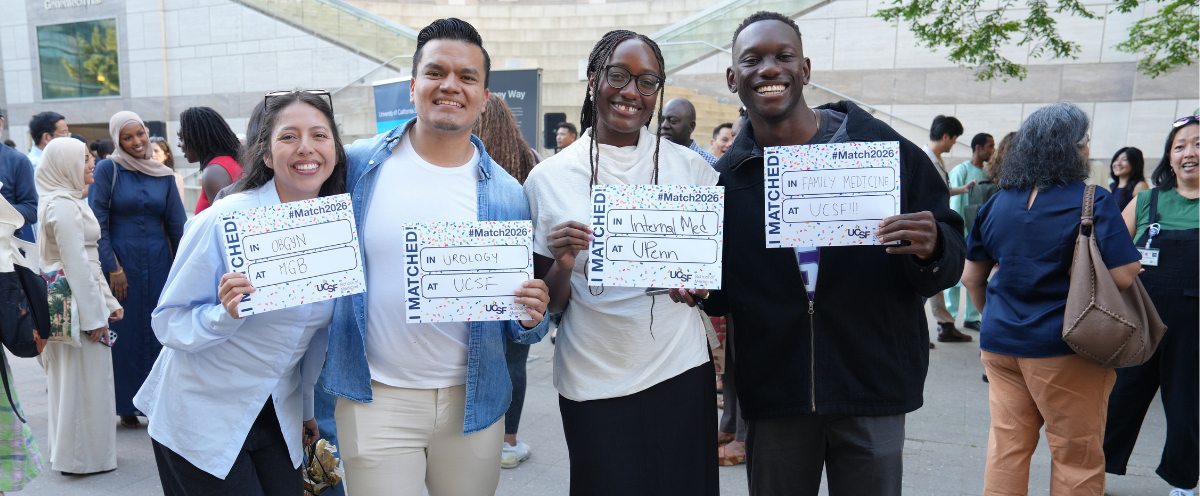
Photo courtesy of UCSF | Medical students celebrate Match Day after learning where they will complete residency training. UCSF Fresno leaders say residency programs play a critical role in retaining physicians in the Central Valley by helping trainees establish professional and personal ties to the region.
published on June 9, 2026 – 4:10 PM
Written by Ben Hensley
Valley health care leaders are increasingly focused on a long-term solution to persistent physician shortages, training doctors locally and encouraging them to build careers in the region.
California Health Sciences University in Clovis and UCSF Fresno are tackling the challenge from different stages of the medical education process, but both are working toward the same goal: expanding the Valley’s physician pipeline.
While CHSU continues increasing the number of medical graduates entering the workforce, UCSF Fresno is focused on what comes next — residency training and physician retention.
Training more physicians
Founded in 2012, CHSU launched its College of Pharmacy in 2014 and its College of Osteopathic Medicine in 2019. Because the medical school follows a four-year curriculum, the university’s first graduating medical class crossed the stage in 2024.
Graduation numbers have increased steadily since then.
The inaugural medical school class included 66 graduates in 2024. That total rose to 109 in 2025 and reached 131 graduates in 2026.
University-wide, CHSU graduated 171 students in 2026, with medical students accounting for most graduates.
“Our mission is to help improve health outcomes of people living in the Central Valley by recruiting and retaining local students from the region and state,” said Dr. Florence T. Dunn, founding president of CHSU.
The university has emphasized local education pathways through its Future Doctor Pathway program, which offers early acceptance or guaranteed interviews to qualifying students from regional colleges and universities.
Keeping students connected to the Valley throughout their training is another key objective.
“We aim to have our medical students complete their clinical clerkships primarily within the Central Valley so they experience serving our patient population while connecting with local physicians and institutions,” Dunn said. “We also encourage our students to apply for local residency programs so they are more likely to stay here and practice medicine.”
Health care workforce leaders say the need remains significant.
“There is a huge demand for health care workers,” Veronica McCallister, associate deputy director for the Fresno Regional Workforce Development Board, previously told The Business Journal. “We know that there are a lot of shortages throughout our region, and making sure that people have access to quality jobs while also ensuring our communities have access to health care is critically important.”
CHSU’s medical school is approved for 150 students per class, a level Dunn said the university expects to reach in the near future.
Keeping doctors local
Graduating medical students is only part of addressing physician shortages.
New physicians must complete residency training before they can independently practice medicine.
That is where UCSF Fresno plays a critical role.
José M. Barral Sánchez, vice dean for the UCSF School of Medicine Regional Campus at Fresno, said creating a strong educational environment is essential to physician retention.
“For us, it really is a matter of, while the physicians, if they are residents or medical students, if they are in medical school, are training, we want to make sure that we create the best possible educational environment for them,” Barral Sánchez said.
UCSF Fresno prioritizes mentorship, meaningful feedback and opportunities for trainees to establish professional and personal relationships within the community. The organization also emphasizes work-life balance to allow residents time to develop roots outside the hospital.
“We are very mindful about looking at working hours and allowing the trainees to have time to develop those relationships and giving them the space and the opportunity to do so,” he said.
Those relationships often influence where physicians ultimately choose to practice.
The connection between the two institutions is strengthening as more CHSU graduates enter UCSF Fresno residency programs, creating a more localized pathway from medical school to practice.
Barral Sánchez said continued growth among federally qualified health centers is helping support that effort by creating additional opportunities for residents to remain in the region after training.
“We are very, very happy that a lot of CHSU students actually select UCSF Fresno after they finish with medical school to do the residencies,” Barral Sánchez said.
Expanding residency capacity
Regional leaders say growing residency opportunities will be critical to retaining more physicians in the Valley over the long term.
CHSU recently partnered with United Health Centers to establish the region’s first Physical Medicine and Rehabilitation residency program.
“The program aligns perfectly with our mission because we need physicians that are professional, clinically competent, and trained to deliver culturally appropriate care to our diverse patient population to ensure the wellness of our communities and increase accessibility to comprehensive quality care in the Central Valley,” United Health Centers President and CEO Justin Preas previously told The Business Journal.
The effort reflects a broader strategy among local educators and providers: create a pathway that allows students to attend medical school, complete residency training and ultimately establish careers in the Valley.
For a region that has long struggled with physician shortages, local leaders increasingly see that full pipeline — from classroom to clinical practice — as the most sustainable solution.