
It’s Sunday morning at the farmers market in downtown Campbell, and John Shimek is selling citrus to a crowd of customers – tight, juicy oranges, plump grapefruit and O.J. in condensation-beaded bottles.
A woman shoves a wad of cash into his hands. “My husband comes here for the mezze dip from the hummus guy,” she tells him. “I come here for you. I’m addicted to you!” He drops a few extra oranges into her shopping bag.
RELATED: From Walnut Creek to Mountain View, the Bay Area’s most exciting downtowns are in the suburbs
“Always a joy to see you,” he replies.
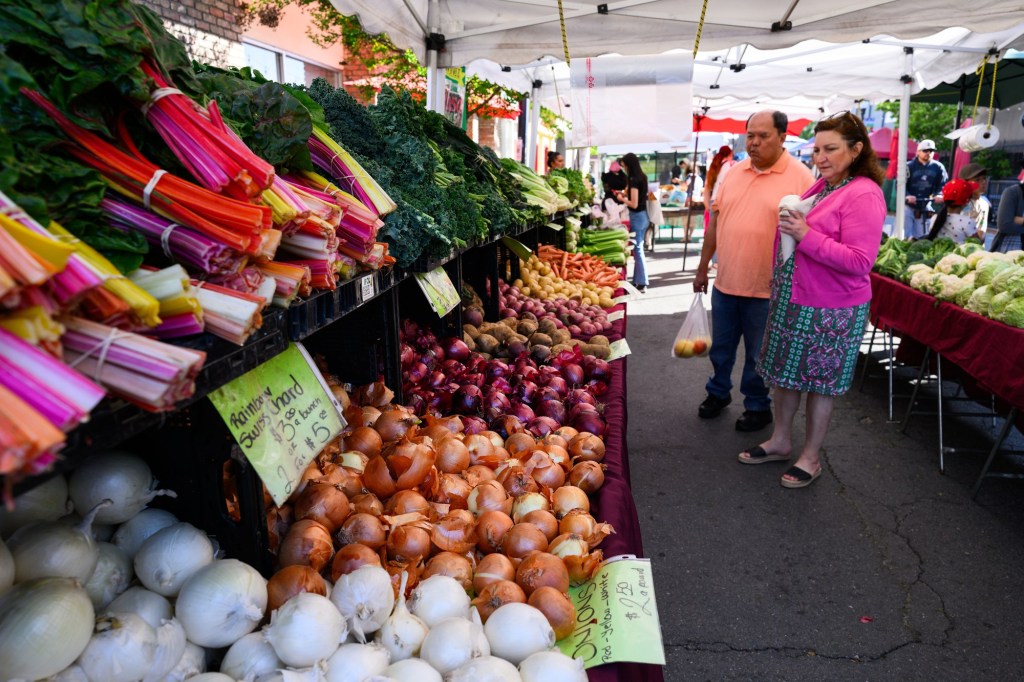
Similar transactions are occurring over the market’s multiple blocks. Shoppers explore pyramids of pomelos, beets with dirt still clinging to them, raw milk and soft cheeses, a bakery with sausage rolls “made locally by legit Britishers.” A grower with “special ugly” Lion’s Mane mushrooms tells a buyer to “marinate and cook it like meat. It turns into a steak, it’s phenomenal.” People gather around a $75 ostrich egg propped up like a museum exhibit, asking if it’s real. “Oh yes,” the seller replies, “and it’s going to feed up to 12 people.”
Is there any experience more quintessentially Californian than the farmers market? Part larder-stocking, part therapy, it’s a routine beloved by millions who head out, recyclable bags in-hand, to suss out what’s fresh through the changing seasons.
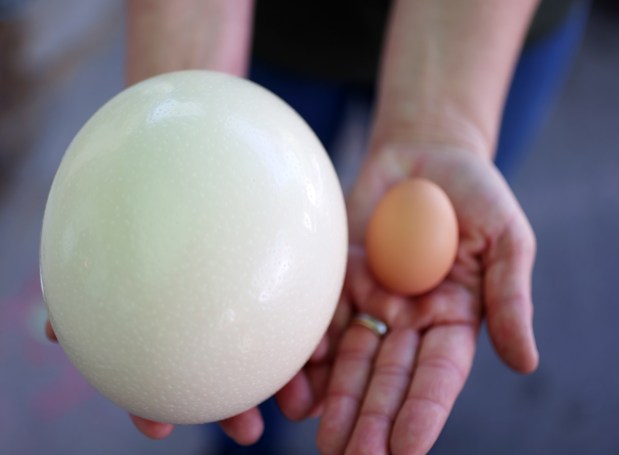 California Ostrich Valley Ranch owner Nataliya Toderica holds an ostrich egg, left, next to a chicken egg during the weekly Campbell Farmers’ Market on Sunday, March 15, 2026. (Aric Crabb/Bay Area News Group)
“People love to know where their food comes from. And if you’re talking directly to the farmer who grew it, who else better?” says Ron Pardini, founder and executive director of Urban Village Farmers’ Markets, which has operated markets in the Bay Area since the 1990s. “In addition, people love to bump into their neighbors — it’s the social aspects that are wonderful at farmers markets.”
Over the years, cities learned that these markets could also be a valuable tool for revitalizing downtown areas that otherwise might not see a lot of traffic. Martinez started one in 2011 for that very reason, and since then it has become the city’s backbone, says Sarah Baird, executive director for Downtown Martinez & Co.
“The need came from wanting to promote downtown and get more business into our stores, and also get people used to coming to Martinez and knowing it’s a great weekend spot,” she says. “We all love our weekend getaways here in the Bay, and we wanted to be one of those places, despite being a little less developed than some of the other coastal towns.”
Martinez’s market takes place Sundays and is managed by the Pacific Coast Farmers’ Market Association – one of a couple umbrella organizations that run markets across the Bay. It spans several blocks of vendors and pop-up eateries selling living microgreens, artisan granola, filled-to-order doughnuts and gelatinous Irish sea moss (“92 essential minerals,” 16 ounces for $55).
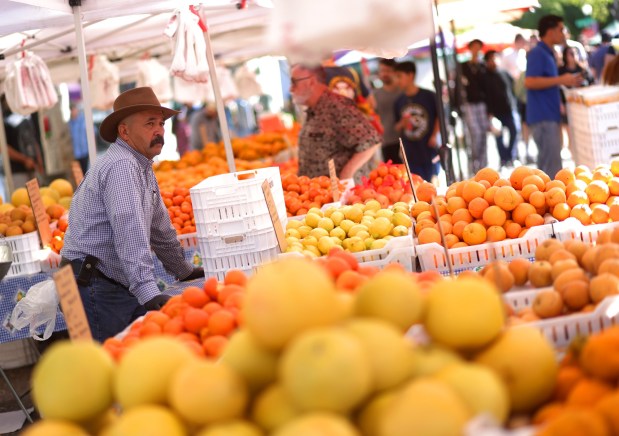 A fruit stand worker watches as customers shop during the weekly Campbell Farmers’ Market on Sunday, March 15, 2026. (Aric Crabb/Bay Area News Group)
This particular market lures in people from all across the region, numbering as many as 3,500 on summer days. There’s a multiplier effect to this foot traffic, too. A study from the Cornell Cooperative Extension in New York found that for every dollar a vendor earns at a farmers market, consumers spend an additional 58 cents at nearby brick-and-mortar shops.
“When it started, a lot of the (downtown) businesses weren’t even open on Sundays,” Baird says. “Now it’s one of their busiest and best days.”
The first farmers market in California was right here in the Bay Area — when canneries were backed up during World War II and growers in the North Bay had nowhere to send their fruit. In 1943, civic-minded citizens claimed a plot in San Francisco and invited farmers to sell their produce there.
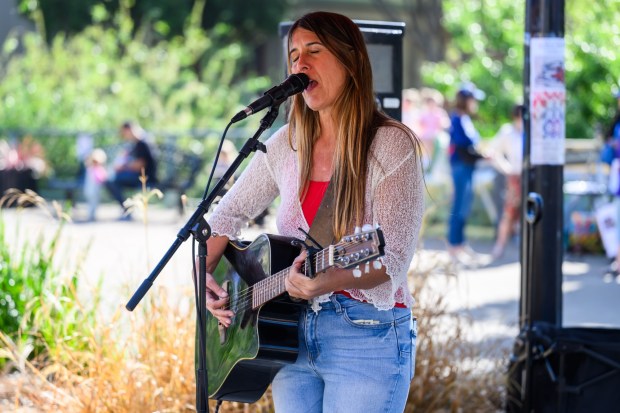 Musican Aprylle Dawn performs at the Martinez Farmer’s Market in Martinez, Calif., on Sunday, March 22, 2026. (Jose Carlos Fajardo/Bay Area News Group)
But the proliferation of the modern farmers market came on the heels of the back-to-the-Earth movement, which gave voice to a growing distrust of industrial farming that relied on herbicides and pesticides, and viewed the smaller markets as a healthy alternative. Walnut Creek launched its first farmers market in 1983, Richmond in 1984, downtown San Jose in 1993. The success of local markets in the Bay Area became so talked-about that Los Angeles sent its own city officials up here to learn how to copy it.
Berkeley started several different farmers markets, which have been as political as most other aspects of the city. They banned produce treated with the pesticide methyl bromide in 1996 and genetically modified produce in 2002. Berkeley finally broke its “dead animal barrier” in 2012, allowing in a fish merchant who had salmon and local crab.
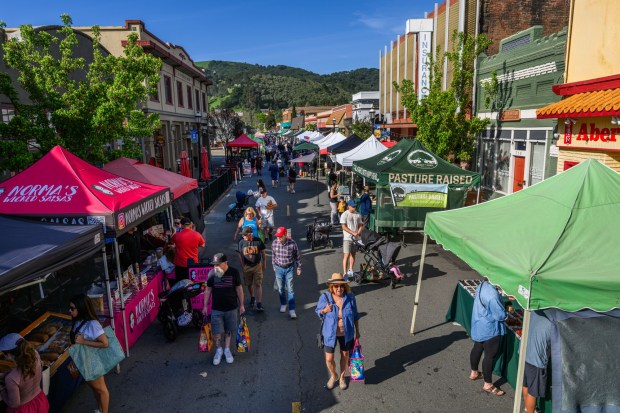 Visitors shop at the Martinez Farmer’s Market on Main Street in Martinez, Calif., on Sunday, March 22, 2026. (Jose Carlos Fajardo/Bay Area News Group)
With roughly 8,700 of them in the United States – around 760 in California alone – the market for farmers markets may now be hitting its limit.
“We are not interested in operating any more (markets),” says Pardini of Urban Village Farmers’ Markets. “Basically, it’s getting a little bit saturated. We just make the ones that we currently run better.”
Enter into the picture companies like Foragers Market from the Tri-Valley, which is in the business of relaunching or streamlining existing farmers markets. Run by Harvindar Singh and Justin Johal, the organization has rebooted markets in San Ramon, Fremont and Livermore, with the latter city giving them an official “certificate of appreciation.”
They also helped develop the farmers market and night markets in West Oakland which, in a pretty amazing development, saw some of its nomadic vendors transition into brick-and-mortar homes in the neighborhood’s newest food-and-events hall, Prescott Market. It’s not uncommon for vendors to use markets as a launchpad for physical shops; for instance, a little business that started in Oakland called Blue Bottle Coffee that sold to a private-equity firm this year for a reported $400 million.
The simpler market gatherings that existed 20 years ago – vehicles for selling “mostly vegetables and fruit,” according to Johal – simply won’t do for today’s audiences. People expect a more comprehensive, even exciting experience, with things like live music, poetry readings and even circus acts.
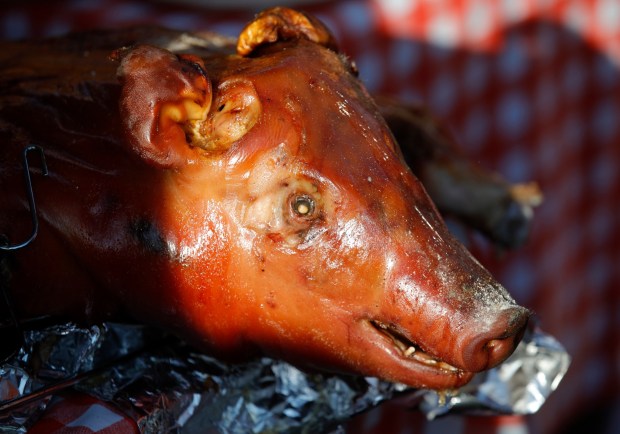 Delaney’s Meat serves roasted pig along 18th Street near Raimondi Park during the Prescott Night Market in Oakland, Calif., on Thursday, July 11, 2024. (Jane Tyska/Bay Area News Group)
“We’ve always been at the forefront of expanding categories and things at the market. We were one of the first to allow the sale of CBD items, one of the first to allow cottage-food operators, like people who were baking in their homes,” he says.
There are no circus acts at the Campbell Farmers Market, founded in 1998, but it’s bustling every Sunday nonetheless. There are more than 100 vendors at this market, all of them makers of their own products – no reselling allowed. There’s the Apricot King from Hollister, the Guacamole Queen from Concord. Ana’s Corn & Potatoes offers just that, corn cobs and baked potatoes. At one recent Campbell market, a butcher holding up a beef coulotte tells a customer it’s a “big boy, my favorite cut right now.” A jeweler receives a compliment on his delicate handiwork, and responds, “I’m a bezel maniac.”
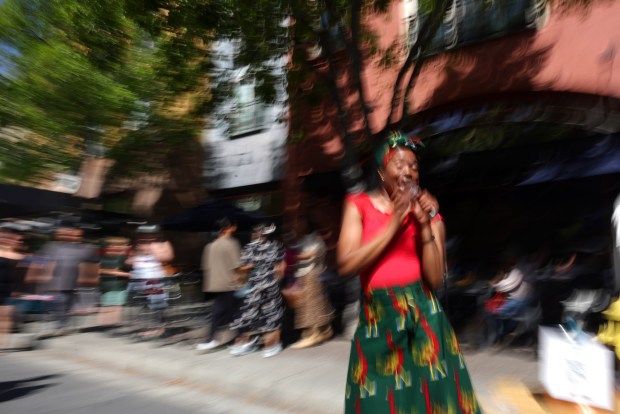 Performer Khalilah Ramirez dances during the weekly Campbell Farmers’ Market on Sunday, March 15, 2026. (Aric Crabb/Bay Area News Group)
Brian Parks from Campbell came here to pick up some focaccia and flowers. “For me, I like the people-watching,” he says. “A lot of the food products down at the beginning are good — the baked potatoes, the pizza. Usually my wife is here with me, but she’s sick at home, so I had to get some cookies for her.”
Maintaining grace among the throng, like a butterfly in a swarm of honeybees, is Khalilah Ramirez aka “Khalilah Peace Dancer.” She’s one of the artists who likes to spread their creativity at the market – there’s also a crazy-haired guy walking and strumming an acoustic guitar, and a Santa cosplayer twisting balloon animals. With her shiny uniform and interpretive gesturing, the Campbell native has gathered a small crowd.
“I’m doing a Dance of Peace,” says Ramirez, “Because that vibration of peace – with all of us locked in, all of us practicing – can really help us get a lot more ease while we go through all the chaos in this world.”
She could try to do it on a stage somewhere, in front of a formal audience, but she likes this better.
“This crowd is open,” she says. “They’re open enough to clap a hand, break into a dance, you know? They’re open enough to really enjoy it and know how special they are for participating. Yeah, I love it here.”