
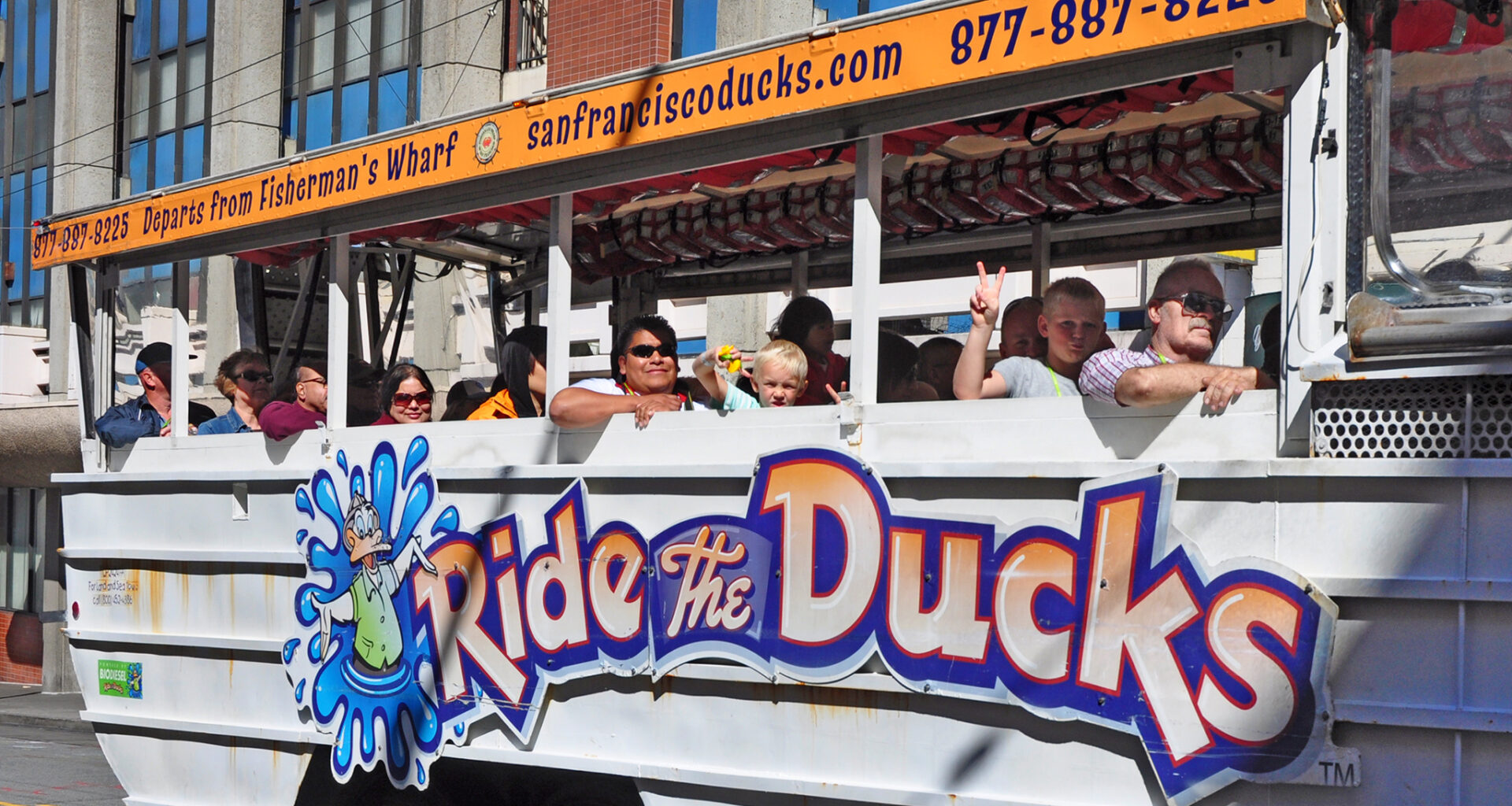
When you see one in person, it’s hard to believe that something so stupid looking could cause so much pain and heartbreak.

With their clunky two-ton builds and garish cartoon logos, Ride the Ducks’ amphibious vehicles were once a common sight near Fisherman’s Wharf, barreling down busy streets before plunging into the frigid waters of the San Francisco Bay. A repurposed relic of World War II, these ungainly vehicles, called DUKWs, were a menace across the city, zooming past the gritty O’Farrell Theatre strip club and narrowly missing cyclists along the way. You could always hear the duck-themed monstrosities approaching, too, since tourists ruthlessly honked at commuters with a kitschy bill-shaped kazoo.
Ride the Ducks seemed inescapable in the mid-2000s, becoming a gaudy fixture in San Francisco’s urban landscape. Just as soon as the flock appeared, though, it would suddenly vanish into obscurity — but given the boats’ horrific safety record, it’s no surprise.
Article continues below this ad
Over the decades, a maelstrom of mechanical errors, government failures and severe weather conditions led to several tragedies that tore families apart, still inflicting pain on surviving relatives years later.
A view of American DUKW amphibious trucks as they transport cargo to the beach during Operation Shingle in Anzio, Italy, on April 15, 1944.
PhotoQuest/Getty Images
An unlikely hero of World War II, the DUKW, pronounced “Duck,” was an amphibious military vehicle used to transport ammunition and supplies to U.S. soldiers. Weighing 2.5 tons and capable of holding 25 people at a time, it could race up to 50 mph on land and sail up to 5 knots in the ocean. During the D-Day landings, these six-wheeled stalwarts took soldiers onto the beaches at Normandy.
But even though they were instrumental in the war, these canopied vehicles posed a threat to their own passengers: Oftentimes, they sank at sea, overburdened by the weight of heavy artillery and rough ocean waves, killing the men aboard. The DUKW’s original manufacturers also probably didn’t think that the boats would continue to claim people’s lives long after the war ended.
Article continues below this ad
After the troops came home, many DUKWs were eventually sold as surplus to tour companies across the U.S., including ones in San Francisco. According to the Smithsonian magazine, the first DUKW tour company was founded in 1946 by Melvin Flath, an entrepreneurial trucker in Milwaukee who purchased one of the amphibious vehicles at a war surplus auction. After installing a few used bus seats, the outlet said, he began charging 50 cents for short, scenic rides around a local lake. By the 1990s, the concept began to take off across the U.S.
Starting in 2005, one locally operated amphibious tour company, Bay Quackers, made headlines when it started doing business in San Francisco, and again in 2009 when it began feuding with Ride the Ducks, its conservative Christian competitor. For $39, guests would embark on an 80-minute tour that drove from Fisherman’s Wharf to San Francisco Bay, where it plunged into the water for a quick view of McCovey Cove. Upon boarding, passengers would be handed a “wacky quaker,” a bill-shaped kazoo that ignited a legal battle between the two rival companies. (John Scannell, the former owner of the Bay Quackers, told the New York Times that he compromised by telling his passengers to growl like a pirate instead. He did not respond to SFGATE’s request for comment).
Legal drama aside, local outlets welcomed Bay Quackers and its adversaries. After all, these tours seemed to provide fun, quirky alternatives to the traditional cable car experience. For a modest price, passengers could get a unique view of San Francisco from the ocean — but they were likely unaware of the boat’s frightening history.
Article continues below this ad
An industry haunted by drownings
One of the first major disasters took place in the spring of 1999, when 13 passengers, including three children, died after one DUKW, Miss Majestic, sank to the bottom of Lake Hamilton in Arkansas.
The boat’s operator, a former substitute school bus driver who had experience working on “party barges,” didn’t explain safety measures, a lengthy National Transportation Safety Board crash report said. And when the operator tried — and failed — to pull a life jacket out of storage, she simply “gave up,” survivors told investigators at the time.
There were other, more concerning signs that the tour wasn’t going as planned.
Article continues below this ad
About five minutes into the boat’s journey, the operator noticed that the DUKW felt more sluggish than usual. Regardless, she continued on their scheduled route around the shore of Saint John’s Island. But when a teenage boy took off his shoes and suddenly felt water on his feet, he saw that the boat was starting to flood. It was already so low that he could reach his hand out and touch the lake’s surface. At first, the operator thought the boat was moving slowly due to uneven weight distribution, so she asked a 6-foot-6-inch passenger to move to the starboard side.
When he got up to move, however, he also noticed that the boat was flooding. Realizing the danger they were in, he began throwing life jackets to passengers, shouting at them to leave. Meanwhile, the operator saw water rushing over the stern and into the passenger area, so she throttled the engine in a futile effort to get back to shore.
People view a row of duck boats in the parking lot of Ride the Duck in Branson, Mo., on July 21, 2018.
Charlie Riedel/AP
There are varying reports on how long it took for Miss Majestic to actually sink.
Article continues below this ad
Some survivors said it was within 15 seconds, while others said it was said it was a full minute. One boater, who had just been passing by, said it disappeared under the brackish water before he could even approach the tour operator and warn her.
Just before it submerged in the green, murky lake, the teenage boy escaped through a window and crawled onto the canopy, narrowly avoiding death.
Meanwhile, the tall man who helped pull out the life jackets was thrown against the boat’s windshield as water rushed inside. He eventually managed to reach air — but his wife, who didn’t know how to swim, died that day.
Even some of the strongest swimmers struggled to survive: One woman told investigators that she seemed to be covered in silt when she finally got her head above water, implying that she sank all the way to the bottom of the lake. Another woman with a bleeding nose later told them that as she freed herself from the sinking boat and swam to the surface for what felt like an eternity, she didn’t even notice that a small child had been clinging onto her the whole time.
Article continues below this ad
Out of the 21 people onboard, only eight survived, with one victim as young as three. For two days, divers recovered the remaining 13 bodies from the lake, and according to the accident report, the boat’s canopy trapped passengers, preventing them from escaping. The vessel itself was also poorly maintained, and mechanics likely didn’t know how to fix them.
But the DUKW tours didn’t stop — and neither did the accidents.
kennejima via FLickr CC 2.0
The next year and the year after, two other amphibious boats sank in Seattle and Milwaukee.
Article continues below this ad
In September of 2000, the captain of a DUKW called the Minnow told investigators that during his routine tour in Milwaukee, he heard a strange “mechanical noise” and then felt the boat “shudder.” But before he could turn back to shore, the engine died and began to flood. This time, though, responders were able to rescue all passengers onboard just before the boat sank.
Similarly, in the winter of 2001, one boat had to turn back after just five minutes into a tour of Lake Union in Seattle — after passengers debarked, officials tried towing it across the lake, where it quickly sank.
Over the next several years, officials reported dozens of equipment failures on DUKWs, ranging from snapped steering cables and broken shafts to dislodged hoses and blown radiators. Loose screws and pins fell out of equipment; ignition coils failed. And the accidents weren’t always in the water, either.
In 2015, a Ride the Ducks-branded DUKW crashed into a motor coach full of college students on the Aurora Bridge in Seattle, killing five passengers and injuring 71 in total. According to the crash report, the operator heard an ominous clanking sound before losing control and colliding with the bus. The King County medical examiner said that they all died of head trauma and blunt force trauma to their torsos and extremities. Meanwhile, 11 of the tour passengers were completely ejected from the boat upon impact. In the subsequent crash report, investigators said that Ride the Ducks International failed to properly repair axle fractures on the DUKW, causing the crash that day.
Article continues below this ad
But World War II vehicles aren’t easy to maintain, partially because their components aren’t readily available when something breaks.
An officer investigates the scene of a crash between a tour bus and a tourist duck boat on the Aurora Bridge in Seattle on Sept. 24, 2015.
Mark Ralston/AFP/Getty Images
During the Miss Majestic crash investigation, officials noticed cracks running through rubber boots, which had been installed immediately before the accident, that were used to plug a leak. A mechanic told investigators that it was difficult to obtain new ones, so they sometimes resorted to using Army surplus that already showed signs of wear.
But none of these tragedies seemed to gain as much national attention as the fatal accident that devastated Missouri in the summer of 2018. It’s since become known as the deadliest DUKW boat disaster in North America, and today, lawyers involved in the case still believe that the victims of these families haven’t fully received justice.
Article continues below this ad
On the evening of July 19 that year, a Ride the Ducks tour boat sank in Table Rock Lake near Branson, Missouri, during a severe windstorm, claiming the lives of 17 passengers and launching a federal criminal investigation. Even though the National Weather Service issued a severe thunderstorm warning for the area, boat operators continued the tour regardless, slightly modifying their route in an attempt to beat the storm.
When the captain noticed the sky turning dark, he tried returning to land, but it was too late: Just five minutes into their journey, a derecho — a fast-moving pillar of thunderstorms — tore through the lake, creating 5-foot-tall waves and 73 mph wind gusts that overpowered the vessel.
A ticket booth for the Ride the Ducks tour boat company in San Francisco on July 8, 2010.
S.F Chronicle/Getty Images
Before it could reach the exit ramp, the boat sank 85 feet below the lake’s surface. According to survivors who spoke with investigators, they saw the captain only partially release the curtains that enclosed passengers before jumping out of a window.
Article continues below this ad
Meanwhile, crew members from another vessel nearby leapt into action and launched a rescue boat, but it was immediately swamped by powerful waves. Some who wore life jackets fearlessly dove into the lake’s turbulent waters to grab other passengers, only to be swept farther out into the water.
But what initially began as a challenging rescue operation quickly turned into a recovery effort.
One by one, divers pulled bodies from the bottom of the lake, where some were found as deep as 88 feet. A few days later, families of the victims took legal action against Ride the Ducks in an effort to figure out what truly happened that day, as well as ban the boats entirely so that no other family would have to endure the same trauma.
‘Death traps’
Ripley Entertainment, which “bought into an industry with a history of drownings and death,” prioritized profit over people that day by ignoring the severe weather conditions, Robert Mongeluzzi, the lawyer who represented nearly two dozen victims, told SFGATE. He still thinks about one of his clients, Tia Coleman, who lost nearly her entire family in the accident, he said. “It was heartbreaking.”
Article continues below this ad
“They are death traps,” he told SFGATE in regard to the DUKWs, explaining that even if passengers wear a life vest, they’ll get trapped by the canopies if the boats ever sink — and if they don’t wear them, they won’t have the buoyancy to reach the surface. But he said that government officials also failed to protect passengers by ignoring the danger of DUKWs for decades and by allowing dozens of people to perish.
“That was the horror of these drownings and these deaths, is that this was a hazard, and they never addressed it,” he said, referring to the U.S. Coast Guard. “Our government was asleep at the wheel, and the duck boat industry didn’t give a damn because they were more concerned about profits than about the lives of their customers.” According to a revised 2020 NTSB report, 37 people have died, and another 104 have been injured due to DUKW-related accidents.
SFGATE reached out to the U.S. Coast Guard but did not hear back before the time of publication.
People pray by a car thought to belong to a victim of a boating accident prior to a candlelight vigil, as seen in the parking lot of Ride the Ducks in Branson, Mo., on July 20, 2018.
Charlie Riedel/AP
Plaintiffs eventually reached confidential settlements with Ripley Entertainment, outlets reported in 2020, but it wasn’t the legal outcome families had hoped for.
Article continues below this ad
Years later, a judge dismissed over 60 combined felony charges filed against three individuals, including the boat captain, KTVI-TV reported in 2026.
“We are shattered and held on to hope for 7.5 years that some sort of legal consequence for their known actions that day,” Jen Asher, the daughter of Bill Asher who died in the accident, told the outlet. “Even with all the discovery and proof, I just don’t understand how the judge can do this.”
Ripley Entertainment declined to participate in an interview with SFGATE.
‘They are and were staggeringly dangerous’
Following these horrific accidents, Ride the Ducks had to shut down its Philadelphia branch after its insurance premiums soared by a staggering 330%. Meanwhile, operations shut down fully in San Francisco in 2015. Its owner at the time, Chris Herschend, merely described the city as a “challenging business environment” that threatened the company’s long-term profitability. But around that same time, the city implemented a new legislation forbidding tour operators from narrating while driving the boats, the Chronicle reported — a costly measure that was put into effect right after a cable-car-turned-bus operated by Ride the Ducks’ parent company struck and killed Priscila Moreto, a 68-year-old city worker, mother and wife who was crossing the street.
Article continues below this ad
A Ride the Ducks-branded amphibious sightseeing bus stops at an intersection in San Francisco’s Financial District on Sept. 30, 2013.
Robert Alexander/Getty Images
Overall, Mongeluzzi said that DUKWs will never truly be safe, even with modern upgrades, because they’re unusual vehicles that don’t adhere to the same safety standards as cars. They aren’t required to have seatbelts or airbags, and they aren’t required to be crash-worthy, he continued. Today, he estimates that there are only 16 vintage DUKWs in the U.S., and he said that a new company with modernized amphibious boats recently opened in Branson, Missouri.

Stay informed, and entertained.
By signing up, you agree to our Terms Of Use and acknowledge that your information will be used as described in our Privacy Policy.
“They are and were staggeringly dangerous,” Mongeluzzi said.
Article continues below this ad
In the end, victims of the Branson disaster received enormous sums of money, he told SFGATE, but he still doesn’t consider this a victory. When he first sat down with the families, he told them that it was impossible for him to win a fair settlement amount because it doesn’t exist. “I don’t care what the number is. It could be 100 million, it could be a billion,” he said. None of it, he continued, will ever be a fair trade for the death of their loved ones.