

National headlines may have shifted, but the impacts of President Donald Trump’s mass deportation agenda are still being felt across Los Angeles.
For many, it has devastated their financial, mental, and physical wellbeing. And as Immigration and Customs Enforcement agents still roam the city, the struggle is far from over.
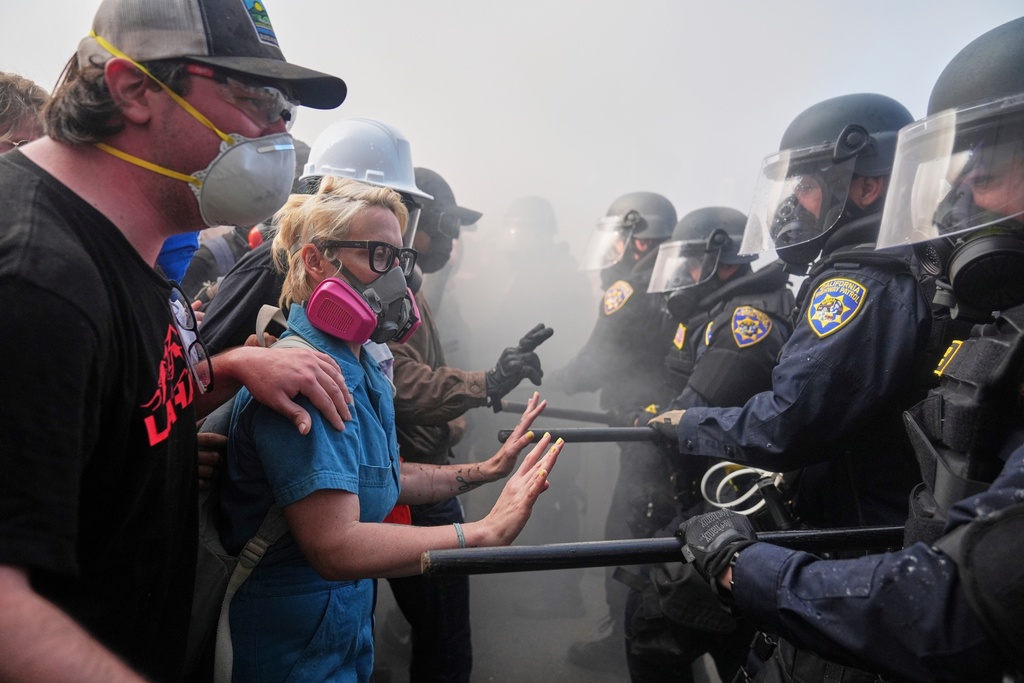 APProtesters confront police on the 101 Freeway near the Metropolitan Detention Center of downtown Los Angeles on June 8, 2025 following an immigration raid.
“Sometimes I wake up in the middle of the night remembering what I endured during those 98 days,” Carlos, a Honduran immigrant detained by ICE last June, said during the Hispanic Federation People’s Hearing Monday.
Carlos was held in California’s Adelanto ICE Processing Center, where he contracted a bacterial infection that caused him to vomit blood. At one point, Carlos, who has a 17-year-old son, said that he was violently attacked.
“I was also nearly sexually assaulted,” he said.
Adelanto is one of many ICE facilities that’s currently under scrutiny for alleged abuse of immigrants. At one point, people held at Adelanto even went on a hunger strike.
But now that he’s back at home, Carlos is one of many immigrants reckoning with a new financial reality a year after the raids. For his family, all of their bills are piling up.
“We are not allowed to work, and what we want most is to live with dignity again as a family, in our own apartment,” Carlos said.
And many other immigrant families feel similarly. For them, fear and financial insecurity loom.
“We are now gradually collapsing because we do not have enough income to keep our businesses going,” Celida, a small business owner, shared at the panel. “We are behind on our bills, and the high costs of rent and merchandise have created a very serious impact on our businesses.”
When ICE raided her community, Celida says that she was too afraid to open her store, causing her to lose significant business.
 APA volunteer sets up an art installation displaying names and faces of people who have been detained, deported, or sent to offshore camps during ICE raids in Southern California on July 3, 2025.
Stories like Celida’s and Carlos’ are tragic, but they aren’t uncommon. And despite living in a sanctuary city, many immigrants feel that the policies have failed them.
As the use of technology—namely artificial intelligence—has skyrocketed, so has its implementation in immigration enforcement.
According to Shiu-Ming Cheer, deputy director of immigrant and racial justice at the California Immigrant Policy Center, the current policies “do not address the growing area of concern about the collection of information about immigrants.”
Surveillance systems developed by companies like Palantir have allowed for ICE agents to use their phone cameras to identify people. And with the approval of the Trump administration, ICE agents have also implemented automated license plate readers. Even more alarmingly, ICE has access to massive databases of citizens’ and immigrants’ private information.
But according to Cheer, there are other vulnerabilities. Police officers are not only permitted by the city to moonlight as ICE officers, but they also have a Homeland Security program to partner with ICE agents. One bill has been proposed to end this.
Related | A year after Trump’s gestapo invaded LA, the fear remains
But while waiting for any meaningful change, people across Los Angeles are suffering.
“Young people worry every day about whether their parents will return home from work. Families are making contingency plans for who will care for their children if a parent is detained,” Raquel Roman, executive director of Proyecto Pastoral, said on Monday.
One family, Roman said, still travels with their belongings in their vehicle in case a parent gets detained.
Like Celida, who is still managing her struggling business, residents of Los Angeles are still clearly feeling the impacts of ICE’s presence.
“A community that lives in fear,” she said, “is a community that becomes weakened.”
We’ll get straight to the point: The financial hardships that Daily Kos is facing this year are tough.
We continue to be paywall-free. We continue to be supported by our readers, not billionaires or corporations. But we need to bring in more revenue. We are leaning on our community more than ever to help make ends meet.
Was this story worth reading?
Recommending and sharing stories helps us decide which stories are most important to show our readers.