
Summary
Hearing officer Jennifer Mazzuchi found that mental disability allegations against Judge Kirsten Nielsen Hartig were not proven.
Two misconduct claims were sustained: failing to promptly provide a psychological report and mistreating court staff.
Allegations that Hartig made false statements to investigators and improperly dismissed criminal cases were not proven.
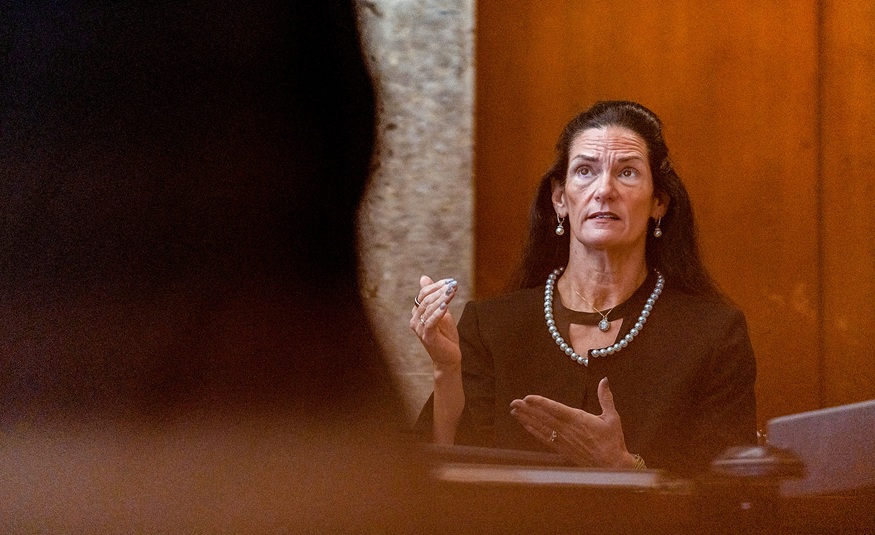
The presiding judge in the hearings against embattled Oakland County Judge Kirsten Nielsen Hartig has given state oversight officials her assessment: Hartig broke rules and behaved badly at times but was not proven mentally disabled.
Hartig of the 52-4 District Court is fighting multiple accusations from the Judicial Tenure Commission, which investigates misconduct by judges and submits recommendations on discipline to the Michigan Supreme Court. On June 9, the process entered its next phase when retired Marquette County Judge Jennifer Mazzuchi submitted her findings for the commission to weigh.
Mazzuchi’s conclusion dealt blows to both the case against and in defense of Hartig. Yet on whether the 59-year-old Oakland County judge has the mental ability to carry out her duty, Mazzuchi came out for Hartig.
“Though there is some basis for concern,” the commission’s attorneys “failed to prove ‘disability’ by a preponderance of the evidence,” Mazzuchi said in her report.
Of the five professional misconduct accusations levied against Hartig, Mazzuchi determined that two had been proven: that Hartig failed to immediately turn over a psychological report to the commission after an examination and mistreated courthouse staff, failing to facilitate the administrative functions of the court.
It had not been proven that Hartig made false statements to the commission or improperly dismissed cases, Mazzuchi found.
The interim executive director and general counsel for the commission, Glenn Page, declined to comment on the report on June 9. An attorney for Hartig, Don Campbell, did not respond to a request for comment.
Both sides get the chance to object to Mazzuchi’s report before the commission hears oral arguments and makes a choice on a recommendation — such as suspension or removal — to the state Supreme Court.
Hartig continues to hear cases on the bench in the meantime, though serious criminal cases have been removed from her docket.
Mental disability not proven, hearing officer says
Three neuropsychologists testified at Hartig’s multi-week misconduct hearing.
Two addressed claims that Hartig suffered mild cognitive impairment and the belief that high on the list of potential causes was behavioral variant frontotemporal dementia. Another disagreed, taking issue with the methods used in comparing sample groups to Hartig’s test results.
The experts similarly described the expected behaviors for the conditions at hand: the afflicted getting mentally stuck on a topic, not being able to appropriately control their behavior, having trouble with problem-solving, and having trouble learning and organizing information.
Hartig made “odd comments” during some mental health court hearings, some of her criminal procedures were indeed “incomplete or imprecise,” and “it seems unusual” that Hartig would be unfamiliar with advice of rights forms or at least not make a better effort to follow court rules while under scrutiny, Mazzuchi said.
But some errors Hartig was reported to have made were not errors upon closer review of court transcripts or emails, Mazzuchi said. Hartig also did not have negative relationships across the board, meaning she was able to control her behavior. Some concerns of 52nd District Chief Judge Travis Reeds “appeared hypercritical,” and other mistakes, such as forgetting a name or attaching the wrong document to an email, were ones Mazzuchi said cognitively healthy people make.
As to concerns raised regarding Hartig’s rulings for men later tied to the murder of Oakland County Sheriff’s Deputy Bradley Reckling, Mazzuchi called the outcome “undeniably tragic.” Hartig let one man out and delayed the case of another ahead of the killing and right around the time of her “unsafe to practice” evaluation. Mazzuchi, however, said that attributing the outcome to Hartig’s conduct was not supported by the hearings.
Hartig also showed efforts to improve her behavior and relationships in recent years. One neuropsychologist said he would be “perplexed” to see a demonstration of personal insight like that in someone with emerging frontotemporal dementia, Mazzuchi noted.
Mazzuchi also watched Hartig testify for days on end, correcting attorneys when they misspoke, pointing out distinctions in questions and showing she was very familiar with the discovery, which filled up courtroom pews with binders.
“The record contains evidence of multiple neuropsychological evaluations that identify abnormal findings or areas of concern,” Mazzuchi said. But the professional charge against her is for “not an emerging or potential issue, but the present inability to perform judicial tasks.”
Only one expert indicated that it was already true, and he based it, in part, on flawed facts, according to Mazzuchi’s description.
‘Unsafe to practice’ report
Hartig underwent a psychological examination at the behest of the commission, or JTC, in May 2024. The resulting report stated she was “unsafe to practice.” She did not turn it over to the commission for months – and kept working.
Hartig argued she did not have to turn it over because court rules only call for “a” mental examination, and she had already had one. Additionally, she argued the court rules say she can be made to undergo an evaluation, but not that she is required to turn over the evaluation’s results.
Hartig had stark concerns about her testing, including whether she was competently tested and whether the report referred to her as a doctor at times.
Hartig’s concerns with the report itself were justified, but she still was obligated to turn it over, Mazzuchi said.
Judge says Hartig court work harder
Not all reports of staff mistreatment were proven, Mazzuchi determined. Hartig often addressed errors in the courthouse properly and, at times, caught ones that could have resulted in wrongful arrest.
Still, while most judges probably at least say or do something discourteous once in their careers, Hartig’s frequent bouts despite intervention amount to a “more significant problem,” Mazzuchi said.
Hartig did not obstruct work at the high-performing court as alleged, but she did make work more difficult for staff and colleagues, such that she failed “to facilitate” administrative functions in the court as required.
Where judge sided with Hartig
Hartig did not have wrongful intent when she made inaccurate statements to the commission, the retired judge determined.
Hartig also could not have misled the body, because her inaccurate statements were about who filed the complaint against her and whom commission attorney interviewed – matters the commission knew the truth of and therefore could not be led astray on.
Additionally, while it was determined on appeal that Hartig should not have dismissed several criminal cases with prejudice, it was not proven that she intentionally violated her authority or made the choice because she failed to maintain competence in the law.
The dismissals, which took place amid a quarrel with the Oakland County Prosecutor’s Office over scheduling, were meant to punish the prosecutors but Hartig asked for briefs on the topic and appeared to genuinely believe she had the authority to take the action she did, Mazzuchi found.
Also, though Hartig should not have looked to a certain case for guidance, its use was not so random as to have proven she had not kept up with knowledge of the law, the retired judge found.
Hartig’s attorneys and those at the commission have 28 days to file objections to Mazzuchi’s report. There is then an allotted timeframe for filing a response to the objection.
Reporting by Darcie Moran, Detroit Free Press / Detroit Free Press
USA TODAY Network via Reuters Connect