
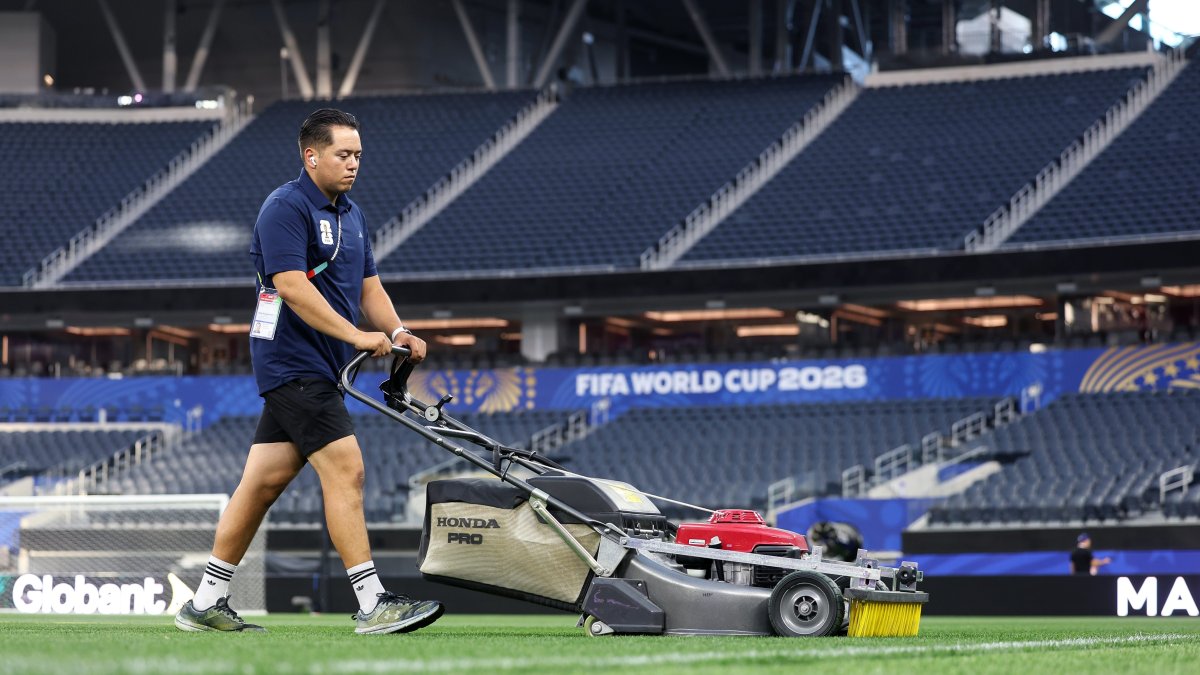
The FIFA World Cup hasn’t been hosted in North America since 1994. Naturally, some of the biggest venues in the area, mostly in the U.S., aren’t equipped with grass fields.
In 1994, the U.S. hosted the grandest event in sports by itself. But that tournament only featured 24 nations. It would increase four years later to 32.
Fast forward 32 years later, the 2026 World Cup is being co-hosted by the U.S., Mexico and Canada — with 48 teams involved for the first time ever.
Throughout that time, several stadiums in major markets across the U.S. have expanded in aspects such as size, technology and more. While Major League Soccer teams typically have their own venues, World Cup attendance numbers means the games are primarily transpiring in bigger NFL stadiums.
Such stadiums typically operate with turf fields. Those are a stark difference to the grass fields used in soccer venues.
Ahead of the World Cup, construction crews and stadium-operating organizers came together to transform turf to grass to create the best possible atmosphere. Juan Carrero, vice president of SoFi Stadium in Los Angeles, broke it down.
“The NFL field is much, much smaller than a FIFA-regulated pitch,” Carrero said. “It sits below grade, lower than what we’re currently establishing for the World Cup. The elevation of the pitch is going to be higher. The corners of the field are being removed to establish the required perimeter and the size of the pitch that FIFA requires as part of the World Cup.
“Part of the establishing of this soccer field and the natural pitch, we’ve partnered up with a tremendous amount of folks…to ensure that we’re actually meeting the requirements of FIFA and being able to actually host the games according to specifications.”
Clark Construction executive Rick Solomon explained that the process actually started two years ago.
“The conversion of SoFi Stadium has started in the off season of 2024,” Solomon started. “Right after the football season ended, we were tasked to come in here and make modifications to the seating corners that you see us pulling out right now. We took that from a precast seating section and turned it into a steel seating section that makes it removable. And that’s important because the pitch is wider than the NFL field.”
SoFi Stadium is one of several U.S. venues that operate primarily with turf fields. Fellow World Cup hosts New York/New Jersey, Boston, Atlanta, Houston, Dallas, and Seattle use various turf installations, while Kansas City, the San Francisco Bay Area and Miami already have grass.
In Canada, BC Place in Vancouver uses Polytan LigaTurf RS+. Toronto Stadium have fluctuated with both since the late 2000s, but currently use grass. Mexico’s three venues in Mexico City, Monterrey and Guadalajara all have grass surfaces.
Carrero further explained that the base of the grass field that came to Los Angeles was farmed out in Washington, about 1,600 miles away. It was then moved over in a refrigerated transport system before starting the layout procedure.
“What I can say is that anyone coming to the stadium, they’re going to be experiencing memorable experiences, lifetime memories that are going to be created,” Carrero said. “…The line of sight from any field will be equal to none. And then ultimately, anyone that’s in the stadium is going to be feeling like they’re part of the game.”
USWNT legend Ali Krieger explains why hydration breaks will be critical at the 2026 FIFA World Cup, especially with summer heat expected across North America. Krieger also discusses the importance of recovery, nutrition and fueling performance throughout a demanding tournament.