
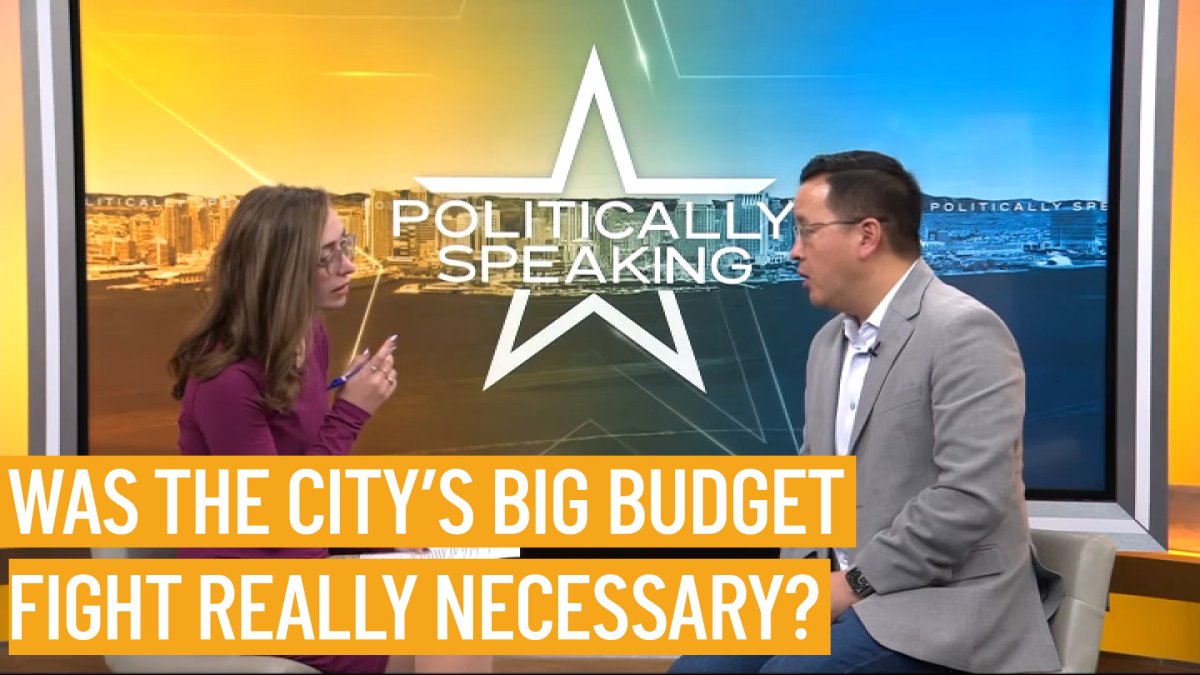
After months of tense negotiations and hours of public comment Tuesday, the city council settled on a budget for the upcoming fiscal year. The council managed to find dollars to fund many of the programs for which residents advocated, while making cuts to some positions, library hours and mandating unpaid furloughs. Councilmember Kent Lee joined NBC 7’s Joey Safchik to discuss the budget on Politically Speaking.
Transcript:
Safchik: It’s budget week in San Diego, and it has been a tough budget balancing act yet again. After months of negotiations, hours of public comment, and with the stench of last year’s paid parking debacle still lingering. The city officially has a budget. It took two votes. The first struck down over debate about whether to keep funding automated license plate readers. But the city is still staring down a nefarious infrastructure backlog. So all that sets the scene for our discussion with Councilmember Kent Lee. Thank you so much for being here.
Lee: Thank you for having me.
Safchik: How are you feeling that this is now in the rearview mirror?
Lee: Well, I think I’m a little relieved. The budget is a challenging process, and it’s months long, and we hear a lot from the public. We hold town halls in our districts. And each of these discussions can become pretty challenging. And I think at the end of the day, we’re proud that as a council, we’re able to unanimously deliver a budget that does have meaningful restorations to a lot of things that I believe San Diego residents have been asking for. So when we’re talking about library hours, recreation center hours, some of the core services that folks come to us about arts and culture, as we had an opportunity announced last week, saw some meaningful restoration as well. And I think at the end of the day, this budget is always, to me, been more than just about getting a financially balanced budget. It’s about having a balance of all the actual needs and priorities that our residents share and trying to ensure that it delivers on that. And I think from where it started, it’s come a long way and we’re proud of what we were able to accomplish.
Safchik: You mentioned that this was unanimous. Last year’s was not. What does that tell you?
Lee: Well, I think each of these budgets can be very challenging. And it was unanimous yesterday, only after a much more contentious, initial vote, because at the end of the day, we are making hard choices. And in a moment where the city doesn’t have an abundance of resources, the choices become a difference between the values that we each have. And I think ultimately we came to a balance yesterday. Last year, you know, it wasn’t unanimous, but it was still a fairly strong approval of the budget. And we ultimately, even as a council, had the supermajority that was necessary to override some of the vetoes that we saw from Mayor Gloria. And I think that showed that there was some strength on the council to have a vision for how we fund the city.
Safchik: Did this play out the way you predicted it would?
Lee: You know, I always feel like every budget cycle, there’s more that we could have done. And I and in this one in particular, I would just point out that while we have meaningful restorations, we had pathways in which we could have funded every library and rec center that had seen proposals for cuts and that’s not the case here. We have meaningful restorations, but there’s still many that are losing hours on Mondays or on Saturdays. We still have rec centers that are losing 20 of their 60 hours a week as an example. So we didn’t deliver on all of that. But I think what we have is still meaningful.
Safchik: Lay out for us, sort of the highlight reel of what was restored and what is on the cutting room floor.
Lee: Yeah. I think, you know, it feels like deja vu sometimes when you go through these budget cycles, because we always start with a budget proposal that outlines in the last couple of years, largely cuts.
Safchik: I do want to ask. It always feels like that first proposal, these draconian, drastic cuts, and then everyone’s able to swoop in and kind of look like a hero. Is that deliberate?
Lee: If it is, I think it’s a terrible way to deliver a budget. Because we shouldn’t have to shock and put folks in fear of losing services within their libraries and parks. We shouldn’t have city employees that are providing these services. Our librarians are our rec center directors. Don’t make a lot. Wondering if their jobs are still going to be here. And we shouldn’t have residents having to fight to claw back every bit of funding that they think is necessary to enjoy the city of San Diego. In the way that they think is important.
Safchik: So what are you proudest to see restored in this?
Lee: So for us in this budget, I think a couple of things. I think libraries and parks are at the very top of that list. That’s what we hear from residents all the time. And I don’t know that we could deliver a balanced budget without proving that we’ve done everything we could to try to restore hours at both our libraries and rec centers. Councilmember Foster and I last week got the opportunity to announce a proposal that was ultimately passed yesterday as well, to restore a significant amount of arts funding. That’s $6 million from the city of San Diego. We received a generous match from the private foundation of $3 million. And with another $1.35 million in funding for granting programs back in the community, that’s $10.35 million that we’re going to see right back in the community. That wasn’t there for the entire budget proposal. Or they may revise. So I think these are the things that we’re most proud of delivering.
Safchik: What is on the cutting room floor?
Lee: Moving forward or–
Safchik: Yeah, because of this budget. What services are lost?
Lee: You know, we’ve seen a significant amount of reductions in the last two years, library hours, recreation center hours have been proposed. This year, most of them, I mean, a chunk of them were restored, but many of them were left and restored as well. I think that is something that will be very noticeable to residents and communities who feel like that’s something that they depend on regularly.
Safchik: Where does this $118 million deficit number come from? Is that a wish list you all have?
Lee: No. So what we have been seeing, and I really think the independent budget analyst for really describing it in a meaningful way each time. A huge shout out to them, because the budget’s a thousand pages and even their summary is a couple hundred pages, but it helps to really digest what the changes are each year. The simple truth for the city is that the revenues that we collect don’t match the degree of services that we’ve been providing. So if San Diegans have loved everything that we are able to provide, the cost of that goes up. Just the same with inflation. And our revenues have not necessarily kept up as well. We’ve had a structural deficit for a number of years, and I think it’s been masked, especially by Covid-era federal funding.
Safchik: That was one time.
Lee: And so I always like to explain to residents that when we balance a budget, it’s much like, it’s much like as a homeowner or a renter, if you pay your rent or your mortgage on time every single month, the city balances its budget every single year. We have to make choices about what things we fund and don’t fund. But even as we balance a budget, it doesn’t mean we’re accounting for the backlog of infrastructure needs that we have. So if you own a home and that roof starts leaking, you need to save up money to be able to meet these sort of long term repairs and needs. The city hasn’t necessarily been doing that other than having a reserve fund. But then also because we rely on one time resources to balance the budget. That means that next year we come back and we’re short that amount. And so last year, we were able to balance the budget with some one time resources. We’ve been closing that structural deficit. This year, we made a significant move to close that again. And as the IBA, I think is projected, we’re about $15 to $20 million, heading into next year. That was still one time. What we’ve seen with changes to Balboa park and with trash will ultimately add to that deficit. Next year as well. And so we’ll have to account for that in next year’s cycle.
Safchik: It feels like we heard primarily about restorations yesterday. How are you paying for those?
Lee: So we’re paying for those in a number of ways. So working with the IBA. This is not new revenue that’s coming in. So for the most part, we’re not looking at new taxes or fees that are impacting residents. I think a lot of us have heard loud and clear from folks that they want to see the city try to figure out how to balance its budget within its current revenue.
Safchik: And is that possible?
Lee: It is. So with yesterday’s budget, we were able to do just that. So, for example, for arts and culture, we were able to take non general fund revenues, tied to tourism occupancy tax, thanks to a recommendation from the Ida and that that allowed us to leverage philanthropic support that I think was always necessary given the challenge we’re facing when we look at some of the restorations to libraries and parks. What we’ve seen is some increases in some revenue expectations for next year because we’ve had better results. For example, with tourism in the last couple of months, the idea, that kind of thing. Yeah. The IBA has also identified other areas where we were able to make cuts. So several council members, including myself, actually asked to identify potential cuts within other departments that are not front line facing in order to get more restorations for libraries and parks. And so, for example, in the IBA’s recommendations, they were able to identify cuts in other departments or cuts that were offered up that we were allowed to shift towards funding libraries and rec centers.
Safchik: This budget includes unpaid furloughs and layoffs of some middle managers. Yeah, certainly that is not enough to offset a $118 million deficit, right?
Lee: And I know the middle manager discussion has been pretty heavy. But the reality is, I mean, we could let go of every middle manager in the city. And that would not just automatically balance the budget. And there’s actually a need for them. And I think what you heard from council members, including myself, is that we need to see a better balance of that. We have a lot of front line employees. When you go into a library, when you go into a rec center, as an example, the folks working there are front line employees delivering on those services, and those are the ones that we want to prioritize. The mayor made some moves on cutting a number of middle management positions. The council helped to deliver more of that as well. And I think ultimately that helped with closing some of that deficit.
Safchik: That being said, the city’s payroll has grown by like 15% over the last decade. Why? And yeah. Can you fix this structural deficit without making significant staff reductions?
Lee: I think these are the difficult choices. We have to be more honest with San Diegans about every single day, which is that if we want a city that just lives within its means, I think we need to be honest. If we’re actually capable of providing that at the level that people want. So when.
Safchik: Do you think you are at the moment?
Lee: I think the honest answer for the city is that looking long term, we’re not going to meet the needs of every resident without actually finding ways to pay for the services that people are seeking. And we’re certainly not going to address the infrastructure backlog. That is not the result of one administration. It’s not the result of, even you know, a series of councils. It’s decades of the city deferring items that have been needed. And ultimately we’re seeing that. Street as a really great example. I think we all drive our streets. I’ve lost tires to potholes myself as well, and I think we would all love to see more streets repaired. And the only way that’s possible is if we actually catch up on the backlog of streets that we’ve built over the decades that we’ve seen.
Safchik: Is the city’s staff bloated? Are there places to find efficiencies there?
Lee: There’s always places that we’ve been able to find additional efficiencies. We’ve seen that in this year’s budget as well. And even asking staff to take, for example, a one week furlough. That’s not an easy request. It means that next year, even if they get a small raise, it’s going to be clawed right back. And that’s something that they offered up knowing that the city’s in these challenges. But what I’ll point out about staffing, that’s really important, is that when you look at the last decade and a half of the city, there was a very long period of time after the efforts at pension reform, where we basically saw a freeze when it came to city staff. And when you think about it, again, I use librarians as a great example. When you think about folks who are working in city facilities making just above the minimum wage, where over the course of a decade they have seen no raises other than just to catch up with minimum wage. I don’t think anyone would suggest that we should be a city. Or anyone personally would want to be in a job where they’re not going to see increases. For them to actually be able to keep up with the cost of living. And as a city, we’ve had a long way in which we had to turn that around. So when you look at a couple years ago, the city of San Diego, for example, had some of the highest vacancy rates that we’ve seen for a long time. And in some of these frontline positions, we had departments that had 20% of positions that were vacant. And it’s because if you can get paid more, we’re working fast food as an example, as opposed to working at a local park. I mean, people make those choices. And so we’ve been able to retain more employees, to hire better, retain more police officers and firefighters just because we’ve actually made moves to raise that pay to be closer to the median. For too long, the city of San Diego had employee pay at the lowest levels compared to almost all of our counterparts within the region, and we’re not even at the middle point for many of them. And that means if we want to be competitive, to have the right people to deliver the services that people want, we do have to be willing to pay people enough to do that.
Safchik: Let’s talk about those license plate readers.
Lee: Sure.
Safchik: Only $2 million at hand there, right? Kind of sounds like a drop in the bucket when you look at the whole budget and even the deficit. Why did that become such a sticking point?
Lee: So I think it became such a sticking point, because we are at a point where we are being forced to make hard choices, and in a moment where we’re looking at technology as an example and whether that technology serves as a core service of the city. I think folks have different answers. I would suggest that when I think of core services, I do think of our libraries or parks. I think of the fact that we want to make sure your water turns on, that your trash gets picked up. That 911 calls get responded to by actual police officers or a firefighter. We’ve seen that just even in the last week. And so is the technology helpful? It is certainly helpful. I think there’s a case to make about how they can help us solve crimes, and they add to the work that we’re able to accomplish. But is it core to everything that we’re doing? Would we take that trade off? Versus keeping more libraries and parks open versus actually hiring more police officers or firefighters? An example we had yesterday to make that choice was that we’ve had a request from our fire department, our fire chief, who’s now our Office of Emergency Services head as well, who recognized that with El Nino’s storms coming that we need to do more on stormwater channel clearance. We had devastating floods two years ago. And that’s, to me, another public safety need that we had to address. And so when you’re taking all of these things into balance, it does mean sometimes coming to the end, picking between what might just be a couple million dollars to make sure that our priorities are lined up.
Safchik: The ALPR discussion has come before the council, before it has. Why did you hope yesterday would result in a different outcome?
Lee: Well, so previously I actually voted in support of the use of the technology for exactly what I just mentioned, which is that the technology does have an ability to help us in solving crimes. I do believe that as a city, we have the ability to put regulations in place to ensure that we protect people’s privacy and that we ensure that the data is not used nefariously. But when push comes to shove, we’re at a point where we’re choosing between services like keeping libraries open, keeping arts funded, ensuring that there are other public safety services that are being met. I thought that this was a moment where we need to be able to have every option on the table, and that was one of them.
Safchik: Do you feel like this budget discussion became public safety versus culture, libraries, parks?
Lee: No. So I don’t think it’s ever about one single item versus others. And we often get asked to pretend like we’re just picking from one item to take to another. It is about the holistic whole of everything. And so, at the end of the day, we do have to make choices, though. So even when we’re looking at things at whole, every million dollars makes a difference, right? When keeping, another library branch open for, Mondays, for example, might be $100,000, then. Yeah, having another $100,000 can make a difference. And so I think the ultimate balance of all of it is the choice that we’re trying to make. And the statement the council made this week was that the budget that we were given that was proposed to us, even with the May revisions, did not actually reflect fully the needs that San Diegans have and that we could do a better job. And I think what we did end up compromising on is how do we at least deliver on a better budget, even if we can’t get everything we want?
Safchik: Did the ALPR discourse become a proxy battle between the more progressive and the more moderate wing of this council?
Lee: You know, I’ve never tried to look at the council as just being two sides because on different issues, we’ve always come up different. And, you know, I respect my colleagues who see public safety, perhaps from a different perspective. I think yesterday it was really about who was willing to, who was willing to put what on the table and ultimately to think about what items we valued. And at the end of the day, we left libraries with hours reduced. We left rec centers with hours reduced. We left other services that are in the public safety sector that were not funded in the final budget. And so, it wasn’t really just a public safety discussion. I think even within public safety alone, you can ask the hard questions about where funding should go. And this council, with the IBA’s help through the budget process, even with the recommendations, even made changes within public safety to try to deliver.
Safchik: Do you think too much money went to public safety?
Lee: So for example, I mean, yesterday, one of the changes that Councilmember Moreno made at the very end was an amendment asking for savings. When it comes to fuel and fleet needs on the PD side in order to fund two actual positions within PD. Those are the kinds of choices that I think are really important that we consider. So it’s not even just about do they have enough funding? The honest answer is there’s nothing in the city that is fully funded at the moment at the level that’s needed. Some more so than others. And I think right now we’re seeing the pain of that. Because public safety is an important consideration for a lot of folks. It makes up a very large portion of our budget, about 50%. But I also tell residents all the time, if you’re frustrated by that percentage being high, it’s also a sign that the city’s budget is not that large either. We spend less per capita on our fire department for example, than almost every other major city in this country. They do a fantastic job, but I think everyone could agree. They could get paid more, and they could get paid better so that we could actually recruit better, to have the firefighters that we need. And, and you could see the same thing about libraries and parks.
Safchik: You mentioned earlier that the city has to be really honest with itself and make some really tough decisions. Did you accomplish that yesterday?
Lee: I think we have continued to move the needle in the right direction, which is that we showed that even when you have to make hard decisions, that cuts across the board isn’t the only option. I think when we were presented with this budget, every budget cycle, we get told that, you know, these cuts that we’re facing for libraries and parks, the reductions that were being asked for for arts and culture, that they’re necessary to ensure that we balance the city’s budget. And I think I wish the conversation was different. I think I wish the conversation was more about how we work together to restore as much as we can and to protect as much as we can. When it comes to city services, not fight about how to allocate them. And I think many of these budget discussions turn into a question about which portions of the city or which services of the city are we willing to walk away from first, when really we should be looking at which items are we capable of protecting? How do we show the public that we’re doing everything we can to be fiscally responsible, but to also deliver on the services that they’re asking for, and then to be transparent with them on why we can’t achieve that.
Safchik: Has this council lost the public’s trust when it comes to finances?
Lee: I don’t think the council is the sole blame of issues with trust in the city. I do think that the city has not held trust with the public, and I frankly think we have an administration who has a lot of work to do on that front. I think that starts with telling residents every day, honest answers about what we can and cannot support and fund why that might be the case, explaining to them why we have a deficit that is not just developed from this administration or this council, but one that we’ve seen generations leave on the table.
Safchik: Like you just mentioned, this council famously inherited a really difficult financial situation. How satisfied are you with what you’ll be handing to the next council?
Lee: I don’t think we can ever be satisfied until we feel like we’ve actually done everything we can to build for the future. And I think that’s the challenge that every one of us in elected office always faces. I’m always telling my team that we get the opportunity to inherit all the good and the bad from those who have come before us. Right. There are new facilities that are opening that we’re very proud of, even in my district, that I always attribute to the folks who have come before us who made that possible. But it’s our responsibility to also start the work that leaves the next generation with things that they can celebrate as well. The city’s fiscal challenges aren’t over. The structural deficit still has to be addressed.
Safchik: Going into next year with a deficit already.
Lee: And even as we address that, the real challenge is how do we ensure that we sustain the support that’s needed to begin addressing our long term infrastructure needs? How do we have regional collaboration so that, for example, arts and culture, it’s great that we were able to secure funding this year and get support, but how do we begin the new conversations that we need to rethink how this region works together to support our cultural and tourism economy in that way? And I think those are the hard discussions that we need to be willing to have now. And, we’re hopeful that we are able to engage more stakeholders, the public, other municipalities. And being part of that conversation because it’s not just our problem alone to solve. And I think the more we can do that and do that honestly with the public, the more chance we have to earn greater trust moving forward and to deliver on the promises that we make.
Safchik: Thank you so much for your time this morning. Appreciate it. Thank you. Councilmember.
Lee: Thanks for taking the time.