
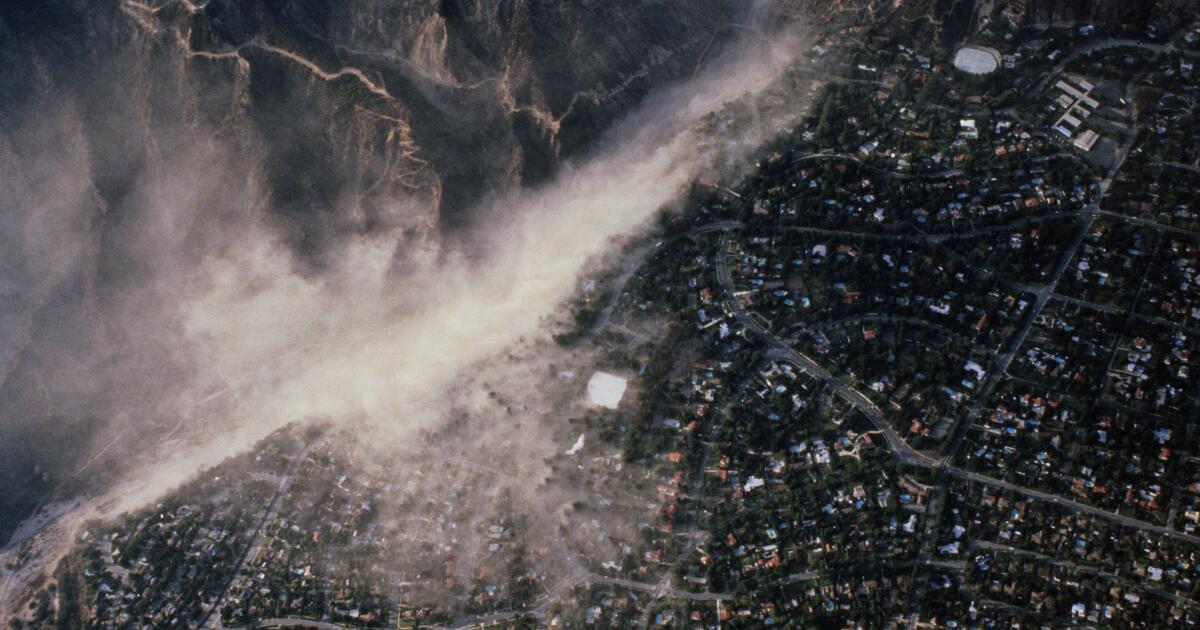
In the dead of night, the earth beneath Southern California buckled, shaking millions of people, damaging or destroying hundreds of buildings, breaking the California Aqueduct and sending more than a billion gallons of water flooding into an ancient desert lake bed.
That quake, a magnitude 6 centered near North Palm Springs, isn’t part of the tectonic pantheon that evokes the worst of California’s seismic fears — your Northridges, Loma Prietas or Sylmars. But while not as well known as some of its fault-busting brethren, the July 8, 1986, temblor kicked off a series of quakes that rattled Southern California for the better part of a decade.
It was the harbinger of the kind of seismic activity that younger millennials and Gen Zers have never experienced. California’s largest cities have been spared major destructive temblors over the last quarter century.
The lucky streak won’t last forever
“It’s a reminder that what a big chunk of the population has grown up with is not the long-term norm” for earthquake activity in California, said seismologist Lucy Jones, a Caltech research associate, in an interview.
And while California has made strides in earthquake safety — with some cities ordering retrofits of vulnerable buildings — progress has been uneven.
Los Angeles has ordered the retrofit of brick buildings, wooden apartments and brittle concrete buildings, but hasn’t required inspections of possibly vulnerable steel skyscrapers. Inland Empire cities in the path of the notorious San Andreas fault haven’t ordered the retrofit or demolition of old brick buildings, which could rain debris capable of crushing pedestrians, cars and buses with deadly force onto sidewalks and streets during shaking.
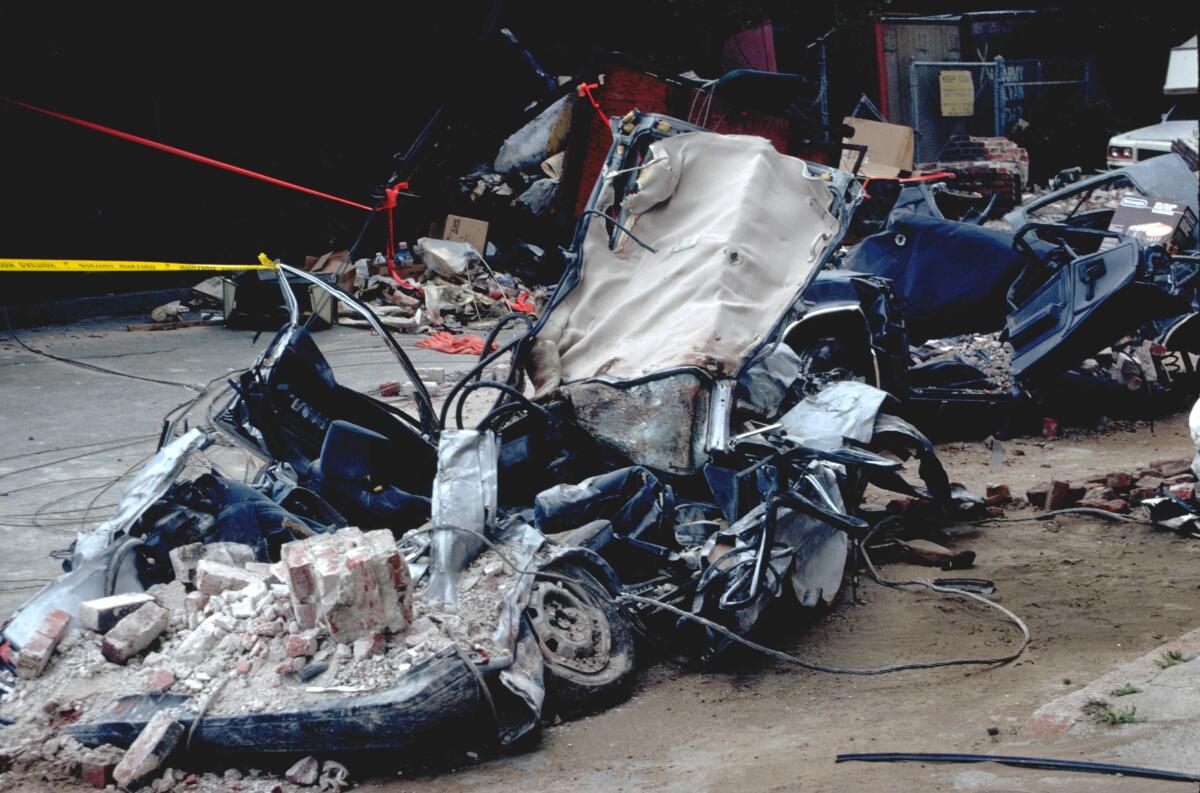
A partially collapsing brick building in San Francisco crushed cars during the magnitude 6.9 Loma Prieta earthquake. Five people died after the brick building’s fourth-story wall fell onto the parking lot below.
(C.E. Meyer / U.S. Geological Survey)
Given the uneven progress, scientists are getting ready to update the ShakeOut scenario — a projection of the devastation that would result from a plausible magnitude 7.8 earthquake on the San Andreas. When it was first released in 2008, researchers said a quake of that strength could kill more than 1,800 people, injure 50,000 others and cause $200 billion in damage.
“We’ve done a bunch of things — and they’ve made a difference,” Jones, the lead author of ShakeOut, said. “And there’s things we haven’t done. And what opportunities have we lost?”
Jones said she recently got some seed funding at her center — the Dr. Lucy Jones Center for Science and Society — to work on updating the ShakeOut scenario. It’s important, she said, because it’s been more than three decades since L.A.’s last destructive metro-area earthquake, and such a large natural disaster is not a matter of if, but when.
But whether the disaster becomes a catastrophe depends on the work done ahead of time.
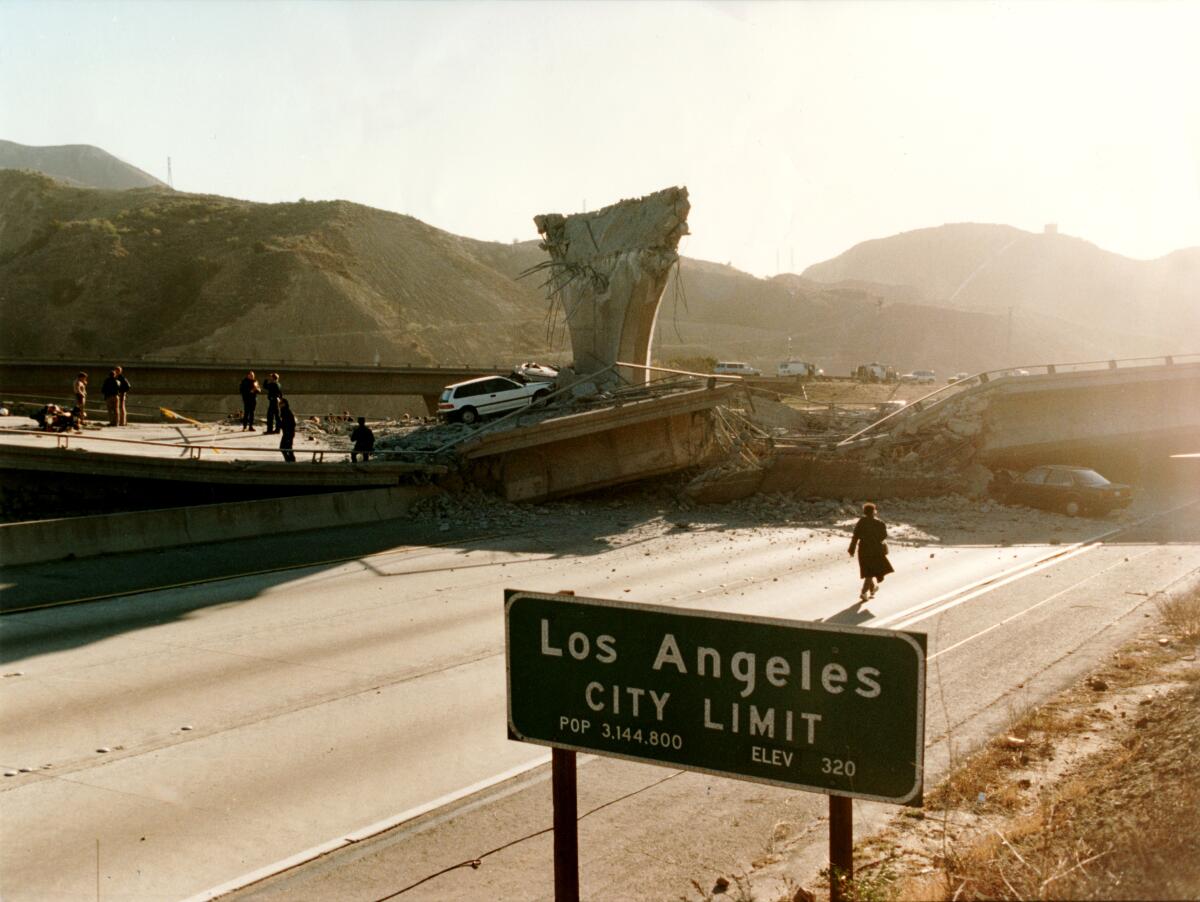
Freeways collapse during the 1994 Northridge earthquake.
(Steve Dykes / Los Angeles Times)
After all, as the ShakeOut report says, a catastrophe is “a disaster when a society is not prepared for the amount of disruption that occurs,” with the effects lasting for decades.
Shakeout 2.0, for instance, could contemplate the possibility of a magnitude 7.8 quake producing a massive urban fire 10 times as large as what burned in the Eaton and Palisades fires combined, Jones said.
Among the reasons why Southern California was seen as vulnerable, the report said in 2008, was a loss of water due to quake damage and the resulting inability of firefighters to extinguish blazes.
One plausible scenario envisions several simultaneous conflagrations in San Bernardino, Riverside, Santa Ana and South L.A. The scenario says the fires alone could kill nearly 900 people and cause $90 billion in property damage.
Such a huge fire footprint has massive public health implications, Jones said: “Imagine we’re putting out 10 times as much aerosolized lead and arsenic.”
California’s terrifying decade of earthquakes
Although California is known as earthquake country, it has fewer quakes on average than places such as Japan and New Zealand.
As a result, the dynamic and imperative around quake preparedness is “just a pretty different social equation” in the Golden State.
Still, California can get megaquakes. Quakes with a magnitude of 7.9 last hit Southern California in 1857 and Northern California in 1906.
Following the 1986 North Palm Springs earthquake, 1987 brought Los Angeles County its first major urban quake in 16 years: the magnitude 5.9 Whittier Narrows earthquake. It struck at 7:42 a.m. on Oct. 1, 1987, and left eight people dead — including a Cal State L.A. student crushed to death by a concrete slab from a parking garage, a construction worker buried alive in a shaft in the San Gabriel Mountains and a man who was thought to have been so frightened by the shaking that he jumped out his second-story apartment in Maywood.
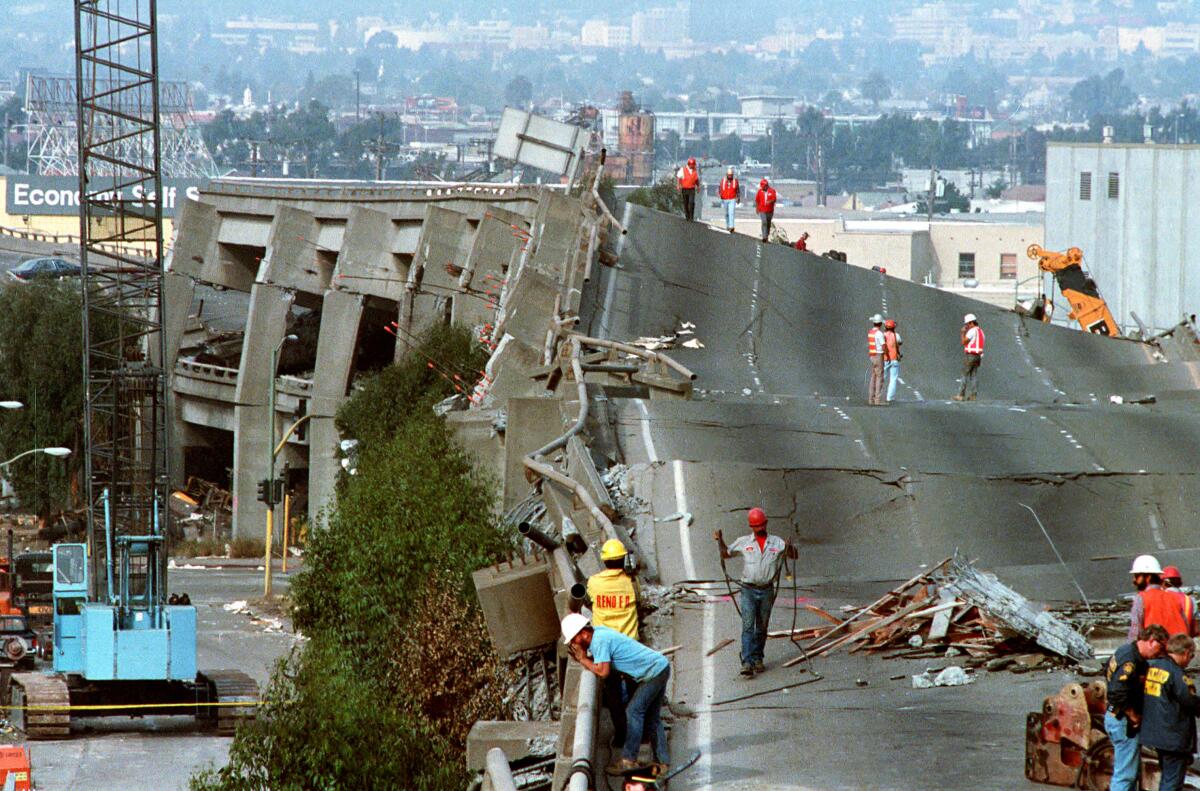
The upper deck of Interstate 880 in Oakland collapses on the lower deck, killing 42 people and injuring 108 others.
(Paul Sakuma / AP)
Even bigger and more destructive quakes followed. In 1989, the magnitude 6.9 Loma Prieta quake hit Northern California, killing 63 people and causing $6 billion in damage.
The pace continued in Southern California, leading up to a destructive finale. 1990 brought a magnitude 5.5 quake in Upland, followed by the magnitude 5.8 Sierra Madre quake that killed a woman at the Santa Anita racetrack June 28, 1991.
Exactly a year later, the magnitude 7.3 Landers earthquake, with an epicenter near Joshua Tree, killed a 3-year-old boy at a slumber party when the bricks from a nearby fireplace came crashing down. That temblor triggered a magnitude 6.5 Big Bear earthquake just three hours later, raising concerns that the San Andreas might be next.
Then came the magnitude 6.7 Northridge earthquake of 1994 that killed 60 people and caused an estimated $40 billion in damage.
Three earthquakes greater than magnitude 7 have shaken up Southern California in the last three decades: the magnitude 7.1 Hector Mine earthquake of 1999, the 2010 magnitude 7.2 Easter Sunday Baja California Sierra El Mayor earthquake and the magnitude 7.1 Ridgecrest earthquake of 2019.
The 2010 quake caused two deaths and damaged many buildings in the Mexicali area, and the Ridgecrest quake sequence damaged scores of homes and caused billions of dollars in damage to the nearby Naval Air Weapons Station in China Lake.
“It’s just they were all so far out in the desert it didn’t really have social impact” on places like metro Los Angeles, Jones said.
Read L.A. Times guides to preparing for earthquakes