
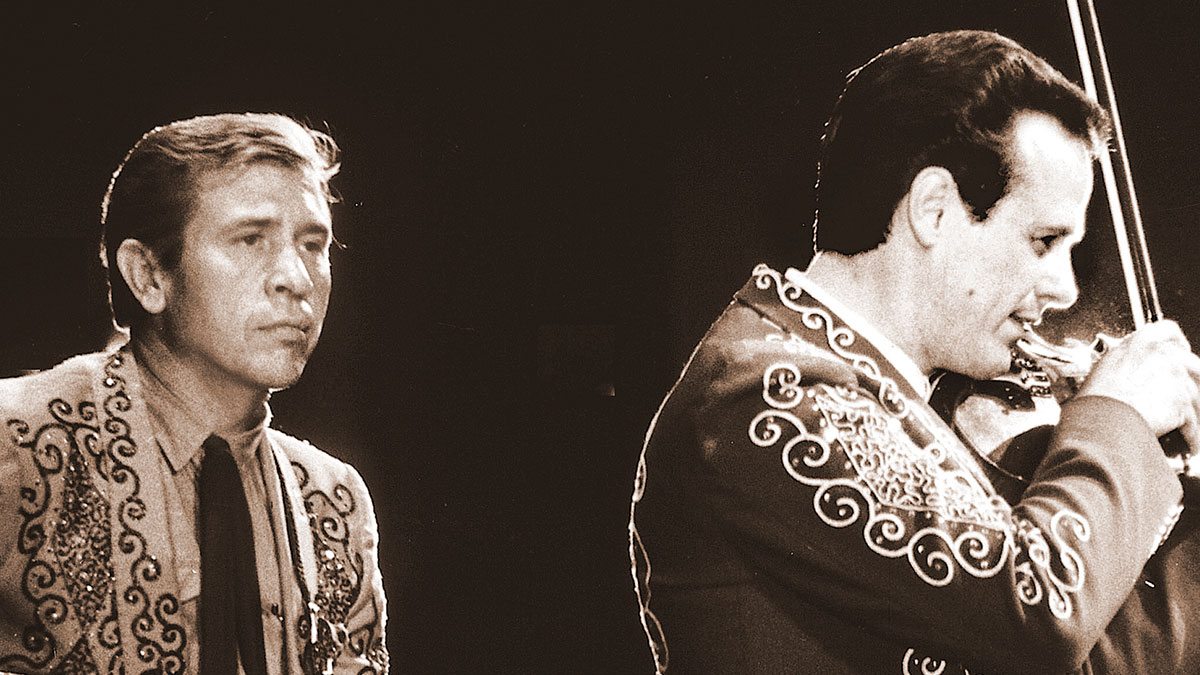
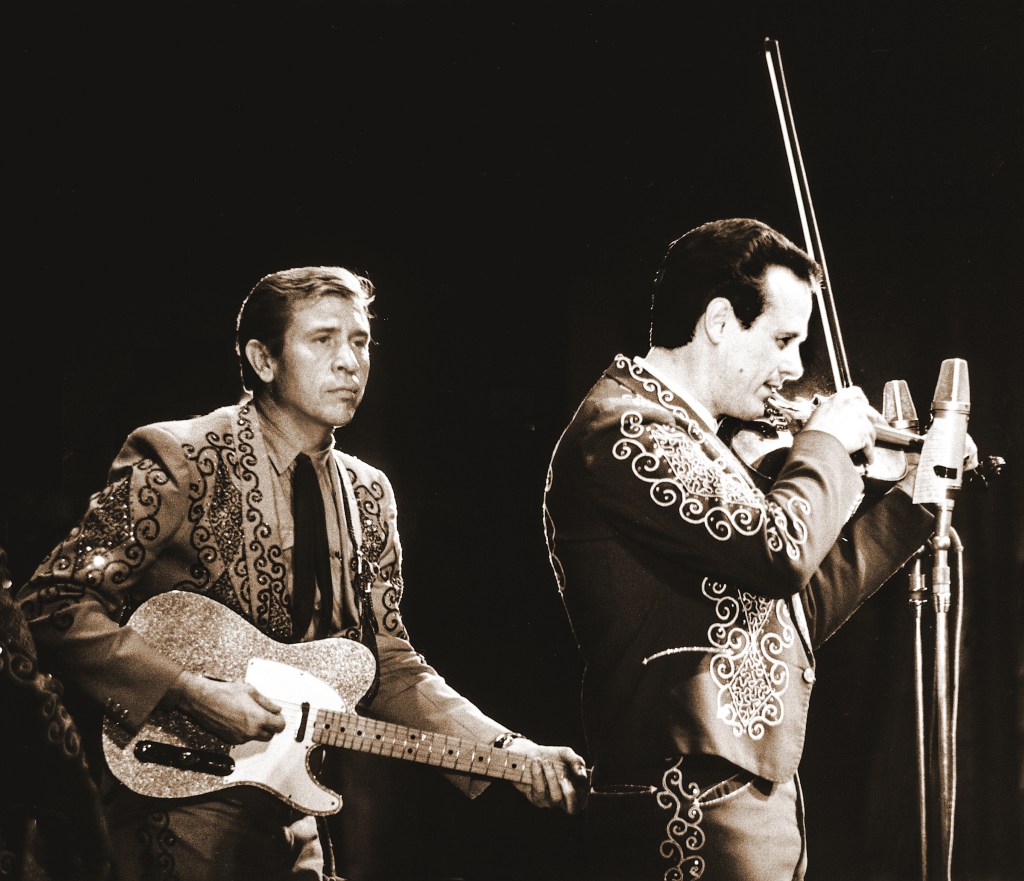
 Buck Owens photo courtesy of Buck Owens Productions.
In 1988, after I heard that Dwight Yoakam got Buck Owens to sit in at a concert in Bakersfield, I called Buck Owens Enterprises to request an interview with the man who’d stayed out of the spotlight since retiring from “Hee Haw” in ’86. That interview, which appeared in the February ’89 issue of Guitar Player, is one of my favorites. Blocking off an entire morning, the country megastar was candid, expansive, at times humorous, other times melancholy.
In the ’60s, Owens scored an astonishing 15 consecutive #1 singles (of 21 total), most of which he penned or co-wrote: “Act Naturally,” “Love’s Gonna Live Here,” “My Heart Skips a Beat,” “Together Again,” “I’ve Got a Tiger By the Tail,” the instrumental “Buckaroo,” and even a cover of “Johnny B. Goode.” In 1988, he climbed to the top spot again, dueting with Yoakam on “Streets Of Bakersfield.”
I simultaneously binged on the new three-disc boxed set of live material, Adios, Farewell, Goodbye, Good Luck, So Long: On Stage 1964-1974, and the 36-year-old magazine. Had he been hip to country-rock bands like the Flying Burrito Brothers and Poco?
“Let’s face it, I’ve always been a country-rock fan – ain’t no doubt about that. I love country, but I love rock and roll, too. I especially like good old, get-down, get-on-with-it rock and roll. Obviously, I recorded enough Chuck Berry songs for people to know what a Chuck Berry fan I am. If ‘Johnny B. Goode’ ain’t a country-rock song, what is? Listen to the lyrics.”
As for the Beatles, who covered “Act Naturally” in ’65, he said, “We played Rubber Soul and Revolver incessantly.”
Deciphering the Bakersfield sound he pioneered, Buck posited, “I think what really made the difference was that people like Merle Haggard and I, just like Dwight Yoakam, would take our own bands into the studio. I always had musicians who were good enough to play on the records.”
The most pivotal of his sidemen was Don Rich, who entered Buck’s orbit when the singer was working as a disc jockey in Tacoma, Washington.
“Don and I traveled around playing with house groups until about 1963, when we got the Buckaroos together,” he said. “We used to play four hours a night without stopping. I had a 1960 Ford Skyliner hardtop convertible, and with the top down, the luggage carrier was just big enough where one amplifier would fit. So we’d put my tweed Bassman with four 10” speakers in there, the guitar along one side, and the fiddle along the other. Don mainly played fiddle up until ’65. He loved the guitar, though. He took what I knew and improved on it, and went by me. Before long, Don was playing all the guitar, and I was just holding mine.”
Buck confirmed that Rich would sometimes drop his low E down to D for effect.
“Spontaneity was Don’s biggest thing,” he marveled. “To get him to play it again, you’d have to get him to understand what he did, because I don’t think he ever knew what he was going to play. That’s why it was so good – it sounded unrehearsed. To me, that’s what makes a great instrumentalist. When I play things, I have patterns that I start with, but I never really know what I’m going to play or how l’m going to play it.”
In 1974, Rich died in a motorcycle accident, just 32 years old.
“That was really tough on me. If it’s possible to be like a son, a brother, and a compadre, that’s what he was. From ’74 to ’79, l think I just did things out of shock. What the hell do you do when half of yourself is gone?”
Naming his own influences, Owens said, “I liked a lot of Bob Wills’ guitar players, and a great guitar player here on the West Coast, Jimmy Bryant – in fact, I did a lot of session work with him. Boy, what a technician. It wasn’t so much his speed as his execution and phrasing. Bob Wills was my biggest musical influence because of the musicianship I found in his records. He had good fiddle players and great guitar players. I always wanted a driving beat. For people to dance, music had to have a beat to it.”
Carving his own niche, he played a lot of instrumental polkas, as on 1968’s The Guitar Player and the live box. “I don’t know why I did that. They were fast, they were showy and flashy, and at the Blackboard Cafe, we used to play mambos, sambas, rhumbas, tangos, polkas – you name it. Somehow or another, the audience had the idea that if you play something very, very fast, it is very, very good. And very, very often it’s very, very bad,” he laughed.
Already cemented, Adios bolsters Rich’s position as one of country guitar’s greats. “All I ever wanted to do was be a honky-tonk singer, and do a rockabilly song if I wanted to,” Buck told me. “I like real music. If it’s country, I want it honky-tonk. I’m a honky-tonker.”
© 2025 Dan Forte; all rights reserved by the author.
This article originally appeared in VG’s October 2025 issue. All copyrights are by the author and Vintage Guitar magazine. Unauthorized replication or use is strictly prohibited.