
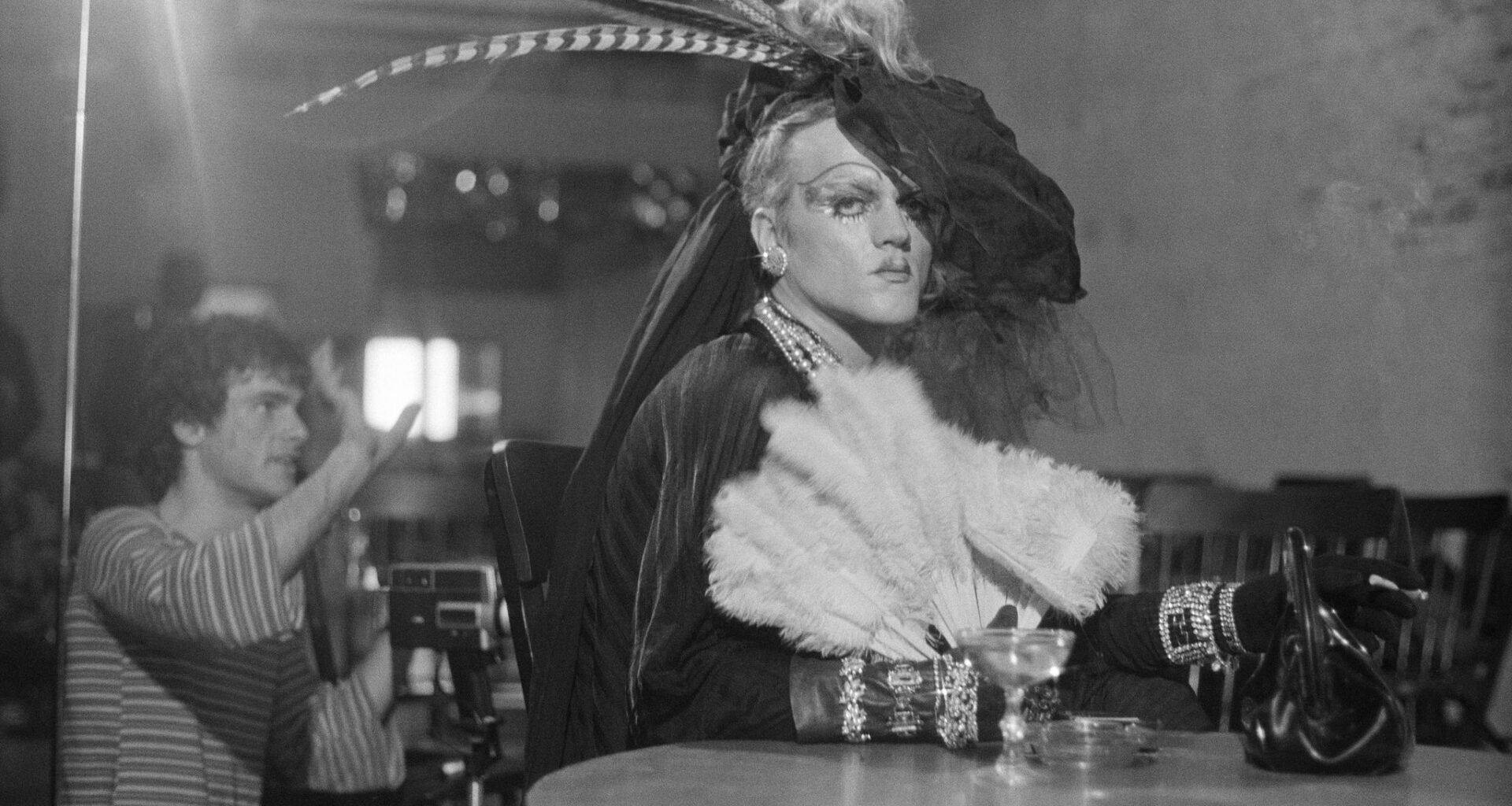
Marc Huestis, left, directs Lulu in his film “Unity” in 1977.
Courtesy of Daniel Nicoletta
There’s a strong case to be made that Frameline and its famous film festival were born out of Harvey Milk’s camera store.
Many of the Super 8 short films screened at the first festival were developed at Castro Camera, the future San Francisco supervisor and gay rights icon’s business, and Milk himself attended the historic first program. Called the Gay Film Festival of Super-8 Films at the time, the event took place on Feb. 9, 1977, at the Gay Community Center at 32 Page St.
An estimated 200 movie lovers crammed into a space with a capacity of 125.
Article continues below this ad
Now called the San Francisco International LGBTQ+ Film Festival, the 50th edition — which begins Wednesday, June 17, and runs through June 27 — is a world-renowned event that draws tens of thousands of ticket buyers, regularly fills venues seating 1,000 or more and brings a lot of history beyond its number of years.
This year, it returns to the Castro Theatre, which underwent a two-year renovation.
Frameline Senior Marketing and Communications Manager Court Ross, from left, lead programmer Kathleen Mullen, Publicity and Project Manager Kate Bove, and Executive Director Allegra Madsen attend the Season 2 premiere of the Netflix reality dating series “The Ultimatum: Queer Love” at Rikki’s sports bar in San Francisco in 2025.
Ariana Minolli Photography
Frameline is the city’s second oldest film festival, behind only the San Francisco International Film Festival, which recently hosted its 69th edition. As Frameline grew, it was a beacon of hope and community during the AIDS crisis of the 1980s, the epicenter of the New Queer Cinema movement of the 1990s and a place for celebration when the Supreme Court legalized same-sex marriage in 2015.
50th San Francisco International LGBTQ+ Film Festival: 7:30 p.m. Thursday, June 17. Through June 27. $30-$35 big nights and special events; $17.50-$19.50 regular pricing at the Roxie and Vogue theaters in San Francisco; the New Parkway Theater in Oakland and the Berkeley Art Museum’s Pacific Film Archive; $23-$25 regular pricing at the Castro Theatre. For more details, visit www.frameline.org.
Now, as it hits the half-century mark, it stands as a symbol of resilience at a time when government funding for the arts has been slashed and a new wave of homophobic resentment is openly encouraged by the second Trump administration.
Article continues below this ad
San Francisco Chronicle Logo
Make us a Preferred Source to get more of our news when you search.
Add Preferred Source
“I think we’re at a really pivotal moment in every aspect — culturally, politically, everything,” Frameline Executive Director Allegra Madsen told the Chronicle. “It’s really powerful to be able to mark this 50th anniversary and look at the trailblazers that have come before us in the queer community and the stories that we have told and how we’ve gotten them out in the world as the beginnings of a roadmap for how we push ourselves forward.
“If the mainstream isn’t going to accept us, we’re going to build the world ourselves.”
Call it the spirit of ’76. It was in the fall of America’s bicentennial year that a group of young amateur filmmakers, who regularly met to share resources and encouragement, came up with the idea of publicly showing their work.
The Gay Film Festival of Super-8 Films poster was designed by Silvana Nova in 1977. The festival would later become the San Francisco International LGBTQ+ Film Festival.
Frameline
The group was led by Marc Huestis, who hosted many of the meetings at his house near Castro and 18th streets; Danny Nicoletta and David Waggoner, who both worked at Castro Camera; and Ric Mears, who was instrumental in the Roxie Theater’s shift to art house exhibition earlier that year, among several others.
Article continues below this ad
“The response was terrific,” recalled Huestis, who screened three of his films in that first program. “We had to turn people away. They were all Super-8, nonsync-sound films, because we didn’t have the money to make sync-sound films. There were gay movies before that, like ‘The Boys in the Band’ (1970) and stuff very mainstream, and there were underground films, but there were never any films that came from out gay people with the gay boys that were together in one program.”
Nicoletta, who had lent his projector for the evening, recalled being embarrassed when his film broke mid-screening. But the crowd was supportive, the film was glued back together and the show went on.
“When I got to work the next day, they had taken one of those placards that had little bags of splicing tape that you could buy, and Harvey had scrawled in his script, ‘Danny Break a Splice,’” Nicoletta recalled.
Frameline co-founder Daniel Nicoletta at work in Castro Camera, Harvey Milk’s business.
Courtesy of Denton Smith
Over the next five years, the nonprofit Frameline would form — to become the nation’s oldest and largest LGBTQ+ media arts organization — and its namesake festival would move into theaters such as the Roxie and the Lumiere.
Article continues below this ad
But the turning point came when a San Francisco State University film student, Michael Lumpkin, answered a call for volunteers and ended up running the fourth festival, the first to show feature-length films.
Lumpkin led Frameline until 1990, helping transform the festival into an international event based at the 1,400-seat Castro Theatre. He also expanded its scope from a largely white male gay festival to include work by lesbian filmmakers, including the late Oakland director Barbara Hammer, and films that addressed interracial issues.
“I was doing what outreach I could do,” Lumpkin said. “In the early ’80s it was difficult to find out about gay films in other parts of the world, other parts of the country, to see what is out in the world and try to get them to Frameline in June.”
The so-called lesbian riot, in which women stormed the Roxie projection booth in 1986 to protest programming, led to some of the changes, which included the creation of a completion fund for underserved filmmakers and elevating women to decision-making positions at Frameline.
Comedian and actor Margaret Cho, left, stands with San Francisco International Lesbian and Gay Film Festival founder Michael Lumpkin at the opening party in 2007.
Mike Kepka/S.F. Chronicle
Lumpkin left in 1990 to co-produce San Francisco filmmakers Rob Epstein and Jeffrey Friedman’s landmark 1995 documentary “The Celluloid Closet,” about Hollywood’s depiction of homosexuality, based on Vito Russo’s 1981 book. (He would return to lead Frameline again in 1996-2008.)
Article continues below this ad
By then, the table was set for a transformational era of LGBTQ+ filmmaking.
Just as a new group of independent low-budget filmmakers such as Steven Soderbergh, Quentin Tarantino and Richard Linklater were discovered at the Sundance Film Festival, the early 1990s also saw a rise in queer filmmaking that captivated art house audiences.
Todd Haynes’ “Poison” (1991), Rose Troche’s “Go Fish” (1994), Maria Maggenti’s “The Incredibly True Adventure of Two Girls in Love” (1995) and Oakland filmmaker Cheryl Dunye’s “The Watermelon Woman” (1996) were just some of the films that made Frameline the Cannes Film Festival of queer cinema.
“The Watermelon Woman” star Lisa Marie Bronson, left, is teased by actor and director Cheryl Dunye at the Castro Theatre on opening night 1996.
Liz Hafalia/S.F. Chronicle
“There was more programming of films by and about people of color and a new emphasis on all of the diversity that we see today in the festival,” said longtime Bay Area filmmaker Jenni Olson, who was lured from running a gay film festival in Minneapolis to become a Frameline festival co-programmer in 1992.
Olson, who has curated a program of her favorite short films from the 1990s and 2000s for the 50th festival, recalls her first visit to the festival in 1989, when she was scouting for films to program in Minneapolis.
“I was relatively young and not super experienced, and I was so excited to be here in San Francisco, the gay mecca,” Olson said. “My most vivid memory was Saturday morning, after opening night, going to the Castro for the ‘Fun in Girls Shorts’ program. I was like, ‘Oh, my God, there’s 1,400 lesbians in the Castro Theatre. I have arrived! This is incredible.’”
The 50th festival pays tribute to its evolution with several blasts from the past. Aside from Olson’s shorts program, retrospective screenings include Donna Deitch’s “Desert Hearts” (1986), Jennie Livingston’s “Paris Is Burning” (1990) and Lana and Lilly Wachowski’s “Bound” (1996).
The San Francisco International Gay and Lesbian Film Festival opening night reception at the Castro Theatre in June 1993.
Liz Hafalia/S.F. Chronicle
There is also a new documentary, Brydie O’Connor’s “Barbara Forever,” which celebrates Hammer and her groundbreaking films, and a clip-filled presentation by Peter Stein titled “San Francisco on the Queer Screen: 50+ Years of Gay by the Bay.”
But Frameline 50 is also an event rooted firmly in the present and looking toward the future.
Its adventurous programming includes the Australian young adult streaming series “Invisible Boys” and cutting edge filmmaker Jane Schoenbrun’s latest genre mashup “Teenage Sex and Death at Camp Miasma,” the closing night film that made a big splash at Cannes.
“There is a lot of momentum and wind in our sails right now,” Madsen said. “Our stories are more important than they have ever been in my lifetime. Frameline really believes passionately in the power of our queer stories to shape the future that we need.”