
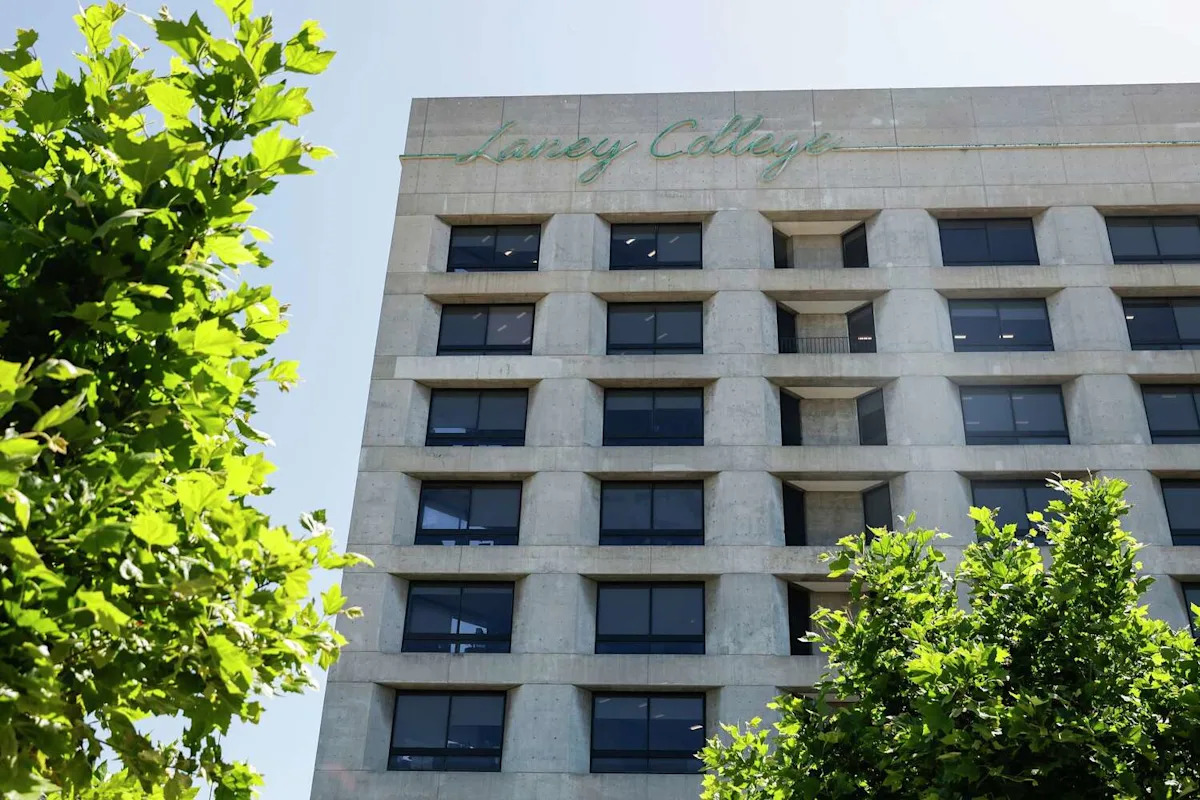
Laney and Merritt colleges, the two largest schools in the East Bay’s Peralta Community College District, will merge next year and become “Oakland City College” as part of a massive transformation aimed at halting a steep dropout rate among students enrolled across dozens of degree programs.
By fall 2027, the sprawling four-school Peralta college district of about 16,000 students is expected to become three schools – Oakland City College, Berkeley City College and the College of Alameda – under the efficiency plan endorsed Tuesday night by the district’s Board of Trustees.
Peralta’s Chancellor Tammeil Gilkerson described a districtwide metamorphosis with a new focus on getting students to finish school. The plan adds more evening, weekend and online classes, as well as streamlined enrollment systems for all students – including those who want to take college classes while still in high school, she told the trustees.
Gilkerson first presented the idea for the merged Oakland City College a year ago and said the overall concept has since been developed and refined by committees of faculty, staff and students.
“We can’t continue to ask students to absorb the consequences of our financial and organizational challenges,” Gilkerson told the trustees, noting that the Peralta district has traditionally responded to declining enrollment and fiscal emergencies by slashing its budget – cutting nearly $28 million in recent years – and putting out fires as they arise without a comprehensive improvement plan.
But that isn’t working, she said. “We can’t reduce our way forward.”
Merging Laney and Merritt colleges will eliminate redundant administrative services and courses, she said. Neither is expected to close, but will become campuses of the new Oakland City College. In addition, establishing “clear, coordinated onboarding across all campuses, aligning schedules and access to high-demand courses” will allow the district to focus on getting students to graduate.
Vice Chancellor Tina Vasconcellos offered the shocking statistic that 90% of Peralta students enrolled in a subset of degree programs neither completed their associate’s degree nor transferred to a four-year college.
Vasconcellos discovered the dropout rate when she studied 26 degree programs that were duplicated across the college district.
“It was really hard to look at,” she said, noting that she hadn’t realized the problem until she immersed herself in the data of the overlapping programs.
Not everyone approves of the plan. A petition opposing the merger gathered more than 200 signatures in just two days, and several of the signers urged the trustees to reject the Oakland City College idea – at least for now – including the petition’s author, Merritt College bioscience professor Gisele Giorgi.
“The current merger proposal is fiscally unsound and would result in a funding loss of $3 million to $12 million every year,” Giorgi testified. (The district’s administration disputes these figures and says the plan will save the district money but has provided no specifics.)
And despite the chancellor’s claim that administrators have consulted widely with faculty, staff and students over the past year, Giorgi told the trustees, it hasn’t been enough.
“We cannot let this happen to our beloved Merritt and Laney colleges,” she said. “We are asking for another year of decision-making and planning.”
Some speakers pointed to Merritt College’s historic role in the founding of the Black Panther Party as a reason to preserve the school as a discrete campus.
In 1966, two Merritt College students, Huey Newton and Bobby Seale, typed up the “Black Panther Party 10-point program” that would form the basis of their movement, including freedom, housing, education, employment and “an immediate end to police brutality and murder of black people” in their demands.
Merritt students also created the first Black Studies curriculum in the country, urged the hiring of Black faculty and stopped the college from being moved from the flatlands of North Oakland to the largely white East Oakland hills in the 1970s.
Both in Oakland, Merritt is at 12500 Campus Dr., and Laney College is at 900 Fallon St.
Instead of merging the schools, “we should be fighting together for increased state apportionment, not cannibalizing what we have,” said Isela Gonzalez Santana, a Merritt College English instructor.
Johnnie Williams, a Laney College computer science professor, faulted the trustees for voting on the merger after the spring semester ended and “everyone’s on vacation.”
He urged the trustees to wait another year because, he said, the plan’s “details are not clear. To me, that’s a gamble. I don’t know if it’s right or wrong, but I know it’s wrong right now.”
The board voted 4-to-2 to endorse the chancellor’s transformation plan.
Against the plan were trustees Sheweet Yohannes, who said she was persuaded by Merritt’s Black Panther history and by opponents who said they did not have enough information to support merging the colleges, and Paulina Gonzalez-Brito, who said vulnerable students “can get hurt in times of change.”
But trustee Cindi Napoli-Abella Reiss, who voted for the plan, said the transformation was critical.
“We’re essentially stabilizing the finances to repair the institution,” she said. “If, let’s say, we don’t grow our enrollment as much as we’d like to in three or four years, we’ll be in a much better place to deal with it organizationally and fiscally.”
Nicky Gonzalez Yuen, another trustee, said he had been through numerous efforts to rescue the district, but that this was different.
“This is not just a merger, but a holistic plan meant to address widespread dysfunction,” he said. “For people who have spoken against this and signed petitions, I urge you to go look at the minutes. Dozens of people representing wide constituency groups, many of whom have complained for years (about being ignored), are now putting in a ton of work.
“As for merging the two colleges, I don’t think we’re undoing history,” Gonzalez Yuen said. “I think the radical and progressive parts don’t go away by merging two colleges. And there’s a kind of honor in calling it Oakland City College. For me, it’s exciting.”
Trustee Bill Withrow was absent.
Subscribe
There’s more to San Francisco with the Chronicle. Subscribe today for just 25¢.
This article originally published at Oakland’s two largest community colleges are merging – and not everyone is happy.