
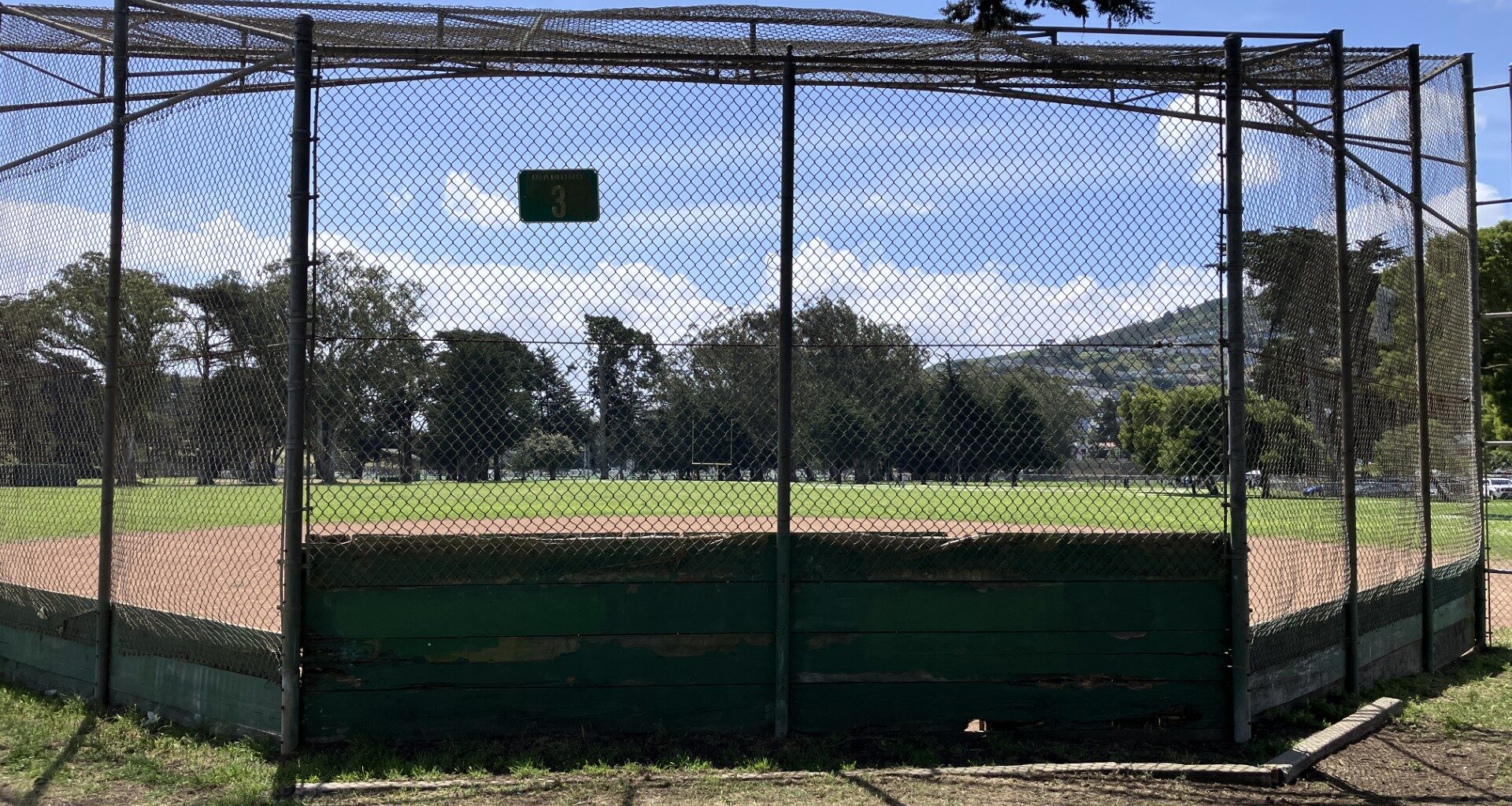
Baseball diamonds at Crocker Amazon Playground will be renovated under plans to create a youth sports facility at the San Francisco park.
Sam Whiting/S.F. Chronicle
With school letting out for summer, San Francisco families and thousands of youth are looking forward to spending more time playing sports, staying active and simply being kids. But one major obstacle stands in the way: The city does not have enough safe, reliable athletic fields to meet the needs of its young people.
I know firsthand the impact youth sports can have. I am the president of the San Francisco Little League, a full-time volunteer for the organization and the parent of a 13-year-old child who participates in school and recreational sports throughout San Francisco. Each year, from February through November, San Francisco Little League welcomes over 1,500 youth from every neighborhood, background and ability level to play baseball, umpire games and volunteer in our league.
Sports like baseball help young people build confidence, resilience, friendships and leadership skills. Youth who participate in sports experience improved physical and mental health, stronger self-esteem, improved social and interpersonal skills, higher academic performance and better school attendance, studies have shown. Those opportunities depend on having spaces where kids can consistently practice, compete and build community.
Article continues below this ad
San Francisco is recognized nationally for the strength of its public parks system. The 2025 ParkScore Index, an annual ranking of park systems in the 100 largest U.S. cities produced by the nonprofit Trust for Public Land, evaluates different amenities and scores cities relative to other major U.S. cities. The ParkScore ranked San Francisco sixth overall among major U.S. cities, scoring 80 out of 100, with top marks for park access and investment.
Unfortunately, the ParkScore Index found that San Francisco has one of the lowest supplies of athletic fields among major U.S. cities relative to population demand. Athletic fields and baseball diamonds received the city’s lowest amenities score, just 7 out of 100, reflecting a citywide average of only 1.28 athletic fields per 10,000 residents. By comparison, San Francisco’s dog parks scored 100 out of 100 points, compared to other major U.S. cities.
San Francisco Chronicle Logo
Make us a Preferred Source to get more of our news when you search.
Add Preferred Source
Unfortunately, conditions at the Crocker Amazon Playground baseball fields reflect those low rankings. The fields are riddled with gopher holes and frequently become unplayable following routine rainfall due to poor drainage and saturated conditions. Weather-related closures alone forced the fields to shut down for 37 days during Spring 2023 (31% of the playing season) and 57 days during Spring 2024 (48% of the playing season). Natural grass fields simply cannot withstand the level of consistent use these diamonds receive from our organization and the 28 other local baseball and softball organizations that rely on them.
Given the volume of year-round use and limited maintenance resources available to the city, synthetic turf is the most practical solution that can safely and sustainably meet the kids’ and community’s needs. Synthetic turf will dramatically increase field availability, save millions of gallons of water annually, reduce weather-related closures and lower maintenance demands. Most importantly, upgrading these fields will ensure that thousands of San Francisco youth have reliable access to high-quality baseball and softball facilities year-round.
Article continues below this ad
The health concerns expressed by some in the community over the use of synthetic turf are simply overblown. The main studies they cite focus on older-generation fields that use crumb rubber infill made from recycled tires. But the proposed fields would use the latest generation of synthetic turf with a cork-and-sand infill system rather than crumb rubber. California’s Office of Environmental Health Hazard Assessment recently completed a multiyear study focused on crumb rubber fields and found no significant health risks under typical use conditions. The San Francisco Recreation and Park Department has adopted an updated synthetic turf policy requiring natural infill materials, third-party testing for environmental contaminants, including forever chemicals known as PFAS and heavy metals, and ongoing coordination with public health and environmental regulatory agencies.
The synthetic turf soccer fields at Crocker Amazon also give us an example of the impact that results when we upgrade. Before they were renovated in 2008, they faced many of the same challenges these baseball diamonds face today. After 15 years of reliable play for youth leagues and community members, the soccer fields were renovated again in 2023 with the cork-and-sand infill system that reflects the city’s current standards for synthetic turf. Today, they remain among the most active and heavily used fields in the city.
Guest opinions in Open Forum and Insight are produced by writers with expertise, personal experience or original insights on a subject of interest to our readers. Their views do not necessarily reflect the opinion of The Chronicle editorial board, which is committed to providing a diversity of ideas to our readership.
Read more about our transparency and ethics policies
Beyond the fields, the revitalized Crocker Amazon sports complex will create a safer and more welcoming community space for families and neighbors. The plans include upgraded lighting, expanded walking paths, community gathering areas, a new dog park, additional parking and accessibility improvements designed to better serve families and residents across the neighborhood.
On behalf of the children and families who play, umpire and volunteer with San Francisco Little League, I want to thank the Giants and the Giants Community Fund for their generosity and commitment to our community. Partnerships like this are investments in the future of our city and in the well-being of future generations of San Franciscans.
Article continues below this ad
Kath Gillespie is president of the San Francisco Little League