
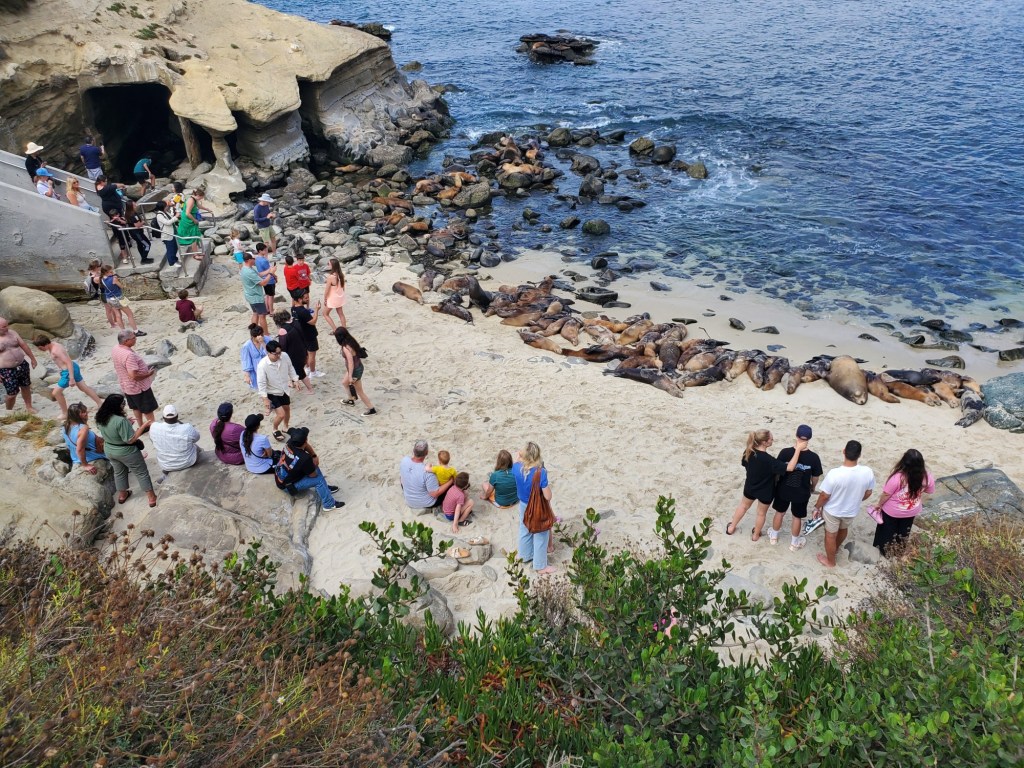
In its continuing efforts to keep people and sea lions apart at La Jolla Cove, the city of San Diego is leaning into a public education campaign. That has meant increased ranger presence, new signs and even the use of drones for data collection that could influence future steps.
Representatives of the city and the Sierra Club Seal Society spoke at the June 10 California Coastal Commission meeting about management strategies that have been implemented at La Jolla Cove to minimize human interactions with sea lions. The item was information only and no vote was taken.
“The city’s preference is always to lead with education and voluntary compliance where possible,” said San Diego Parks & Recreation Director Andy Field.
He said the city’s objectives are to protect marine wildlife and public safety and preserve coastal access.
“One of the most important points we want to emphasize is … the [intent that] La Jolla Cove remains open to the public year-round,” Field said. “While Point La Jolla next door remains closed, The Cove continues to provide coastal access and supports a wide range of recreational activities, including … wildlife viewing.”
The Cove attracts more than 3 million visitors annually and is “recognized around the world as one of Southern California’s premier coastal destinations,” Field added. “At the same time, it sits within a marine protected area known for its biodiversity and abundant marine wildlife. Therefore, the success of management efforts at La Jolla Cove has implications not only for locals but for the millions of people … that come to experience this unique resource.”
Ranger staffing
With the city’s shoreline ranger program now “fully staffed” with eight rangers at The Cove daily (with increased staffing on weekends and/or holidays), Field said “We are seeing a greater opportunity for education, enforcement and proactive visitor engagement.”
He said the city uses the National Oceanic and Atmospheric Administration’s “Share the Shore” framework, which provides “simple but effective [guidance] for responsible wildlife viewing.” Its messaging includes “keep your distance,” “recognize signs of animal distress,” “keep pets away from wildlife,” “leave pups alone” and “never feed or harass marine wildlife.”
Many of the city’s public outreach efforts have centered on those principles and been conveyed through signs and rangers. But, Field said, “we have seen that education has been most effective when there is a consistent presence onsite.”
Full staffing enables rangers to “engage visitors before issues arise,” said Field, who added that rangers serve as “educators, ambassadors, resource stewards and public safety professionals.”
Their interactions with visitors focus on safe enjoyment of the area “while respecting the marine wildlife and the surrounding environment,” he said.
Field said the rangers have conducted “substantially more interactions” with Cove-goers since being fully staffed and that the city expects “a lot more [engagement] as we enter the busy summer months.”
Thus far, he said, “we are seeing positive results, which is really exciting.”
Rangers also are working with tour bus operators to educate riders so “they arrive informed and prepared before entering The Cove itself,” Field said.
Those interactions, he said, “often prove to be the most cost-effective tool available to us.”
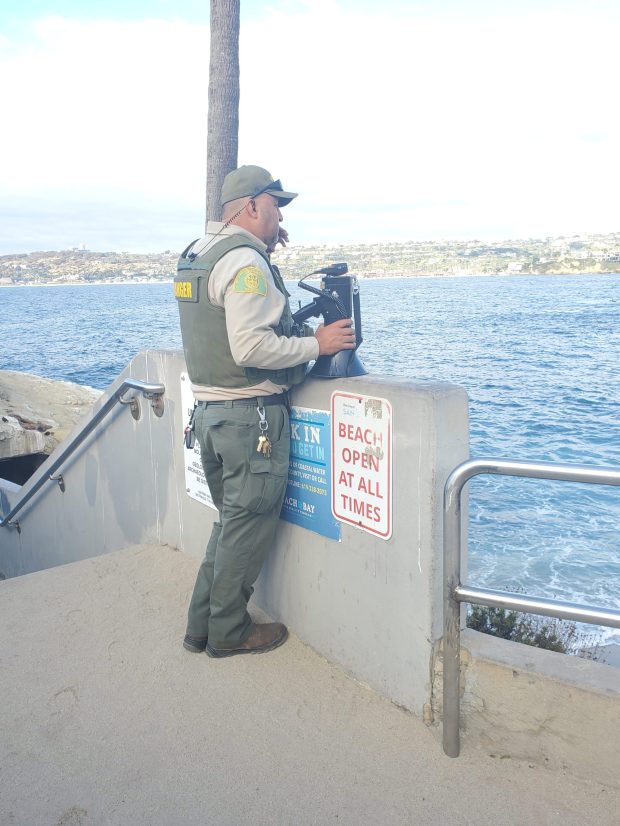 A ranger stationed at La Jolla Cove carries a megaphone to warn beach-goers to stay away from sea lions. (Ashley Mackin-Solomon)
Signs and cones
Field also touted the use of new signs and the occasional use of cones at The Cove to help guide people who visit the area.
“These tools are intended primarily as education and visual cues rather than creating barriers,” he said. They are meant to “provide a buffer between visitors and vulnerable [sea lion] pups.”
Rangers place cones on the beach based on the location of pups, the visitor crowd size, the tides and other factors.
He said the new signs communicate needed information in multiple languages.
Field said the efforts would not be possible without the city’s “exceptional partnership” with the Seal Society.
Robyn Davidoff, the group’s president, said volunteers are onsite 40 hours a week to help educate the public at Point La Jolla and La Jolla Cove.
“The Seal Society has collaborated with the Parks & Recreation Department … to learn about management practices [that allow] visitors and pinnipeds to share the shore,” Davidoff said. “It’s important to note that La Jolla hosts the only sea lion breeding area on the coast of California and is in a very urban area, making it more challenging than other areas to manage.”
She said the goal of the effort is to maintain public access year-round while “implementing crowd management techniques.”
“It … will take some time and experience to execute, but we have made great strides,” Davidoff said.
Drones and docents
Davidoff said the Seal Society is working on a drone monitoring and data collection project and taking steps to increase the authority of its docents.
Last year, the group consulted with the city and the California Department of Fish & Wildlife to obtain a permit to fly “a special low-noise, wildlife-safe drone” over the ocean to collect data on seals and sea lions on the coast.
In January, the Seal Society worked with Microsoft to “fine-tune an AI model that is also used by NOAA to quickly count sea lions and seals, which is not an easy task when you are trying to do it by hand,” Davidoff said.
After refining the model to not count things such as rocks and large birds, “we have reduced the time it takes to process a day’s worth of photographs from one volunteer hour to 15 minutes,” she said. “The data is used to study how seal lions and seals use their breeding and surrounding areas throughout the year, as well as if the population is changing.”
She said Seal Society members also are “exploring a more formal relationship” in which docents are trained as city volunteers. In such cases, docents could be authorized to place or move cones under the direction of rangers.
Commissioner comments
During Coastal Commission comments, member Caryl Hart expressed appreciation for the collaboration between the Parks & Recreation Department and the Seal Society and “everything the city has been doing. I know it’s been a challenging situation.”
When she inquired about enforcement at night, Field said the city currently does not have a program for night enforcement and that “we would need to figure out” overnight operations.
“[It] might be something to consider down the road if this turns out to be a significant problem,” Hart said.
The city would have to apply for a permit for such a program. ♦