

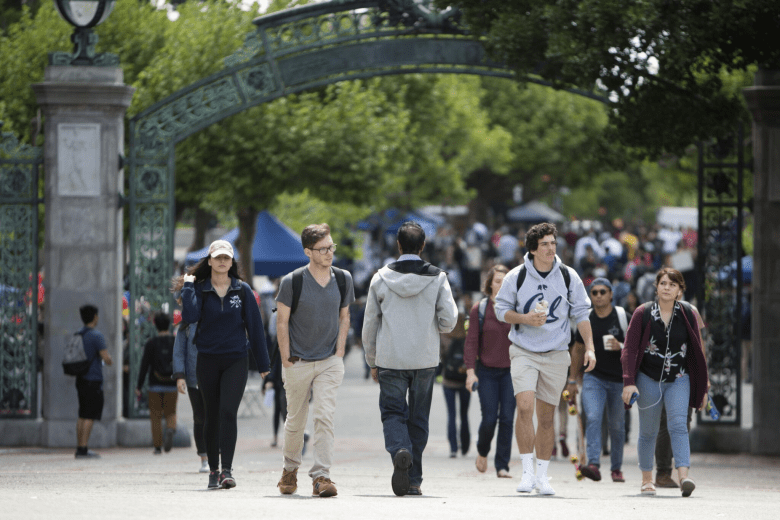
 UC Berkeley students stroll around campus near the landmark Sather Gate. Credit: Alison Yin/EdSource
A University of California committee will formally consider whether to require standardized exams such as the SAT and ACT in freshman admissions, UC’s Academic Senate announced Thursday.
UC’s Board of Admissions and Relations with Schools, the committee that oversees undergraduate admissions matters, is creating a faculty work group that will examine the potential advantages and disadvantages of using SAT and ACT scores in admissions. They will also investigate the possibility of using 11th grade Smarter Balanced scores. The Smarter Balanced assessment is California’s annual exam administered in grades 3-8 and 11.
The committee will consist mostly of faculty but will also include representatives from UC’s systemwide president’s office and the California State Board of Education, plus two additional UC staff members with relevant expertise, such as a campus-level admissions director.
Any proposed changes would have to be approved by UC’s Board of Regents.
The review comes as some UC faculty have complained that too many first-year students are unprepared for college-level math. More than 1,400 faculty have signed an open letter calling for UC to reinstate the SAT and ACT as an admissions requirement for students in science, technology, engineering and math programs.
UC in 2020 stopped requiring the SAT and ACT in admissions. Calls to reinstate the tests are not unanimous among faculty. Other faculty members are against the idea, saying that the exams are biased against low-income students and that it’s up to high schools to better prepare students.
“I know we want every student admitted to UC to make the most of their college education. Our responsibility is to ensure that our policies and practices make that possible,” Academic Senate Chair Ahmet Palazoglu wrote in a letter Thursday to Senate faculty.
If math faculty are successful in their push to reinstate the SAT, the fall 2028 admission cycle is the earliest it would take effect.
Other top universities have already reinstated the SAT and ACT as admissions requirements, reversing prior policies that made the exams optional. That includes Caltech, Stanford and several Ivy League universities.
‘No objective measure’
About a dozen first-year UC Berkeley students gathered one afternoon last fall inside a classroom in Evans Hall, where math professor Zvezdelina Stankova held office hours for one of her calculus sections.
The students came for calculus help but struggled to answer a middle-school level algebra problem: solving for x from the equation 7x – 5 = 9.
“I told everyone to drop their pens and watch,” Stankova said. “We had to go through it step by step.”
Across the University of California, math faculty say they are increasingly teaching first-year students who are unprepared for college-level math and unable to survive coursework for UC’s rigorous science and math majors.
In April, most of the UC system’s math department chairs and vice chairs convened at UC Davis to discuss the math preparation dilemma.
For months, they and other faculty had been debating a report from a UC San Diego committee that found “a steep decline in the academic preparation” of first-year students, especially in math. The report revealed that, in fall 2025, about 1 in 8 incoming UC San Diego freshmen had math skills below high school level, according to their results on a placement exam administered by the campus.
At UC Davis, the faculty had a spirited discussion about standardized exams, Bruno Nachtergaele, chair of the UC Davis math department, said. A majority agreed they wanted tests reinstated as an admissions requirement. That view was not unanimous, Nachtergaele said, so they held off taking action.
Several weeks later, the group of five UC Berkeley professors took it upon themselves to write the open letter calling for the return of a test requirement for freshman STEM applicants. As of Monday, 1,427 faculty had signed the letter, including seven of UC’s nine math department chairs.
Faculty argue that other key admissions criteria don’t provide enough information about students’ preparedness. Grade inflation makes it more difficult to put stock in a student’s grade point average, and the proliferation of artificial intelligence means they can’t trust that applicants are writing their own essays.
“So with that, there is no objective measure for math readiness,” Stankova said.
‘Trying to create a narrative’
Others are not sure standardized testing is the solution.
Test opponents point to a fall 2025 report authored by Saul Geiser, a senior researcher at UC Berkeley’s Center for Studies in Higher Education. The report found that grades were a stronger predictor than test scores of first-year success at Ivy League and other elite colleges, and that ranking applicants by SAT scores disadvantages Black, Latino, low-income and first-generation students.
Geiser’s report also noted that UC has enrolled more Black, Latino and low-income students since the system stopped requiring the exams.
“All it will do is keep students out of mathematics, and it may push some students, especially underrepresented students, out of the UC system,” said Bjorn Birnir, a math professor and chair of the math department at UC Santa Barbara.
Birnir was one of two UC math department chairs who opted not to sign the open letter. He discussed the issue with his department’s undergraduate committee. A majority of faculty on the committee opposed signing the letter.
“We think the problem needs to be addressed in high schools, and they need to make a real effort to make sure their students learn at least some mathematics,” he said.
Some critics also question whether math preparation is as bad as the UC San Diego report claims.
The report pointed out that, in 2024, the number of students placed in one of UC San Diego’s lowest math courses — Math 2 and Math 3B — increased from 490 to 916 students. But that same year, the campus stopped allowing students to use calculators for their placement exams. Also that year, the campus changed the criteria for placing students into a higher level of math, meaning that “many of the students who previously would have been placed into Math 3C were instead placed into Math 3B,” according to UC San Diego’s math department.
Additionally, freshmen at the campus are still doing well enough that they aren’t dropping out. UC San Diego’s first-year retention rate for STEM majors was just over 95% last year, the same level as it was prior to elimination of the SAT.
“It strikes me as being a little bit of a campaign here. I think they’re trying to create a narrative,” said Harry Feder, executive director of FairTest, an organization that opposes high-stakes standardized exams.
Addressing math unpreparedness
Even if the San Diego report overstated the problem, most educators and advocates agree that preparedness has declined in recent years, especially since the pandemic.
At Berkeley, a study found that, as of 2023, nearly one-third of first-semester calculus students displayed “severe preparation deficits.” At UC Davis, the number of students needing to start in a precalculus class has quadrupled over the past five years, Nachtergaele estimated. And at UC Santa Barbara, about 10% of incoming STEM majors are unprepared for calculus, Birnir said.
“It’s been an issue for a long time, but it’s definitely getting worse,” Birnir added.
When admitted STEM majors at UC Santa Barbara aren’t ready for calculus, staff encourage them to take a precalculus course at Santa Barbara City College during the summer before their first term on campus.
For most students, that solves the problem, Birnir said.
UC Davis, meanwhile, is making changes to its own precalculus offerings.
Davis, which operates on the quarter system with 10-week terms, currently offers a single 10-week precalculus class for students who aren’t ready for calculus. Starting next year, the campus plans to add a second quarter of precalculus for students who need more time to learn the material, according to Nachtergaele.
But for some students, Nachtergaele expects that an extra quarter of precalculus still won’t be enough. That’s why he is in favor of bringing standardized tests back to admissions.
“There are certainly issues with it, like with anything in education,” he said. “But I think a reasonable way to alleviate the situation is to reinstate the tests.”
Berkeleyside is a media partner of EdSource, a nonprofit newsroom dedicated to providing analysis on key education issues across California. Berkeleyside occasionally republishes EdSource stories we believe will be of interest to our readers.
“*” indicates required fields