

The city of San Diego plans to bring back spraying to help mitigate odors at La Jolla Cove, but the method is raising some alarm.
An application filed in early June by the San Diego Parks & Recreation Department seeks a coastal development permit from the city to “abate noxious odors where accumulated bird and sea lion excrement pose a health hazard to the public.”
The area covers about 2,180 square feet of the bluffs overlooking La Jolla Cove north of Coast Boulevard.
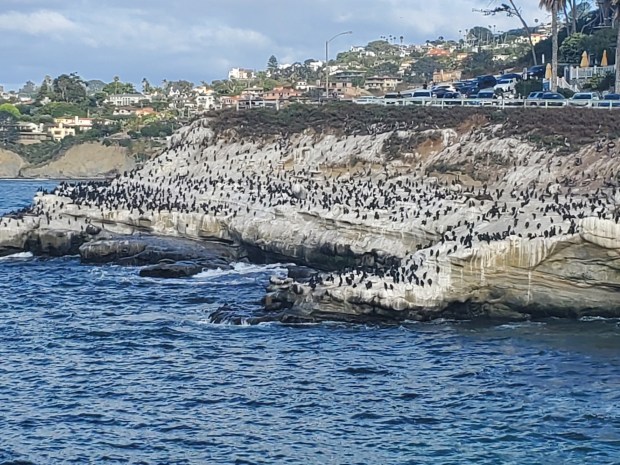 Seabirds flock to the bluffs near La Jolla Cove. (Ashley Mackin-Solomon)
The city intends to spray a non-pathogenic bacterial agent onto the bluffs to effectively “eat” the animal waste. The product, BIOCAAC (Bioactive Odor Counteractant and Cleaner), is from Coronado-based Ark Environmental Solutions.
Representatives of Ark could not immediately be reached for comment.
“BIOCAAC is a water-based blend of cultured, non-pathogenic bacteria and surfactant, similar to those in household soaps, which acts as a foaming effect to prevent the application from running off the bluffs,” said city spokesman Benny Cartwright. “The bacteria activates when diluted with water [approximately 100 gallons of water for every 10 gallons of product] and then digests and accelerates the breakdown of animal waste, reducing the odors associated with high ammonia levels and harmful bacteria. The byproducts of that breakdown are water, oxygen and carbon dioxide. Once the medium dries out, the bacteria dies and stops working.”
Funding for the project, which would cost about $325 per application, would come from the city’s general fund. The spray is expected to be applied as needed and not on a set schedule.
Years ago, the city applied a similar agent to the bluffs above La Jolla Cove to diminish the odor. The city stopped the spraying after calling it a “success” in 2013.
Though the U.S. Environmental Protection Agency states that “most daily-use surfactants are safe in small, diluted quantities,” some are concerned about its use at The Cove.
The EPA also says “concentrated exposure can cause skin irritation, eye damage or respiratory issues,” and local swimmer Eric Fletcher says he’s concerned about potential harm to humans and the environment and whether something like this is even needed.
“While some feel frustration with the odor [at La Jolla Cove] … putting a chemical and biological cocktail directly over our marine protected area is a dangerous and short-sighted mistake,” Fletcher told the La Jolla Community Planning Association during its June 4 meeting.
He fears the product “creates immense ecological risk and severe human health hazards” and said that “while these products are labeled as biodegradable, that process takes days or weeks, not seconds, and it does instantly sterilize guano.”
He contended “the surfactants strip away the protective lipid and mucous barriers on human skin and eyes, and anyone passing through the discharge plume [can] face severe eye and membrane irritation” and other possible risks.
“The city is facing a massive … budget deficit, which is forcing painful cuts,” Fletcher said. “Spending taxpayer dollars on this spray program … is fiscally reckless.”
“Proponents claim the odor is destroying tourism,” he added, but he noted that millions of people still visit The Cove, smell and all.
Fletcher echoed those concerns at the June 10 California Coastal Commission meeting.
However, a city representative said “this same product has been utilized many times in the past to mitigate the odor in those areas,” and “our environmental team and partnering wildlife groups are working together to ensure the city’s work in this area does not impact wildlife or the water quality for swimming conditions.” ♦