
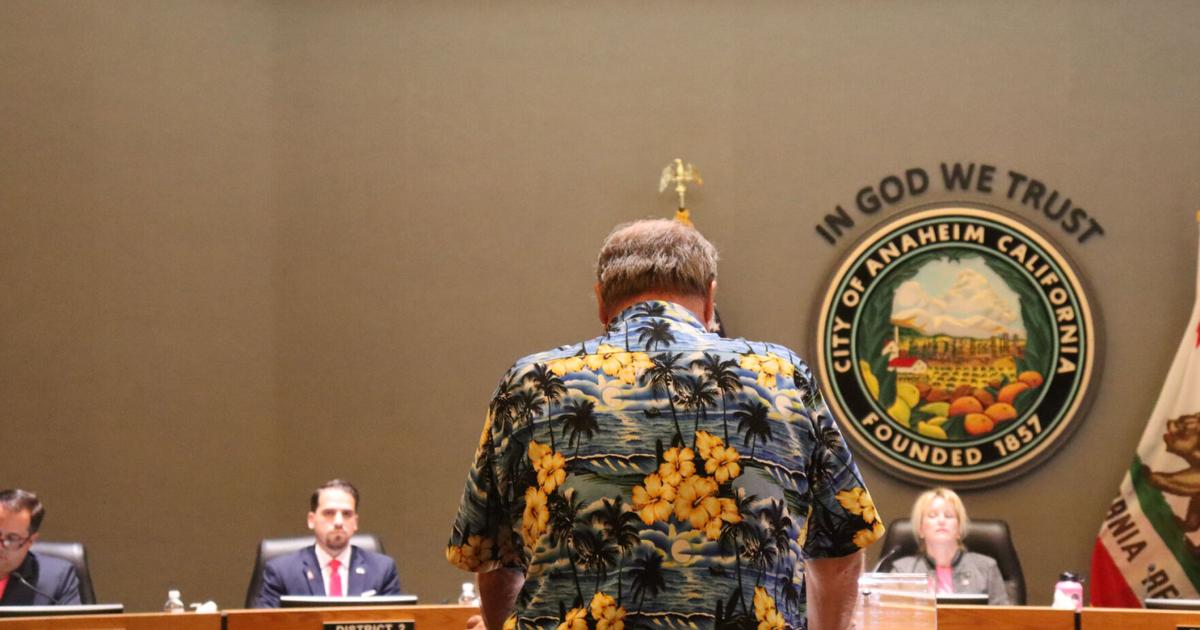
Anaheim City Council decided not to proceed on Tuesday with the Anaheim Tourism Improvement District tax, opting instead to study other revenue options in the city and analyze how these options could negatively impact residents.
If passed, the motion would have allowed voters to modify the ATID in an election on Nov. 3, 2026. The modification would have established a 3% admission ticket tax on privately owned theme parks, sporting and entertainment venues with a capacity of 20,000 and a 10% parking tax on parking facilities with over 1,500 spots.
The tourism tax would generate $89 to $134 million annually, and the parking tax $19 to $30 million annually. Both would be used for general city services such as park and street maintenance, first responders, senior services and affordable housing.
Over 25 members of the public spoke on agendized items, the majority in favor of adding the motion to the ballot.
Many members of the Anaheim Police Department argued in favor of the taxes to fund the department, claiming that their large jurisdiction of venues, theme parks and resorts has left them understaffed and overbooked.
“This item is about keeping the promise that was made to residents of the city of Anaheim,” said Anaheim Police Officer Breana Castro. “We appreciate the jobs and the tax revenue that they bring to the city, but no one can objectively look at this and our neighborhoods and say it has been an equal bargain, an equal partnership; it has not.”
City Attorney Robert Fabela explained that the specific general services, such as building senior services, described on the proposition wouldn’t be guaranteed under the ballot, as the revenue from the taxes would be placed in the general city fund.
In the staff report, both the tourism and parking taxes were presented with a 20% margin of error, as the staff had to make assumptions using a 2023 Disney attendance report, single-day passes and varied pricing, rather than specific reported numbers.
“We’ve got 20% in here but it sounds to be possibly more,” Councilmember Ryan Balius said. “We don’t really know what this is. What the actual dollar amount is gonna be.”
Councilmember Norma Campos Kurtz and Mayor Ashleigh Aitken emphasized that, if passed, this tax would only target Disneyland, as the staff report deemed it “unreasonable” to include revenues from Angel Stadium at this time.
Although taxing a single entity isn’t against state law, it compromises the contract Anaheim has with Disney.
“There is the agreements we have with both OC Vibe and with Disneyland Forward that require applicable taxes to be city-wide,” Anaheim City Attorney Robert Fabela said. “My verbal presentation is subject to some interpretation. We would argue this is a city-wide tax, I’m sure they would raise another argument, and then we fight that fight at some later point.”
According to the Disneyland website, Disney has generated $279 million in tax revenue, covering 60% of the general funds, paying Transient Occupancy taxes, Sales and Use taxes, Property tax, Business License tax and other Disney fees.
The city of Anaheim reported that its reliance on the resort area will fund over $302.8 million of the budget this fiscal year. The city will use around $162 million for debt services and safety programs, saving $140.8 million as surplus.
Council members, including Balius and Kristen Maahs, argued that a motion to diversify the budget, rather than solely relying on Disney, could be in the best interest of the city.
“I’m always open to create a solution for our budget challenges. I’m most interested in diversifying our revenue streams,” Maahs said. “I too have a concern that this may slow that development. I think we have the best park in the world and Disney’s best asset, but the reality is that they do have other places where they can invest.”
The lack of support from the council led Councilmember Natalie Rubalcava to request a continuation that would allow other income revenues to be studied to fund city services, which was seconded by Meeks. The vote to continue the study at a later time was 5-2, with opposition from Balius and Aitken.
Budget-wise, the city of Anaheim is in better standing than other cities in Orange County. Anaheim is expected to receive a payout that will give it a budget surplus of over $60 million.
According to the report, there could be a potential structural deficit in 2030, but it wouldn’t exceed $1 million.