
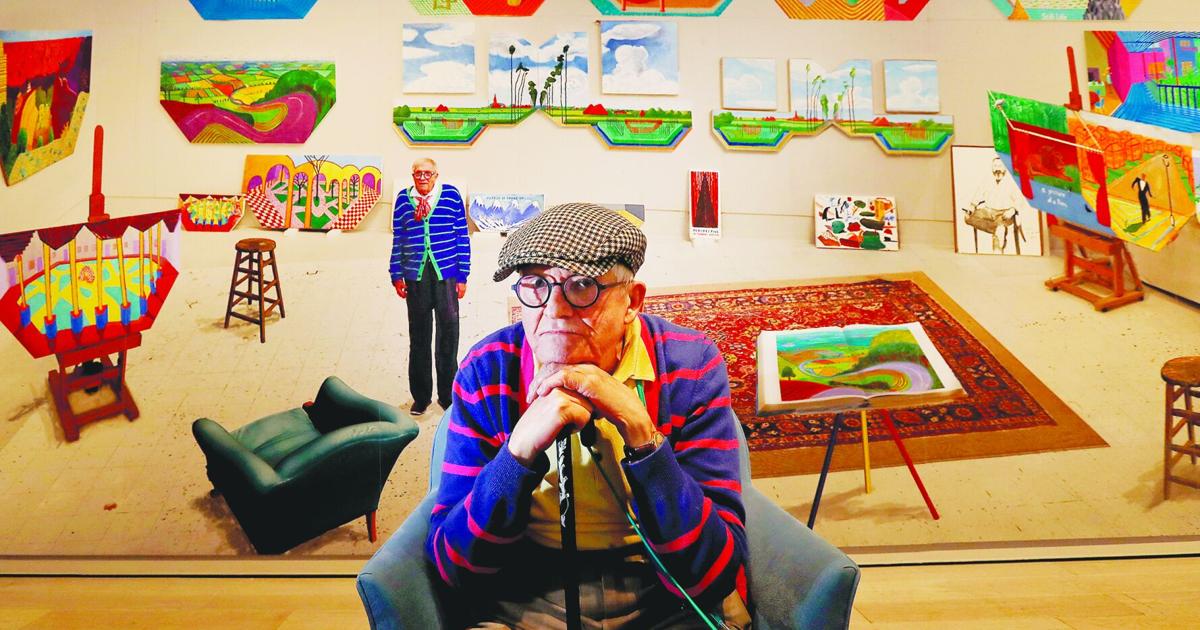
David Hockney, the innovative and prolific British artist who arrived in Los Angeles in 1964, soon celebrating its sun-drenched life and landscapes in colorful, wildly popular paintings, died Thursday at his home in London. He was 88.
His death was confirmed in a statement by his publicist Erica Bolton.
Calling himself “an English Los Angeleno,” Hockney immortalized the city’s sparkling swimming pools, palm trees and beautiful young men, then went on to experiment with intricate photo collages, portrait suites, painted and filmed images of Yorkshire landscapes, iPad drawings and more.
“Los Angeles will always be thought of by many people worldwide through the images that David created,” said Stephanie Barron, senior curator and head of the modern art department at Los Angeles County Museum of Art, which holds more than 150 works by Hockney in its permanent collection. “But for me one of David’s greatest gifts was his ability to look at the world with wonder and joy in whatever medium he decided to work in. … He was fearless in his embrace of technology, and I think that enormous curiosity ran throughout his career, and continued to the end. He was involved in looking at art history and the future simultaneously.”
Barron, who knew Hockney for 50 years, said LACMA staged more exhibitions of Hockney’s work during that time than any other artist. “David considered LACMA and the Tate his two museums,” she said.
Since his Pop Art paintings in the early ’60s at London’s Royal College of Art, Hockney was rarely out of the limelight and, more importantly, rarely out of fresh ideas for how to draw, paint, film, print, photograph or otherwise express his creativity. The David Hockney Foundation owns more than 8,000 of his works, including about 200 sketchbooks, more than 230 self-portraits, opera designs and portraits of family and friends.
Hockney first visited Los Angeles in 1964 — attracted to its light and leisure and hopeful that it represented a less repressive atmosphere when it came to homosexuality. He moved officially to LA in 1976, and in 1978 he rented a multicolored home and studio complex nestled in the Hollywood Hills. There one might find a clutch of art world luminaries at the dining room table, a guest or two in the pool or on the bright blue porch, or, in the studio, a model for his newest opera set. The writer Christopher Isherwood and his partner, artist Don Bachardy, were among his many favored guests.
“For David in the 1960s, Los Angeles was an enigma — a unique city different from his native London or even from New York City where he had his first encounter with ‘America,’ ” his close friend and fellow artist Doug E. Roberts told The Times last year.
Hockney loved Hollywood — the people and the place — and liked to say he was brought up in England and Hollywood because of the time he spent at the movies. His peroxide blond hair reportedly was inspired when he was a student and saw Clairol TV ads claiming “blondes have more fun.” But it was his interest in everything from Elvis Presley to the Hubble Space Telescope and his sense of humor that set him apart. Time magazine art critic Robert Hughes once called him “the Cole Porter of modern art.”
He was open about being gay, even when homosexuality was outlawed in Britain. His early love affair with artist Peter Schlesinger, a younger man he met when teaching a summer drawing class at UCLA in 1966, inspired Hockney’s monumental 1972 painting “Portrait of an Artist (Pool with Two Figures),” a centerpiece of Jack Hazan’s 1974 film “A Bigger Splash.” The painting’s 2018 auction at Christie’s drew a record $90 million for a living artist.
He was a dedicated reader and student of art, paying homage in his work to Picasso and Cubism as well as to Monet, Matisse, Van Gogh and Cézanne. A lover of opera, he often had it playing loudly in the studio and enjoyed taking visitors on curated car trips through the Hollywood Hills or Malibu while listening to Wagner. He designed sets for major companies in Los Angeles, Chicago, New York, London and elsewhere over the years, and some of his set models were later shown in museums.
His solo shows drew enormous crowds to the Los Angeles County Museum of Art as early as 1988. In 2017 a major retrospective of his work, keyed to his 80th birthday, was presented at New York’s Metropolitan Museum of Art, Paris’ Centre Pompidou and London’s Tate Modern. Chronicling Hockney’s arrival as an important artist in the “ravishing” Met retrospective, the New Yorker writer Andrea K. Scott called it “a revelation.” It was, she wrote, “a retort to all the eye-rollers,” including herself, who dismissed his work “as, at best, a guilty pleasure.”
In 2012 he received the coveted Order of Merit, which Queen Elizabeth II presented to him at Buckingham Palace.
David Hockney was born the fourth of five children to a working-class family in Bradford, England, on July 9, 1937. He has said he started “making marks on paper” at 8 and received private painting lessons before moving on to Bradford School of Art in 1953. His father, Kenneth, was a pacifist and a conscientious objector in World War II, which made the family somewhat outcast in its small hometown.