
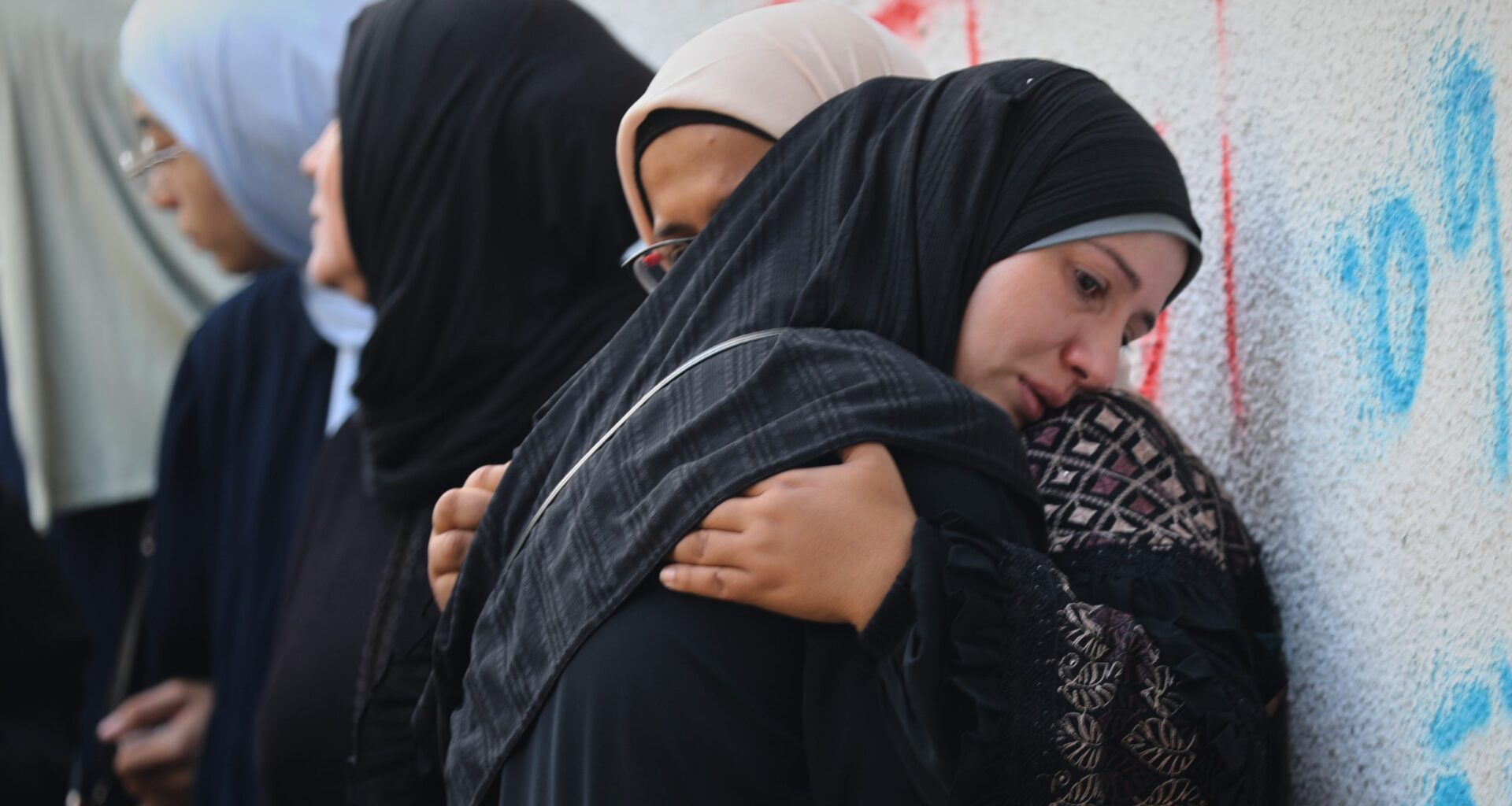
A poem by the Palestinian American poet Lisa Suhair Majaj, published a few weeks into Israel’s war on Gaza, reads in part “we wake Palestinian, breathe Palestinian, sleep / and dream Palestine, touch Palestine to the foreheads / of our children, die Palestinian.”
As a tenuous ceasefire was taking hold in mid-October, The Oaklandside sat down with Lujain Al-Saleh, an Oakland resident with family in Gaza, to find out what it’s been like as a Palestinian American to witness so intimately the long two years of war in Gaza, which the United Nations determined, in September, was a genocide. After we spoke, Israel violated the ceasefire with airstrikes across Gaza that killed more than 100 people, including at least 46 children, according to the Palestinian Ministry of Health. Another 253 were injured in the strikes, including 20 children who were in critical condition at Al-Shifa Hospital in Gaza City. Israel said the bombardment was in response to gunfire aimed at some Israeli military vehicles in the West Bank, which killed one soldier; Hamas said it had no connection to the attack.
Al-Saleh has lived in the Bay Area for a decade and in Oakland for six years, part of an Arab-American community in California that is larger than that of any other state. She has studied environmental science and has a master’s degree in public health; she now works at a statewide environmental justice organization called Communities for a Better Environment, focusing on pollution in Richmond, especially from the Chevron refinery. And she’s been a member of the Arab Resource and Organizing Center, or AROC, for eight years.
We spoke about what it was like being glued to her family’s WhatsApp group, how she handled waking up every day to images of destruction, and how she was heartened by efforts to organize for ceasefire resolutions and an arms embargo here in the Bay Area.
This interview has been edited for length and clarity.
Tell me a little bit about your family. When and why did your family emigrate from Palestine? And where else does your extended family from Palestine live?
I’m Palestinian on my father’s side. My father was born in Gaza, in 1964. My grandfather, my father’s father, was born in Jerusalem before the state of Israel was established in 1948. My grandmother was from Gaza. Ultimately, they were displaced and ended up in Jordan, where my grandfather was able to get work — he’s a lawyer — and then eventually got a job in Saudi Arabia.
My father mostly grew up in Saudi Arabia and Jordan, in between the two. They were never able to obtain Saudi citizenship, and they weren’t able to go back to Palestine. Most of my immediate cousins, my uncle’s children — the children of my father’s brothers — live in Kuwait, Dubai, Jordan, and Saudi Arabia.
And then I have my extended family who, unfortunately, I don’t know very well, who are either in Gaza or in East Jerusalem. These are my family on my grandmother’s side. Unfortunately, I have not been able to meet my family in Palestine. I’ve never been to Palestine myself.
Of course very few people are permitted to leave or enter Gaza. Were there family members in Gaza you or your father or uncle were in touch with over these past two years?
My eldest uncle, who lives in Kuwait, was in touch with our family in Gaza and our family in the West Bank — he was in direct contact with most of them. I was only in touch with one person, my late cousin’s wife.
And your cousin and his wife, where in Gaza were they living before the war began?
Most of my extended family was in Gaza City, in central Gaza. That’s the family that comes directly from my grandmother’s side of the family.
Bring us back to Oct. 7, 2023. What went through your mind? What were you worried would happen?
I think, first, I was in a state of shock. And then, after coming out of that state of shock, I was really scared about what was going to happen next. I knew, given what I’d seen as a kid on the news, that the response was going to be brutal. I didn’t have any doubts about that. I was really scared about what would happen to Gaza since, as you know, before Oct. 7, Gaza had been repeatedly bombed and under siege for 17 years.
So I had this intense fear about what would happen next.
And those fears were realized very quickly.
My late cousin, Roshdi Al Sarraj, was a journalist. He was a co-founder of a media organization called Ain Media, along with his childhood friend, Yaser Murtaja, who was killed during the Great March of Return protests in 2018.
Yaser was killed by a sniper while covering the marches. And then my cousin Roshdi’s brother Mahmoud Al Sarraj, who was also a journalist, was killed earlier this year while covering aid relief efforts during the period of first ceasefire agreement. They were very connected to journalists on the ground, to artists and writers.
A lack of media coverage from Gaza ..
due to the killing more than 12 journalists, the bombing, and the blackout of electricity and the Internet.
However, we are still trying to withstand and continue coverage so the world can see the israili crimes in Gaza. pic.twitter.com/ELlmUN2984
— Roshdi Sarraj (@RoshdiSarraj) October 17, 2023
Roshdi was killed on October 22, 2023, at the very beginning of the war. It’s incredible to see all the articles about Roshdi and the work that he did.
What a terrible loss, Lujain. How did the news of Roshdi’s death reach you?
It was in my family WhatsApp group with my uncles, including my uncle who’s most connected to our family in Gaza. They had shared an Instagram post from one of Roshdi’s colleagues, who confirmed that he had been killed.
From my understanding, he had actually just come back to Gaza. He had been on the way to Mecca with his wife and his daughter, she wasn’t even one year old yet, and they came back to Gaza, to their family home. It was the morning, and, from what I’ve read and talked about with my family, he and his wife and daughter were at home eating breakfast when the airstrike occurred.
Knowing the precision of the Israeli air strikes and the ability of the military to know who they’re targeting, I believe it was a targeted air strike. I don’t know if it was an F-35, but given the research on Israeli airstrikes, it was likely an F-35 jet fighter jet. Other family members were injured and traumatized, but fortunately no one else was killed.
What happened to Roshdi’s wife and their baby daughter after he was killed?
My understanding is that they had to evacuate immediately, for safety.
I don’t know how many times they had to relocate after that, but I’m sure they had to several times, given the constant bombardment and daily attacks.
And Roshdi had returned to Gaza in order to cover the war?
I think so. There’s this quote by him, from a week or so before he died, where he says, “We won’t leave. We’ll exit Gaza to the heavens, the heavens only.”
He was very rooted there and he didn’t want to abandon his home, his loved ones, and his community. My understanding is he also would have wanted to cover the war. His brother, Mahmoud, was covering it over the past two years.
Was Mahmoud covering it with the group that Roshdi cofounded, Ain Media?
Mahmoud was a contributor to multiple news outlets, including Ain Media. He worked with a group of journalists. I think that it was him, a video editor, two other cameramen, and several aid volunteers. They were on their way to deliver aid, and he was among the journalists covering it. This massacre happened on March 15 of this year, in northern Gaza.
I’m sorry, he was also killed?
Yes, Mahmoud was killed on March 15, 2025. This was just at the end of the first ceasefire agreement that began in January. It was essentially a group of volunteers working with the UK-based Al Khair Foundation and journalists who were documenting their aid efforts. They were in a van and that van was targeted, and everyone was killed. There were a series of drone strikes.
He had lived in Gaza City but he was in the north, in Beit Lahia, when their vehicle was targeted.
Lujain, you lost two of your cousins! I am so deeply sorry. I am trying to imagine what it has been like over these two long years, being glued to this family WhatsApp where you would receive such terrible news. And then Israel would impose telecom blackouts when you would get no information at all.
It’s been really devastating. Every day there’s a massacre in Gaza. There’s this feeling that things are just happening as usual, just business as usual, here, when every single day in Gaza there are massacres and entire family lineages are destroyed.
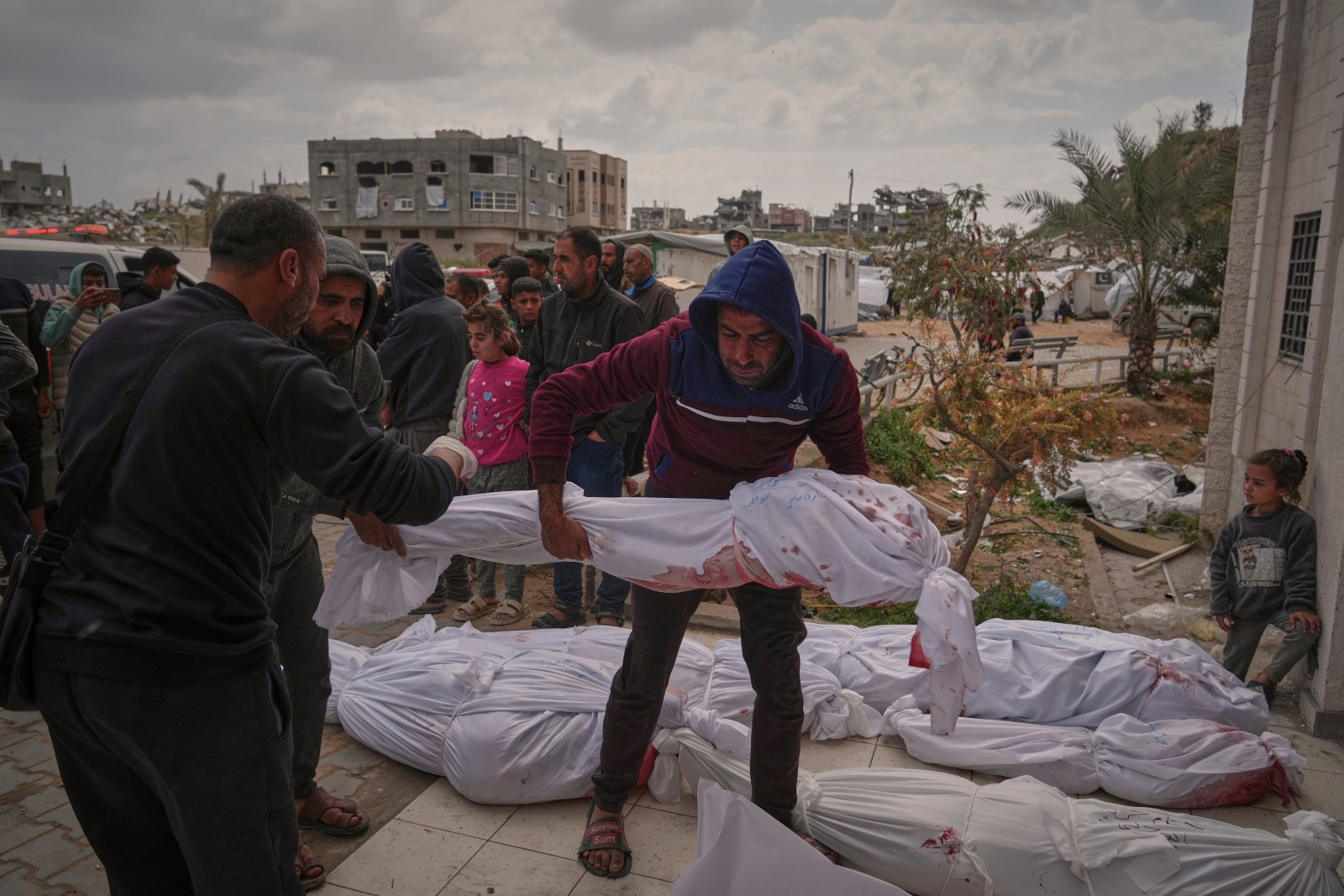 Victims of an Israeli army airstrike are prepared for burial at Indonesia Hospital in Beit Lahia, in northern Gaza, March 20, 2025. Credit: AP Photo/Jehad Alshrafi
I think, also, I experience a lot of grief. Grieving not knowing my own family, you know? I think a lot about how different our relationships would be if they had the ability to travel and I had the ability to go to Gaza. There is also so much guilt knowing that my tax dollars and the tax dollars of my family who live in the United States are going toward the genocide of not just our family, but hundreds of thousands of Palestinians.
And then finally hearing the news about the Oakland San Francisco Bay Airport having a direct connection to the genocide. The airport is sending F-35 components directly to the Israeli military, and we’ve had family members who were killed by airstrikes where F-35 fighter jets were likely involved. I feel a lot of disgust and shame knowing that this is what our money goes to.
We’re living in Oakland where there are so many people without homes and places to go to, where we see the disinvestment in schools, and all of these things that people deeply need in Oakland — and then knowing that so much of our money is going toward the US military and toward sending weapons to the Israeli military.
What was it like to watch the news feeds? Even for those of us who don’t have family there it was overwhelming. Were you staying up all night scrolling? Did you just have to stop sometimes?
It was, and it still continues to be, tough. Because I want to know what’s happening every day. I want to know as much as I can. I want to know what’s happening on the ground. And continuously reading about the massacres — massacres not just in Gaza but also in the West Bank and the escalation of violence in other countries, too, like Lebanon, Syria, Iran — it becomes so overwhelming. I definitely have had to take breaks over the past couple of years, just for my own mental health.
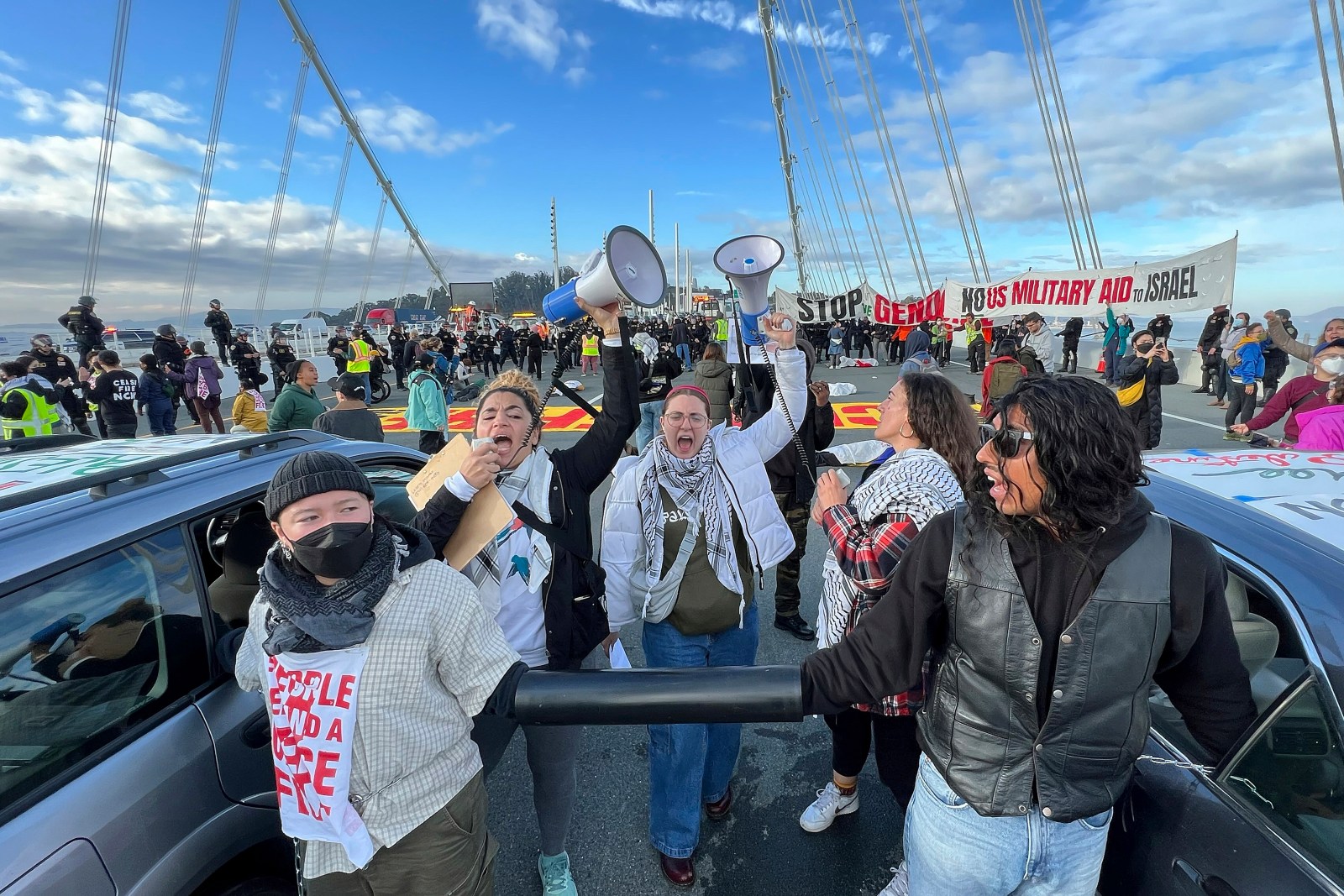 Demonstrators shut down the San Francisco Oakland Bay Bridge on Nov. 16, 2023, to demand a cease-fire in Gaza. Creid: AP Photo/Noah Berger
At the same time, there’s a lot of shame in taking breaks because Palestinians in Gaza and the West Bank don’t get a break, they’re constantly being bombarded. So it’s really been a mix for me, where there are some days that are especially hard and it’s hard to look. I think a lot of people feel this element of almost desensitizing yourself when you’re reading about and seeing so much of this violence — and then, you know, you’re still living your life. Like everything is fine, but it’s not. Still, as much as I can, I try to stay updated every day. I’ve been closely following Democracy Now!’s daily reports. They’ve been doing a really good job of reporting on Palestine over the past couple of years.
I’d like to ask about your public health training. Through that lens, what was concerning you most as you watched the war unfold, the destruction of sanitation, of housing, of hospitals?
I think being Palestinian has shaped why I studied environmental science and public health. From every single level, from the soil to the water to the air, to, as you said, the healthcare infrastructure, everything is being destroyed, and destroyed intentionally. Recently, there’s been a lot of movement in terms of environmental justice organizations saying things about what’s happening, making strong statements about the genocide.
And at the same time, a lot of US and international public health and environmental justice organizations feel like saying something about the genocide is somehow political. And so I have felt a lot of frustration, and I have definitely felt disappointed — especially at the start of the genocide when a lot of organizations refused to say anything or made statements to staff like, “Hey, we’re not going to talk about this.”
I think for anyone who cares about public health and addressing health disparities or health justice, they have to care about what’s happening. It’s a complete crisis on every level — on a health level, on an environmental level, on a human rights level. There has been a lot of movement, and organizations have ultimately shown their solidarity and support, but I definitely saw a hesitancy.
Were you and your family at any point trying to help get relatives out of Gaza or trying to get money into Gaza to support them?
Definitely. My family set up GoFundMe’s for family members to try to get them out of Gaza and also to help with food. But at the end of the day, so many GoFundMe’s were shut down and getting the money directly to family members is very difficult. On top of that, flour, basic food supplies were incredibly expensive. People couldn’t afford what they needed for their daily survival.
And it’s very difficult for Palestinians in Gaza to leave. The US suspended visitor visas for people from Gaza that had been used by Palestinians seeking medical aid in the United States, and by aid organizations helping to get Palestinian children here for medical care, children who have had amputations, who need immediate medical attention. It has been really challenging to both get money in and to get family members out of Gaza.
And then, also, in the case of Roshdi, he didn’t want to leave — he wanted to come back. You know, people are really scared and at the same time they don’t want to leave their homes because deep down they know that if they leave, they’re likely not going to come back, or they won’t have homes to go to — their homes are completely destroyed. It’s a terrible situation either way. Leaving is incredibly painful and staying is, too, so people are just stuck in the in-between of immense loss and pain.
Let’s turn to what it has been like inside the Palestinian or broader Arab-American community in Oakland and the East Bay during this period. You mentioned your own family’s GoFundMe, and it did feel like everyone was racing to raise funds to assist people. What was happening in your community?
There’s definitely a strong sense of Arab community and Palestinian community in the Bay Area, and a lot of organizations have mobilized around stopping the genocide. Especially in the beginning, there were weekly mobilizations and people working with local elected officials to pass ceasefire resolutions. More recently, there’s been the Alameda County ethical investment policy and divesting from companies that have a direct tie to the genocide or to human rights violations. There’s been so much mobilization and also strategizing around how do we go beyond a ceasefire and implement a full arms embargo to end Oakland’s complicity in Israel’s war crimes and violations of international law. We’ve really grown in terms of our coalitions and organizing.
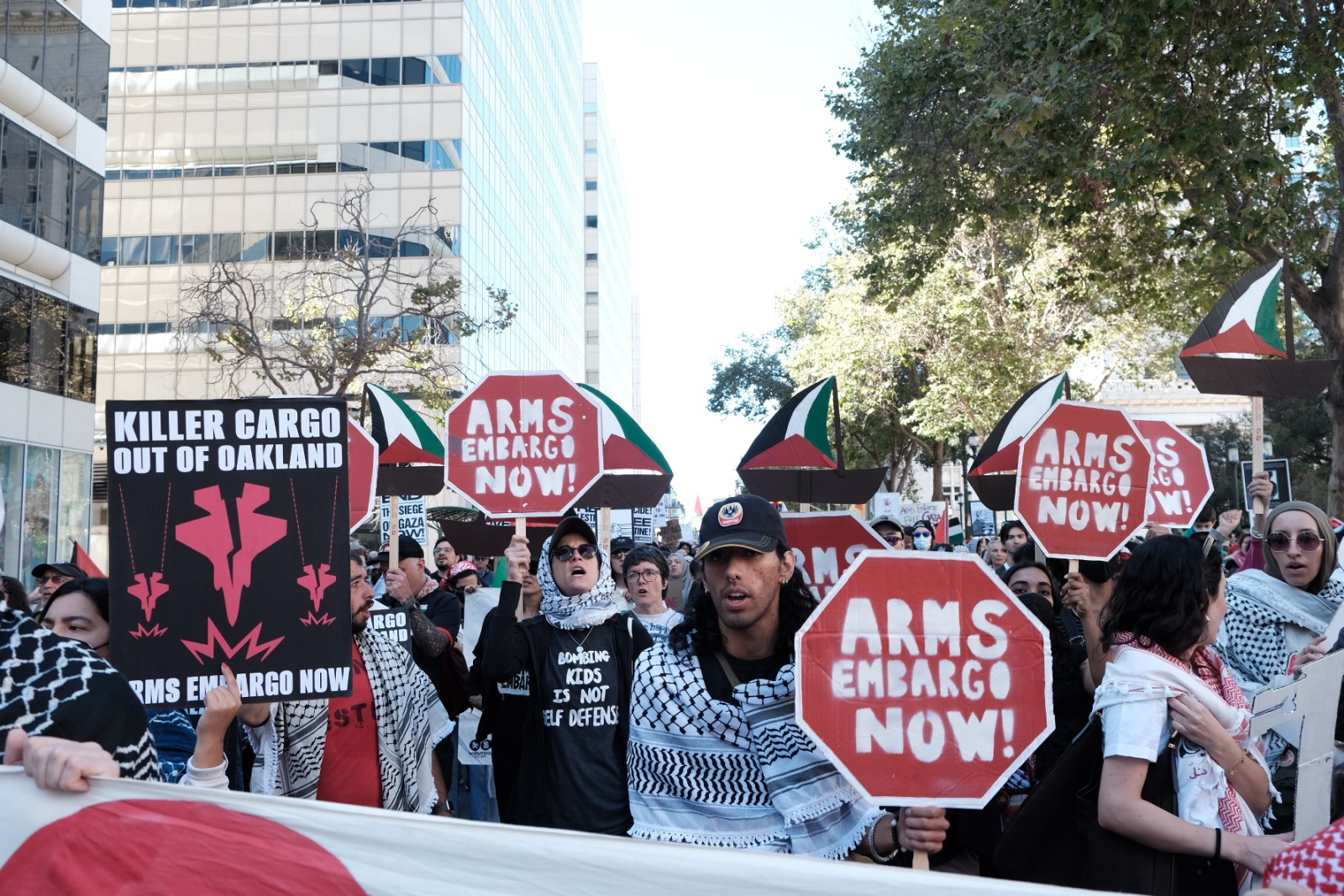 Protesters gather at Oscar Grant Plaza, in downtown Oakland, to call for an embargo on the shiptment of weapons and military supplies from Oakland San Francisco Bay Airport, October 4, 2025. Credit: Malak Ali
I think it’s important that people are out in the streets, but that can only do so much. You know, we go out, we mobilize, nothing happens, nothing changes. People have gotten really sick of it. And so we’ve been pushing to go beyond that.
The Palestinian Youth Movement recently conducted research and found that the Oakland Airport has been sending out these F-35 weapons components and detailed how the Bay Area is supplying this genocide. We’ve been shifting to how we can implement an arms embargo on a local level, ultimately with the goal of expanding that to other cities across the United States.
Oakland was one of the very early cities to pass a ceasefire resolution, back in November 2023. Were you involved in that effort?
Yeah, I was there and gave public comment. AROC met with Councilmember Carroll Fife and Councilmember Nikki Fortunato Bas to draft the language around the ceasefire resolution. Definitely in the beginning it was slow to move forward. I think at the time, there was a fear among elected officials that this was somehow a controversial issue and, at the end of the day, they’re also worried about reelection.
I work a lot with the Richmond City Council, and Richmond was actually the first city council to pass a ceasefire resolution. I think Richmond’s decision influenced Oakland’s movement. Hundreds of Oakland residents came out in support of it.
Ultimately, the root of the ceasefire resolution was Oakland’s love of life, the love of life and the importance of not just recognizing Oakland’s history of social movements, but actively honoring that. Oakland divested from South Africa during apartheid in the 1980s, and the city has a long legacy of social justice. So really honoring that history by passing the ceasefire resolution.
What about the retaliation and the backlash? From very early on, journalists were being fired for using the term genocide, academics were losing their jobs, students were being suspended, immigrants were being detained, all for their speech on Gaza. How did that touch your community here in Oakland, in the Bay Area?
I know many people who have been let go from their jobs for being explicit about supporting Palestine and being against the genocide. I also have friends and family friends who are university students, some of whom were students during the encampments, who were targeted or put on this website called Canary Mission, which is a doxxing website. I have a friend who was suspended from Columbia University for her involvement in the encampment movement, and we’ve seen cases like Mahmoud Khalil, who was detained in Louisiana for months for his activism and was recently issued deportation orders — even though he has a green card. We’ve seen the targeting of students who are vocal in their support. There has been a lot of backlash.
There has also been a lot of support and, I think, growing support. I don’t think I’ve ever seen this number of people coming out to protest, giving public comment, and doing whatever they can to stop this genocide.
Polling on how Americans think about Israel and Palestine has really shifted over the course of the war, right?
Yeah, it has.
Just using the term genocide about the war on Gaza was a fireable offense in many industries. Then, almost a year ago, Amnesty International concludes that Israel’s actions are tantamount to genocide. And now recent polling shows that 39% of Americans see the war that way. What has it been like to experience that dramatic shift?
It has been really powerful to see the number of people who have learned, who didn’t maybe know much about Palestine before, who have been coming out to protest, attending city council meetings, and educating their family and friends.
And in Oakland, I feel like whenever I go outside I see people wearing keffiyehs, the Palestinian scarf; I see signs in people’s windows. There’s a lot of solidarity, especially at local businesses. Either they have a Palestine flag or a Free Palestine sign. In my life, I haven’t seen this amount of support everywhere. That’s inspiring, too. And learning of all the countries that have been — more recently — recognizing a Palestinian state. That’s also really huge.
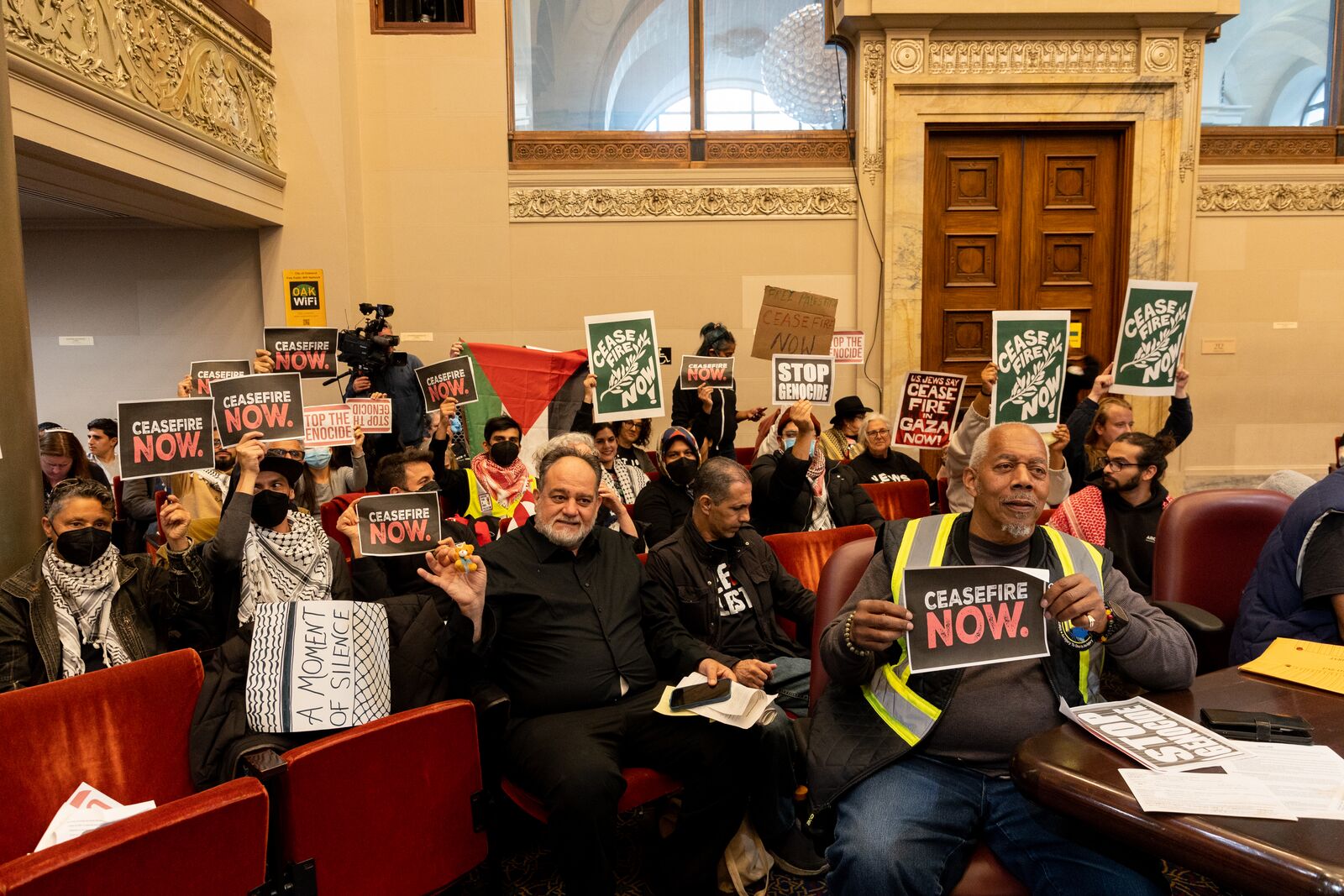 The Oakland City Council holds a meeting to vote on a resolution calling for a ceasefire in Gaza, Nov. 27, 2023. Credit: Amir Aziz/The Oaklandside
A lot of people are now seeing ties between US-based corporations and other international corporations, and how they connect to their own communities and Palestine. Specifically with Chevron — Chevron has a massive refinery in Richmond and it also directly fuels Israel’s military. There’s a direct tie to the genocide. People are making these connections and doing everything they can to put pressure on their local governments to stop investing in these corporations.
Bring me back to that moment when Amnesty and Human Rights Watch for the first time called Israel’s war on Gaza a genocide. How did you wrap your head around the idea that experts in international law were saying, Yes, this is a genocide?
It felt like finally — finally — there’s a recognition that this is a genocide and people aren’t getting into semantics or making excuses.
I felt like, I’m glad that institutions are now recognizing it as genocide. That was important. But at the same time it’s really frustrating that it’s taken so long for certain countries or organizations or media to recognize it as such. It’s important that we name it for what it is. And yet I felt like, Why has it taken so long?
You mentioned US weapons shipments earlier. Obviously there were many months while Joe Biden was president when he was talking about trying to achieve a ceasefire or a resolution, but meanwhile he was continuing to send weapons to Israel. What was your experience of that whole prolonged period, when the war had been declared a genocide and the weapons kept going?
I mean, the dissonance was so frustrating. It’s also become really clear to not just Palestinians, but I think to Americans who see what’s happening and see it as a genocide, that both parties — both the Democratic Party and the Republican Party — are invested in supporting Israel with weapons and with money.
There’s this facade of wanting it to stop, wanting to be anti-war. This is something Donald Trump said, too; he said, I’m the anti-war candidate! And we quickly saw that’s obviously not the case.
There is the active prolonging of the genocide, while simultaneously saying things like, We care about peace, we care about human life, while signing bills that directly supply Israel with more weapons. This is incredibly contradictory and I think that it’s become clear to the masses that both parties have been complicit in this genocide, other genocides, and other human rights violations around the world. Both parties have actively supplied our military and other militaries to kill people. I think that’s been more clear than ever for the majority of Americans.
That’s a powerful word you used, dissonance. How have you lived with that dissonance?
That’s a great question. I mean, realizing that our political parties are not really serving us. They’re not listening to us. And, given that, we have to do everything that we can to stop this.
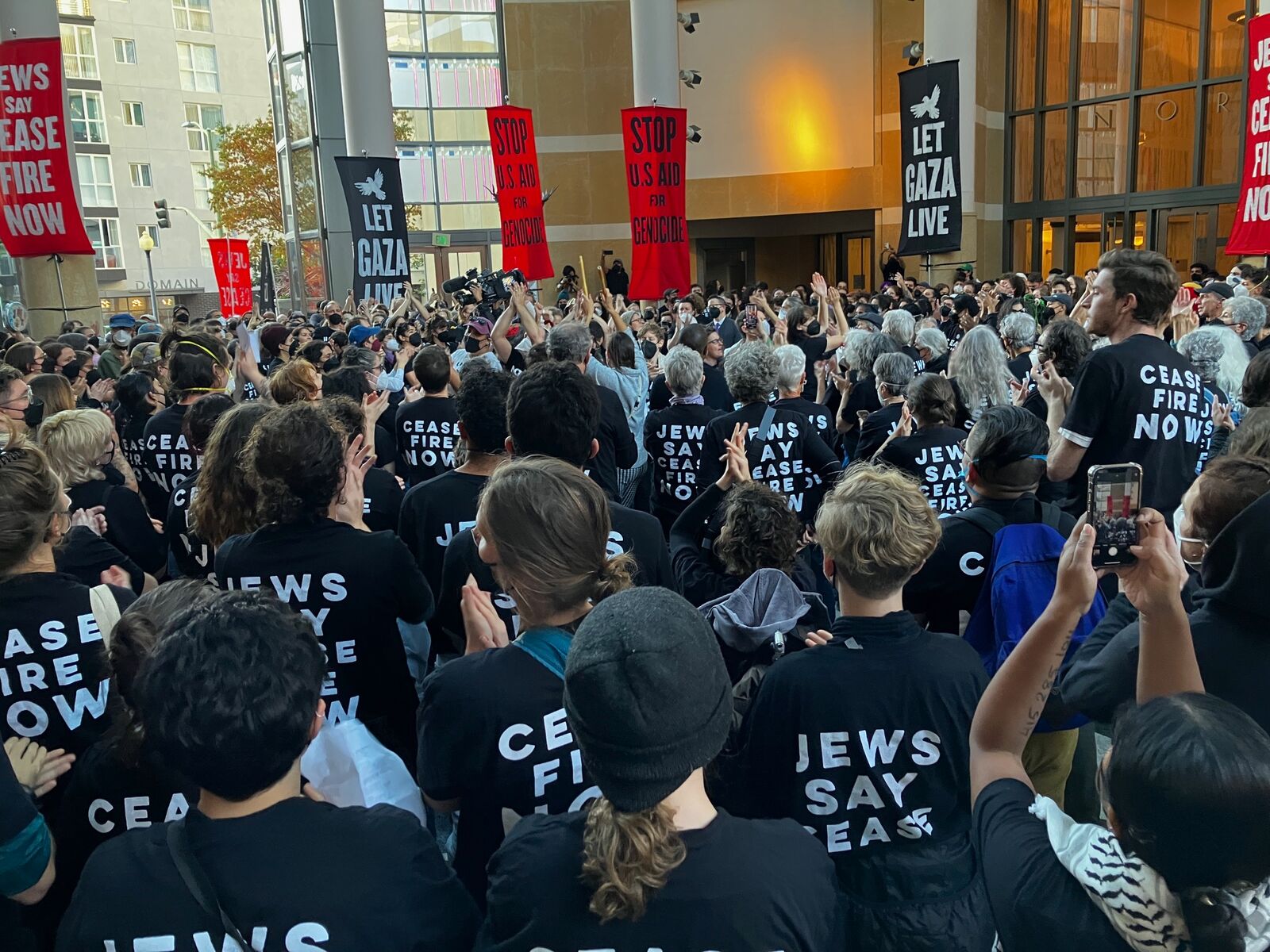 Protesters occupied the Federal Building in Oakland on Nov. 13, 2023, to call for a ceasefire in Gaza. Credit: Natalie Orenstein/The Oaklandside
There have been massive protests in New York and Washington, DC, where people are occupying the Capitol halls, disrupting meetings. That’s just one strategy. But really thinking about if our politicians and political parties are not listening to us, then what is our leverage? Going back to this local campaign, this research about the F-35 weapons components and learning that it’s being sent by FedEx directly out of the Oakland Airport — this is an opportunity for everyday people to put pressure on our local government to stop this, because they have the power to do so.
There’s a lot of power in being able to grow social movements locally. We’ve seen this with so many social movements, where they started locally, like Ferguson with Black Lives Matter, the Civil Rights movement. There is power in local campaigns and there can be real wins. So that’s part of our goal is advancing this arms embargo and expanding it to other cities.
Let’s come up to March of this year, when Israel imposed the blockade on Gaza and starvation began to set in. What was on that family WhatsApp group at that time? What was rippling through your community here, and what was it like to take in those images? What was everyone scrambling to do?
Ultimately, we were scrambling to end the blockade. No aid was coming in. There were images of trucks, aid trucks, just waiting. And we’ve seen the attacks on boats. Activists from around the world literally buying boats and trying to go to Gaza with aid, that are being actively targeted. The Handala is one of the ships that was targeted a few months ago. Ultimately, the symbol of the flotilla movement is our governments are not stopping this, so we’re going to stop this. We’re going to go and deliver aid directly since our countries aren’t doing anything about it.
It’s very devastating to think that countries could be stopping this, they could be sending ships to go in and end the blockade. It’s also inspiring to see the number of people around the world sacrificing their own lives to do something.
It’s very scary to do so. People were killed on one of the flotilla ships, the Mavi Marmara, in 2010. We’ve seen people directly killed protecting homes.
So it’s during this period, during the beginning of the blockade, that your cousin Mahmoud was covering that aid convoy.
Yeah, exactly, it was in the beginning of the blockade, where he was covering aid relief efforts.
It was through a UK-based charity called the Al-Khair Foundation. There were at least nine people who were killed. It’s really disgusting — in one news article, they’re basically being described as terrorists, as if they were terrorists who were doing this. And, no, these are journalists, these are aid workers. So even the narrative around when we have family killed or friends, loved ones, it’s like, Oh they’re terrorists, or they’re human shields of some kind. It’s completely denying their murder. It’s a way to justify it.
Is that another terrible piece of news you got from the family WhatsApp group?
Yeah, it was, actually. I found out in my family WhatsApp group.
I think for us there was a bit of hope with the first ceasefire agreement. My late cousin Roshdi’s wife, Shrouq Aila, who is also a journalist, was on Democracy Now! talking about it and how people were feeling relief. And that relief was quickly taken, in a matter of I don’t even know how many days.
With any kind of pause, there’s this fear that it’s going to quickly happen again, given how inconsistent it has been and the routine violations of these agreements.
That brings us to the current ceasefire. How did you feel when it was announced? And how do you feel a week later?
We all welcome it. It gives our families a break. Palestinians in Gaza were celebrating, and we support them celebrating. They have the right to celebrate.
However, given the timeline of the genocide over the past two years and the continuous ceasefire violations, we also still feel really unsettled. And since the announcement, there have been at least 100 Palestinians who have been killed, and, on top of that, Israel has announced it’s not going to abide by the humanitarian terms of the ceasefire agreement. Not enough aid is entering. It’s just a drop in the ocean of what Gaza needs.
It’s become so clear to us that there needs to be an arms embargo. Because at the end of the day, these agreements are continuously violated and they’re violated through violence. They’re violated through military weapons, through F-35 jets, and the way to stop this is to stop the shipments and the arms sales. That’s the only way that we can enforce a true ceasefire. It’s the only way we can do it.
Beyond a weapons embargo, what else is on your mind? People are returning north to rubble, rubble that might hide unexploded ordnance. There are, as you mentioned earlier, so many people with serious injuries, amputations. There are children who haven’t been in school for two years. What is weighing most on your mind right now?
Along with everything you shared, it’s the rebuilding of Gaza. It’s very unclear what will happen next, especially given that Trump has repeatedly said, Gaza will be this beachside waterfront resort. Seeing his relations with Benjamin Netanyahu and the threat of expanding settlements, it’s really scary.
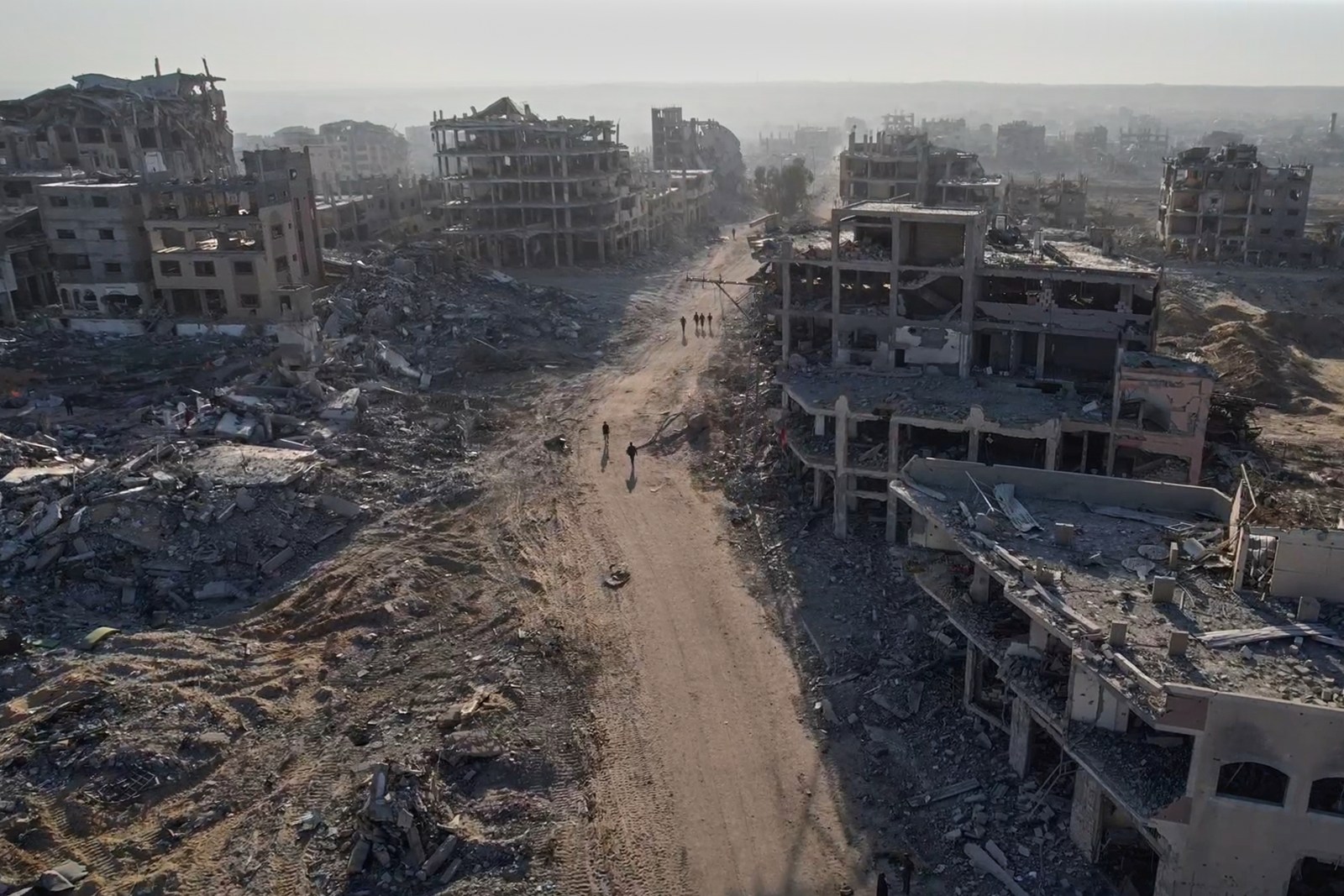 The destruction in Gaza City visible on Oct. 11, 2025. Credit: AP Photo
My dream is that we will rebuild — that ultimately Palestinians in Gaza will have the power to rebuild, to go back home, and to return. Where kids can go back to school, where there’s no longer a siege, where people can live their lives.
Where they can document life in Gaza, not death.
I think that’s something my cousin did, especially before the genocide: He documented both the suffering, but also the beauty of Gaza. It’s a very beautiful place, you know. It’s right by the Mediterranean Sea. It’s a beautiful place and unfortunately, there’s so much suffering.
So that’s what we hope for and what we’re fighting for, is that not only does this genocide end, but Palestinians can return and they can live in peace. They can move freely. And they no longer have to live in fear of losing their families and being killed on a daily basis.
“*” indicates required fields