
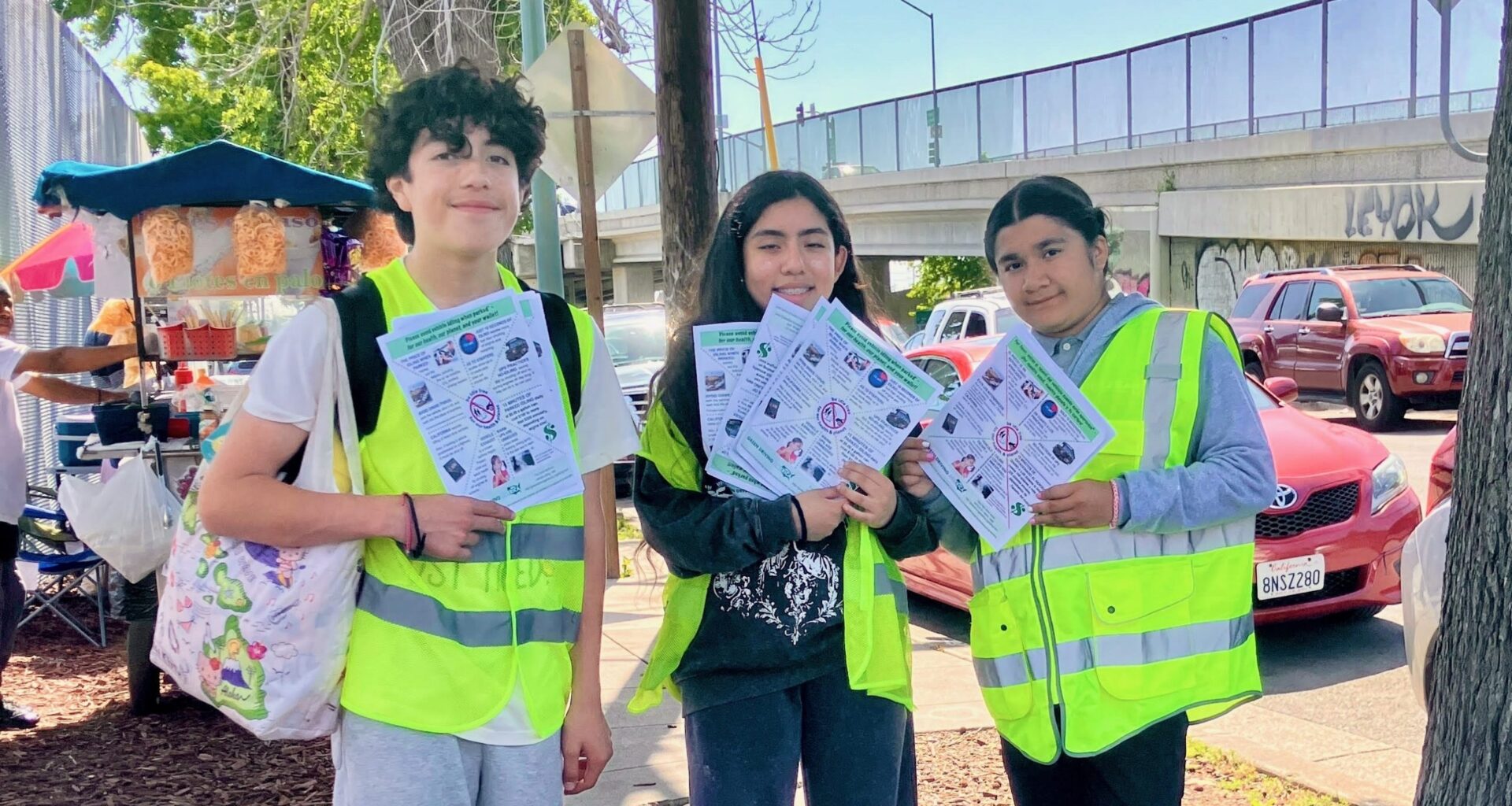
Anyone who lives or works near a stretch of street where cars are idle knows the acrid smell of exhaust. For many Oakland students, that’s the smell surrounding their school entrance, where parents idle in the line to drop off and pick up their children day after day, exposing them to emissions.
For more than a decade, Wayne Michaud, the founder of the Sacramento-area nonprofit Green Driving America, has sought to reduce idling at schools through an anti-pollution educational and data-collection program called Schools Are Not Drive-Thrus. Oakland Technical High School, the city’s largest high school, was a participant in the program last year; this past spring Lazear Charter Academy in East Oakland signed up.
The program starts by collecting data, then shows kids and their parents how much impact they can make simply by turning off their engines as they wait. Michaud said of the 20 school-based studies the campaign has run so far, some have reduced exhaust tonnage dramatically — by up to 85% at a Vermont high school and 75% at Carlmont High School in Belmont in the South Bay.
The program seeks to educate parents about the level of harm that a single idling car can cause when it’s multiplied by all the school days in a year. The nonprofit has found that, on average, 20 to 30 cars per school idle for 15 minutes or more each, resulting in 500 gallons of fuel burned and five tons of CO2 per year.
The program is simple enough to be replicated at any school: collect idling data over several days, tracking how many cars idle in front of the school and for how long, then extrapolate to show the impact over the course of a school year.
The process begins with a meeting with kids and teachers about idling. Second, kids conduct the study out on the sidewalk. Third, the school encourages parents not to idle through emails, an app, and signage at the dropoff line. Fourth, students speak directly with parents or guardians at school stops to teach them about environmental harms. An optional fifth step has the kids collect the data again to see whether cars are idling less.
The program, based on the Environmental Protection Agency’s idle-free schools toolkit, also has teachers work with students on how to get the word out about the harms of idling.
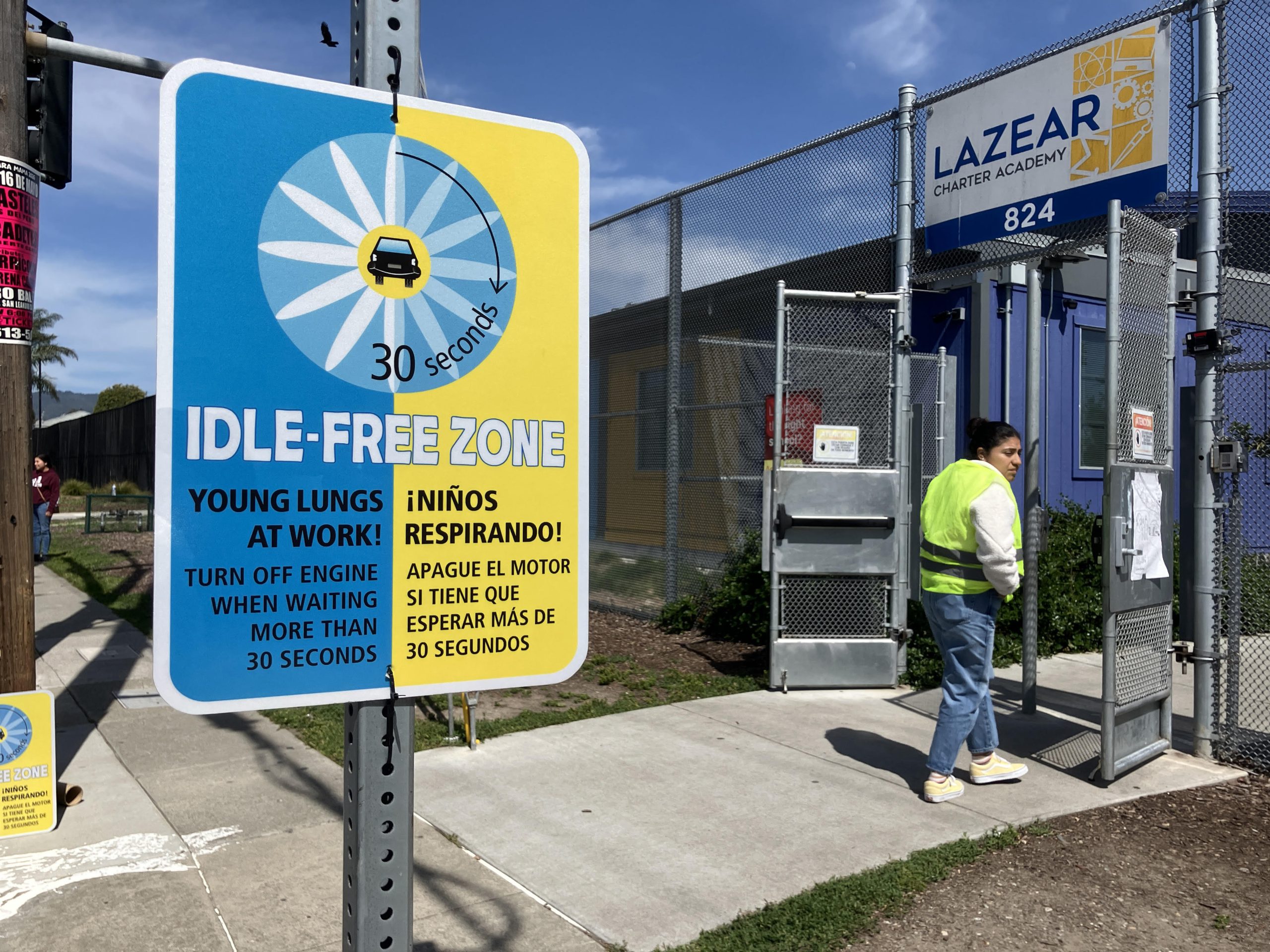 Green Driving America’s Schools Are Not Drive-Thrus program provides curb-side signage for schools. Credit: Wayne Michaud
The program focuses on reducing idling at schools — rather than, say, at businesses or fast-food lanes — because the exhaust from internal combustion engines poses a greater risk for children whose lungs are still developing.
Academic and government research has found that idling is harmful. The California Air Resources Board has encouraged Californians to reduce their idling time. “Idling of all vehicles causes damage to our health and our environment,” an informational flier states.”If possible, turn off your engine if you are waiting for more than 10 seconds.”
Anti-idling campaigns have cropped up around the country and internationally. In Colorado, the Engines Off campaign, supported by the Regional Air Quality Council, includes programs to reduce idling in schools, and Idle Free in Utah says it has engaged more than 1,000 students a year in air quality advocacy. A national campaign by Sustainable America, promoted by banker and environmental activist George Pakenham, reminds drivers that two minutes of idling produces as much pollution as a mile of driving.
Students at Lazear Charter hit the curb
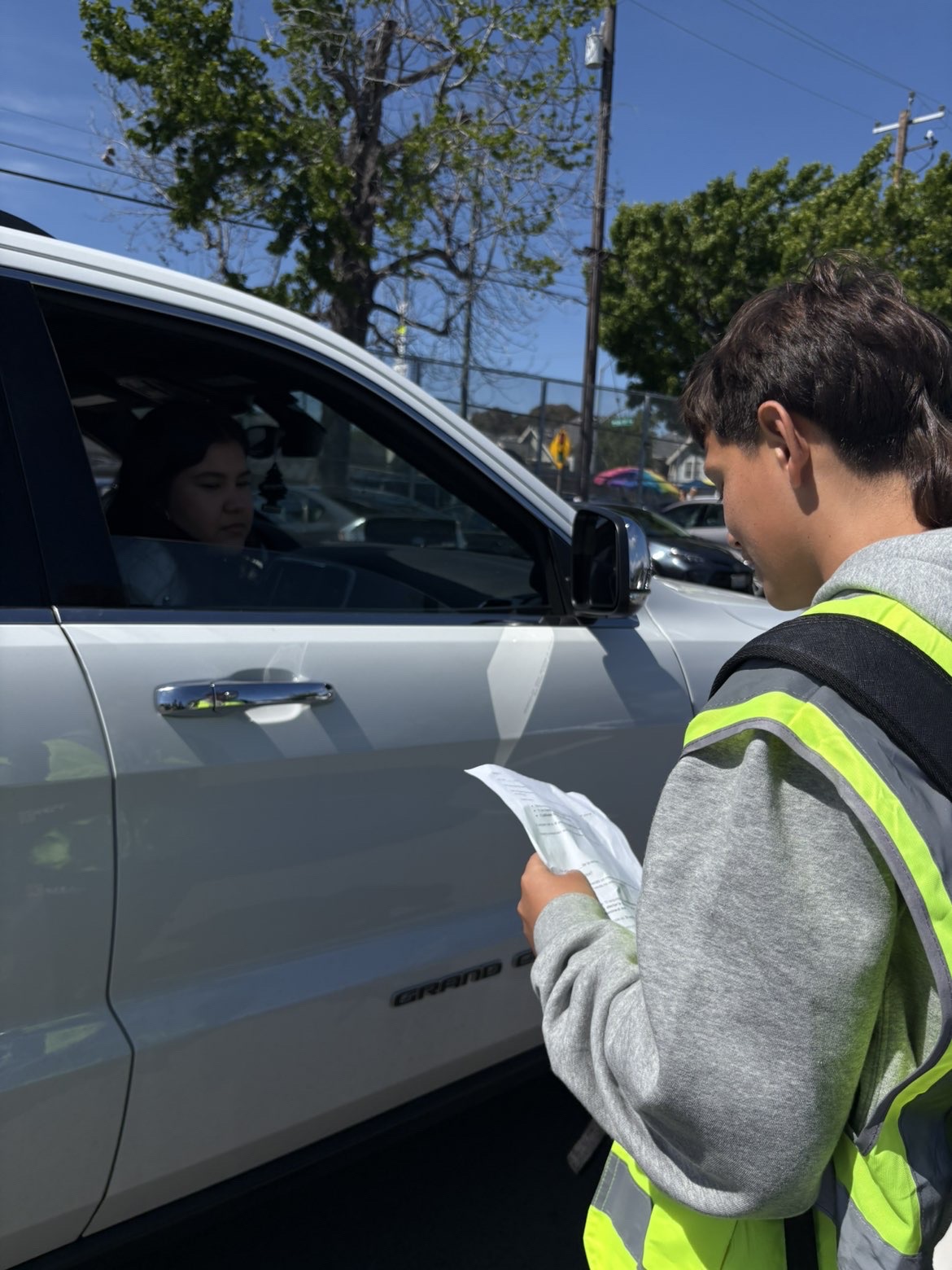 A student at Lazear Charter speaks to a parent driver about the environmental harms of idling. Credit: Esperanza Magallanes
This past semester, with Michaud’s support, Lazear Charter Academy took part in the program under the guidance of science teacher Esperanza Magallanes.
In February, students there observed one day that about half of the 96 cars waiting to pick up kids idled, and those idling minutes added up to three hours in total, or about 9.8 pounds of CO2 per day on average. After a period of outreach to parents in April, the students gathered data again in late May. Unfortunately, idling slightly increased, with cars this time discharging an average of 10.4 pounds of CO2 per day.
Michaud told us it’s not unusual for idling to rise on hot days with average temperatures of 80 degrees, as drivers tend to keep their car engines on to run the air conditioner.
“People do not want to be uncomfortable. Just like in a home environment, we compensate for more extreme temperatures by the clothing we wear and by adjusting HVAC systems,” he said. But he suggested that parents could come up with alternative solutions to idling with the heat or AC on, by keeping warm clothing on hand for cold days or bringing a personal fan when it’s hot. Besides, he said, Oakland’s temperate climate rarely requires even that level of preparation.
Magallanes told The Oaklandside that the idea for getting her school involved began when she was creating a lesson plan on the world’s limited energy resources.
She had her students explore the emissions of internal combustion engines versus electric vehicles, and she asked them to explore the energy involved in producing lithium-ion batteries that power those cars. That lesson sparked classroom discussion about how to eliminate the use of gas. She got in touch with Richard Battersby, of the East Bay Clean Cities Coalition, who put her in touch with Michaud. The Coalition ended up funding the anti-idling program at Lazear.
She said students immediately wanted to learn about idling when they heard about it.
“The idea of turning off the engine is common, that if you leave your car running, it’s bad for the environment,” she said. “Having a name to this idea – idling – brought more awareness. They were very excited about it.”
Some kids were interested in sharing the information with their parents, many of whom were Spanish speakers who lacked access to science-based information about the effects of idling. “They said that a lot of families listened,” she said — though some did not. “But they all said, ‘At least I tried.’”
 Students at Lazear Charter Academy during their campaign to decrease idling emissions. Credit: Wayne Michaud Credit: Wayne Michaud
Gael Ortega-Torres, one of her students, said it was a fun project to work on with friends, especially figuring out together how to communicate creatively with their parents, including through decorative posters. Cynthia Campos, another student in Magallanes’s class, told us she found the project “really impactful” because parents at the pick up spot told her they had reduced their idling as a result.
“Most of them were really surprised about the effects of it and immediately turned off their engines when we explained it — one thanked us,” she said. Campos said the experience made her more interested in pursuing a career as a biologist.
Ortega-Torres told The Oaklandside his parents are among those who are now idling less. He said he’s also more aware of the effects of particulates on the lungs, as someone who plays soccer.
“Kids have athletic or other passions, and pollution might affect you,” he said.
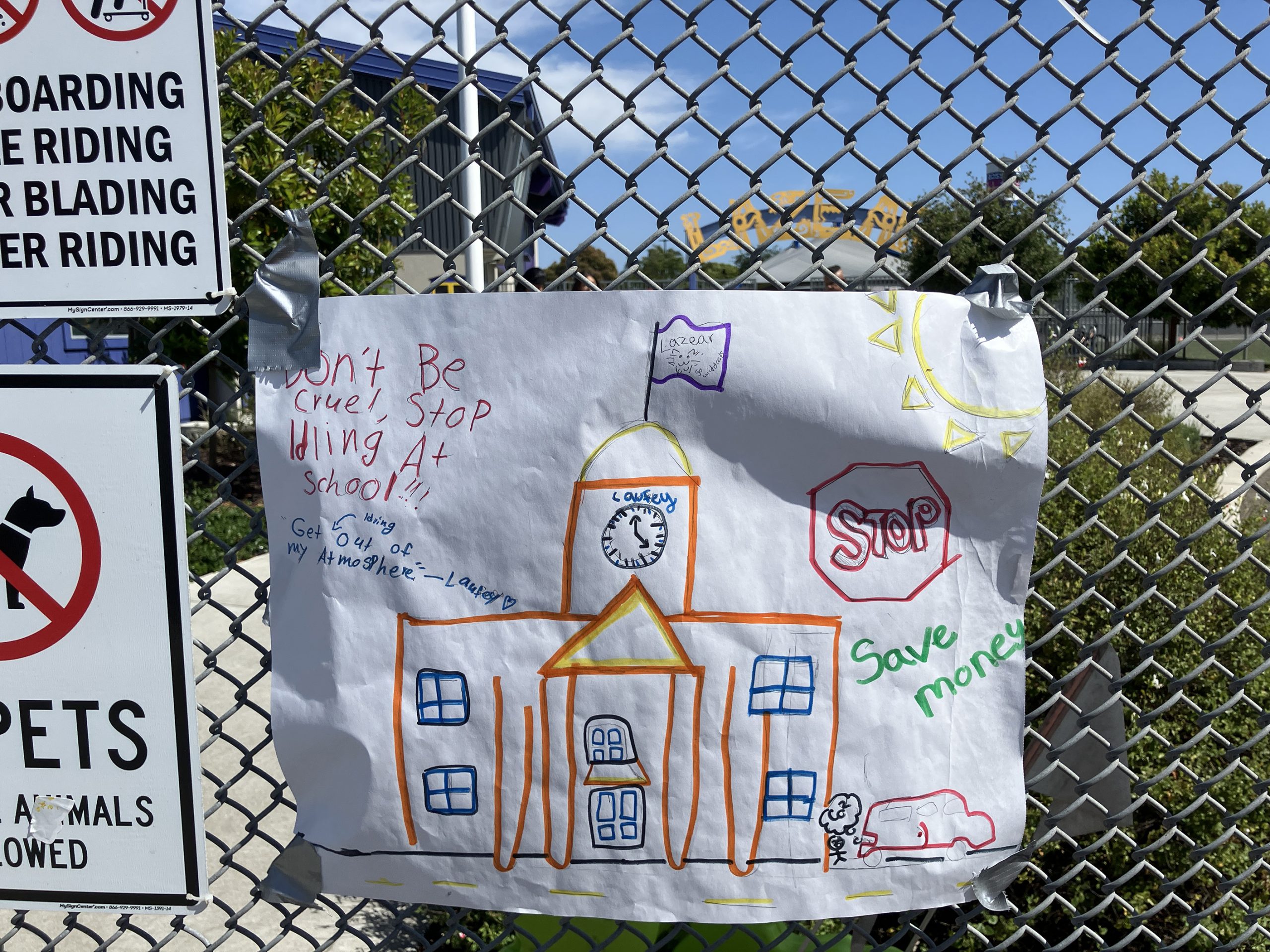 Each student at Lazear Charter created their own version of an anti-idling poster. Credit: Wayne Michaud
On its main program page, Green Driving America notes that the Environmental Protection Agency has found high levels of benzene, formaldehyde, acetaldehyde, and other air toxins at schools during pick-up and drop-off times, which, at high concentrations, can contribute to asthma.
Magallanes said the program can empower students, by showing them they can make a difference in addressing global warming. Last year, during the program at Oakland Tech, students created their own anti-idling YouTube video (featuring some off-color language) that they distributed around the school.
“It’s a lot to process for these kids, and they don’t know what to start with,” she said of climate change. “As a small kid, you want to know you can still make a difference.“
“*” indicates required fields