
California’s Class of 2026 sets new record for completed FAFSA applications | EdSource
This story was originally published by EdSource. Sign up for their daily newsletter.
California’s Class of 2026 surpassed a 70% completion rate for financial aid applications this year, setting a new record, as part of the state’s campaign to boost FAFSA dollars for students, according to the California Student Aid Commission.
“High school seniors, you made history this year,” said Daisy Gonzales, the commission’s executive director. “This milestone is a testament to the hard work of our students, families, educators, and community partners across the state.”
The record completion rate puts the state one step closer to its target goal of an 80% financial aid application completion rate by 2030. The goal was set shortly after a 2022 state mandate made the completion of the Free Application for Federal Student Aid or the California Dream Act application a graduation requirement. More than 325,000 California high school seniors completed their applications this year, a roughly 16% increase from 2019.
The skyrocketing costs have made students increasingly skeptical of dividends paid from a college education. In response, school districts across the state have ramped up outreach and persuasion to help students access aid, including the state’s CalGrants and Pell Grants. Schools in San Diego County, for example, increased their completion rate from 49% in 2019 to 65% in 2026 with schools completing applications for a cash prize.
“The data tells a different story than the headlines: students have not abandoned postsecondary education,” said Catalina Cifuentes, Chair of CSAC. “They are actively pursuing diverse pathways, including career and technical education programs that lead to meaningful careers.”
Students planning to attend a community college still have until Sept. 2 to complete their FAFSA or CADA application.
EdSource is dedicated to covering in California and nationally. Other publications may republish EdSource articles, online or in print, at no charge, provided adherence to our guidelines. The embed code provided here includes a tracking pixel to enable us to measure the reach of our stories. It must be included in any online pickup of EdSource stories.
The following guidelines apply to all EdSource content, including stories, podcasts and video:
Editing stories: Trimming stories for length or adding additional localized reporting is allowed. However, if you wish to make material edits, please contact EdSource for approval prior to publication. Please reach out to Andrew and Smita at republish@edsource.org with questions.
Crediting EdSource: Authors and EdSource should be credited in the byline with a link back to the original article. (This is in the embed code. Please be sure to include it.)
Monetization: EdSource stories cannot be sold, but it’s OK to put EdSource articles on pages with ads.
Photos and graphics: Assets such as photos and graphics must be added manually. Photos taken by EdSource staff may be republished, but some images, such as those from third-party providers (Associated Press, iStock), may not be republished without permission or payment. Proceed with caution. You may also run your own photos with the EdSource story. On occasion, EdSource editors may be able to provide partners with embed codes for graphics or localized data. If you have questions, please contact us.
RSS Feeds: News organizations cannot systematically republish all EdSource articles via RSS feed or other mechanism.
News Brief
Wednesday, June 17, 2026 — 9:25 am
June 17, 2026
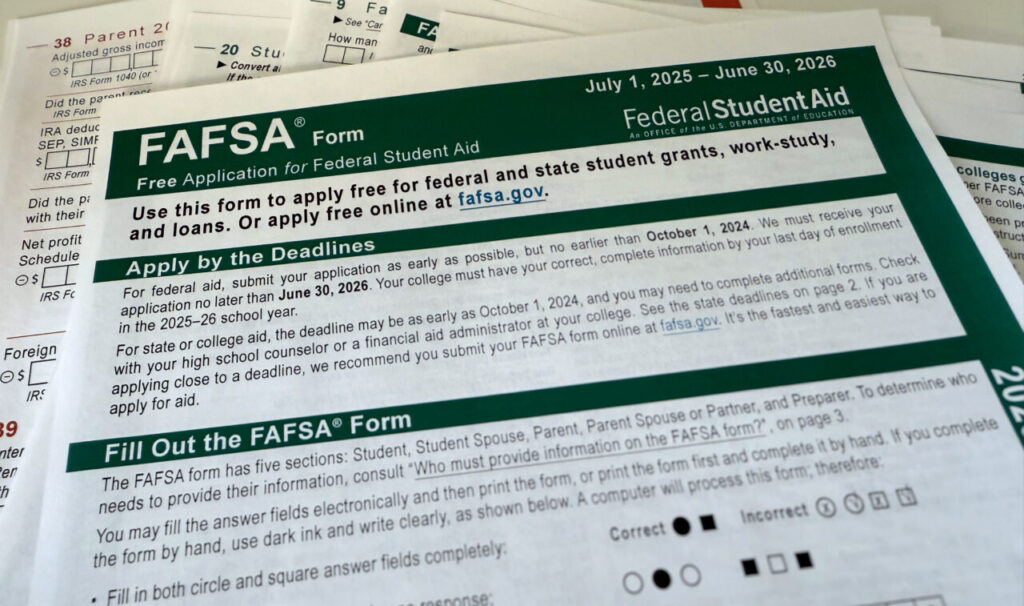
California’s Class of 2026 surpassed a 70% completion rate for financial aid applications this year, setting a new record, as part of the state’s campaign to boost FAFSA dollars for students, according to the California Student Aid Commission.
“High school seniors, you made history this year,” said Daisy Gonzales, the commission’s executive director. “This milestone is a testament to the hard work of our students, families, educators, and community partners across the state.”
The record completion rate puts the state one step closer to its target goal of an 80% financial aid application completion rate by 2030. The goal was set shortly after a 2022 state mandate made the completion of the Free Application for Federal Student Aid or the California Dream Act application a graduation requirement. More than 325,000 California high school seniors completed their applications this year, a roughly 16% increase from 2019.
The skyrocketing costs have made students increasingly skeptical of dividends paid from a college education. In response, school districts across the state have ramped up outreach and persuasion to help students access aid, including the state’s CalGrants and Pell Grants. Schools in San Diego County, for example, increased their completion rate from 49% in 2019 to 65% in 2026 with schools completing applications for a cash prize.
“The data tells a different story than the headlines: students have not abandoned postsecondary education,” said Catalina Cifuentes, Chair of CSAC. “They are actively pursuing diverse pathways, including career and technical education programs that lead to meaningful careers.”
Students planning to attend a community college still have until Sept. 2 to complete their FAFSA or CADA application.
More News Briefs
Tuesday, June 16, 2026, 10:32 am
Tuesday, June 16, 2026, 9:32 am
Supreme Court rejects 2 student speech cases in 1 week
Tuesday, June 16, 2026, 9:24 am
Los Angeles Unified board to vote on cuts to equity, Black student achievement efforts
Tuesday, June 16, 2026, 9:19 am
Long Beach Unified again hires from within for next superintendent
Monday, June 15, 2026, 9:36 am
California sues federal Department of Education over special education cuts
EdSource in your inbox!
Stay ahead of the latest developments on education in California and nationally from early childhood to college and beyond. Sign up for EdSource’s no-cost daily email.
Thanks for signing up!
Stay informed with our daily newsletter