
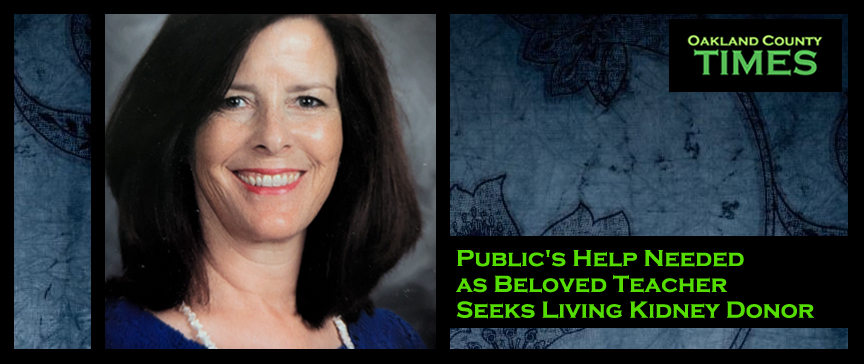
Public’s Help Needed as Beloved Teacher Seeks Living Kidney Donor
(Lara Mossa, June 17, 2026)
TROY, MI – Liz Peters needs your help. The 67-year-old former teacher has been on a waiting list for a kidney transplant for two years.
“She’s a wonderful lady,” said Brandon Hays, Living Donor Ambassador for Give to Live Health. “She’s been working hard, and I just want her to be rewarded. It’s been along road.”
A teacher for more than 40 years – most recently at Marian High School in Bloomfield Hills – Peters has a large family but none of the willing donors have been a good match.
Peters has had kidney disease since 1998 and is now in end stage renal disease, which means she has little to no kidney function left.
“It’s just gradually gotten worse over the years,” Hays said.
Married to Dan Peters, Liz enjoys gardening, playing soccer and traveling. “She made such an impact on so many kids and young adults, I imagine there has to be someone out there who wants to help.”
If you are interested in becoming a donor, the first thing you need to do is reach out to Hays. He will have a 10- to 15-minute initial conversation with you to go over what the testing process includes and answer any questions. Then, the living donor team will contact you and start their evaluation. They will do a health screening over the phone,which includes everything the donor is willing to share about their family history; medications and surgeries they have had.
The next thing to do would be some blood work.
Interested donors will be asked to come to the transplant center at the University of Michigan in Ann Arbor for in-person testing, which would include anything from an MRI,chest X-ray to stress test. They will meet with the entire medical team, including the social worker, nurse coordinator, dietician, surgeon and nephrologist.
The meetings and testing are done during two half days at the hospital. After that, the team will present the donor’s case to the committee and evaluate whether the patient is able to be a recipient.
There are two types of donors – a direct donor and a paired donor. A direct donor is someone with the same blood type and would undergo surgery. A paired donor is someone who has a different blood type and would undergo two surgeries. Being a paired donor takes a little bit longer, but both are a better options than a deceased donor transplant.
“The surgery is a lot more manageable than most people think,” Hays said. The procedure takes about two to three hours; the donor will be in the hospital for one to two days; and then have a two- to four-week recovery. There is no cost to the donors; they do not need to take lifelong medications; nor are they restricted to a specialized diet. “They can return to normal life, and there is no further adjustment,” Hays added.
Donating is not the only way to help. Hays is also looking for ways to spread the message and help Liz find a match.“It really has been an unfortunate stroke of luck with Liz,” he said. “She deserves better. We’re trying, but it hasn’t worked out yet.”
For more information, call Hays at 734-219-9240 or email him atbhays@givetolivehealth.com.
This story is presented without internal advertising due to the nature of the story.
 Save this post to PDF
 Print this post