
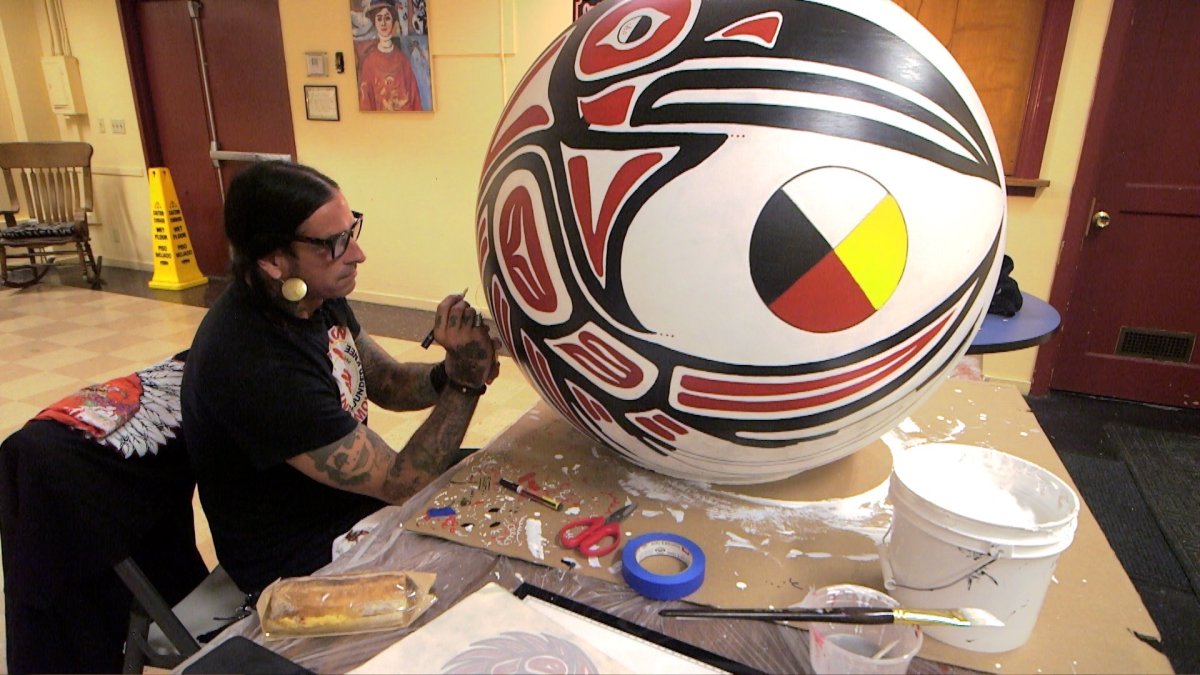
This Saturday at San Francisco’s 16th Street BART Plaza, the city will celebrate the installation of two spheres painted by artists with tribal designs and images as part of the burgeoning American Indian Cultural District.
The spheres were hand-painted by artists Maize Black and Felicia Gabaldon as part of an effort to tell the story of San Francisco’s American Indian community — as the city marks the 250th anniversary of its founding, which drastically impacted the area’s indigenous people who were already living in the region.
“We truly believe this sort of art, this American Indian, this culturally-rooted art is something to elevate as a sense of pride and strengthen this neighborhood,” said Sharaya Souza, executive director of the American Indian Cultural District.
For Black, who is of the Haudenosaunee Mohawk Confederacy and Gabaldon who is Choctaw, the project is an opportunity to feature American Indian art in a prominent location – the 16th Street BART Plaza, which is now designated by the city as part of the American Indian Cultural District.
“This is a raven or a crow,” said Black as he painted a tribal design on the 3-foot orb. “The bird represents basically life.”
The project is partially funded by the city as part of its Indigenize SF Initiative, a project aimed at highlighting American Indian culture through public art, cultural heritage and education programs. Souza said San Francisco’s indigenous communities have been left out of civic conversations far too long.
“A lot of people don’t know that San Francisco is the third largest relocation city in the United States,” said Souza, standing in front of a large mural in the BART plaza depicting American Indian chief. “There are over 18,000 American Indians here in San Francisco.”
The unveiling of the art spheres in the plaza, which will eventually number four, comes as the city marks the 250th anniversary of the arrival of the Anza expedition — a group of colonists led by Juan Bautista de Anza of the Spanish Empire who landed in what would become San Francisco on June 27, 1776, seven days before the signing of the Declaration of Independence at the other end of the continent.
The anniversary is not a happy one for indigenous people whose ancestors were forced to work in the newly built Mission Dolores and the Presidio, stripped of their culture, and exposed to disease, which devastated the population.
“There were several tribes, specifically the Ohlone, who were massacred,” said April McGill, executive director of the American Indian Cultural Center. “Several of our California Indian people were enslaved here, they were trafficked here, and those stories are the ones we’re not really talking about.”
The artworks to be unveiled Saturday are part of a temporary installation but are part of an effort to create a permanent American Indian corridor through the Mission District, named for Mission Dolores, which the colonists built.
“We obviously are still here, we still exist,” said Gabaldon as she painted the figure of a native woman on the sphere. “Which is why this is 250 years of resilience and honoring that.”