
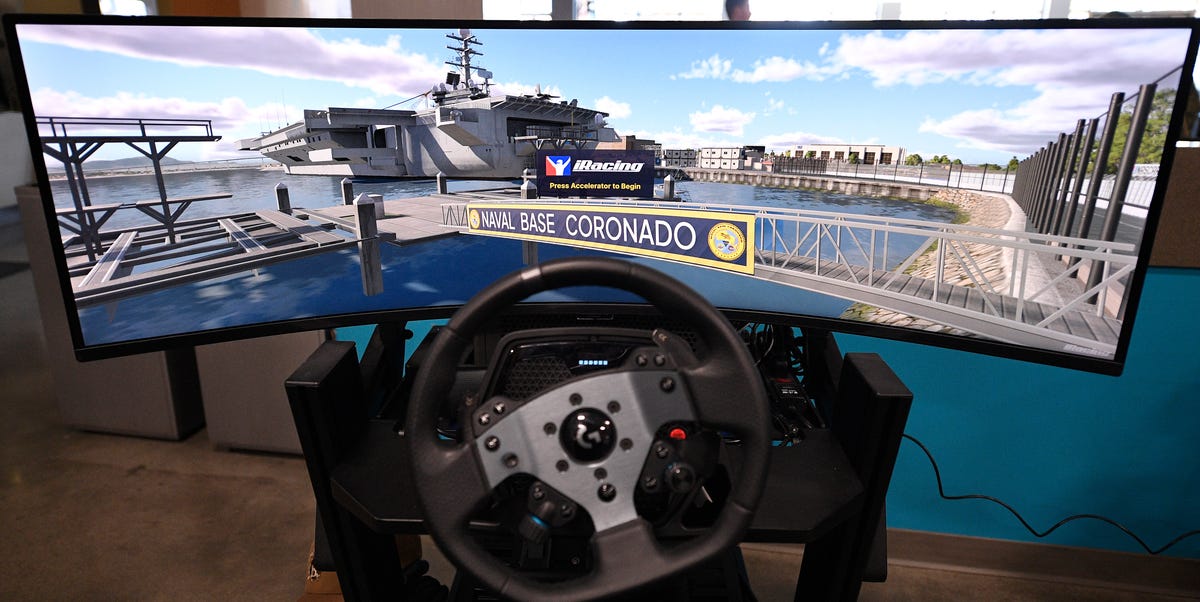
NASCAR’s inaugural foray onto an active military base has resulted in a 16-turn, 3.4-mile course that drivers are describing as the most technical and challenging road course they have ever faced.
“It took me a good 45 minutes to an hour to learn the track and figure out which turn was coming up next,” William Byron said about his time in the simulator. “The middle of the course is very difficult. There’s just a lot of open space that is really not used, so I think you’re going to see a lot of passing opportunities through there. You’re going to see dive bombs because you can give up an exit just to get position on someone, but they might be able to kind of make a run back at you.
“It’s tough. It’s visually difficult because you’re just trying to figure out what corner is coming up next. It is way more complicated… than Chicago was the first time.”
Key areas of the course are:
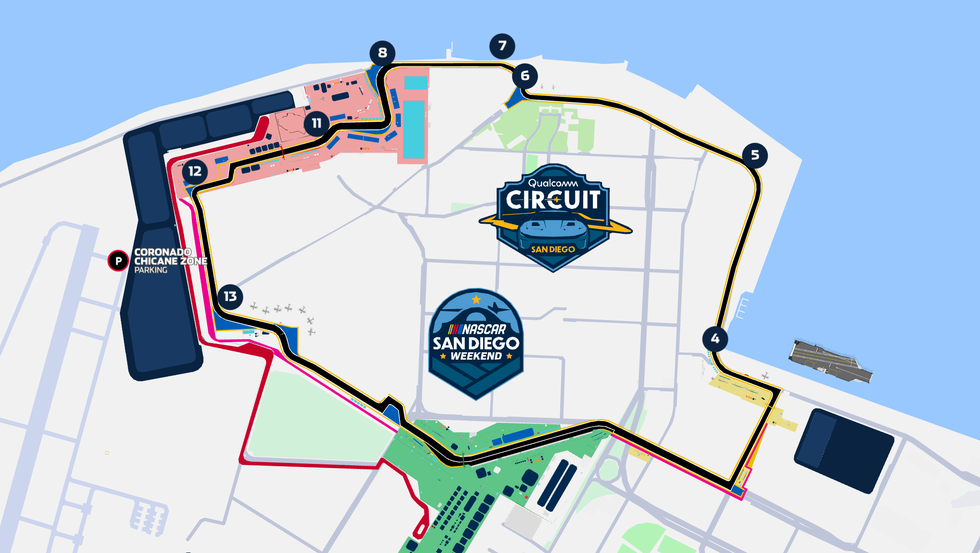
The concrete pit road, which is located between turns 16 and 1. It is rough concrete because it’s where helicopters are parked. The pit road entrance’s design is similar to the one at Sonoma Raceway but the car’s position on it is like Watkins Glen’s. Each team’s pit stall is 28 feet-by-2 inches long and 16 feet-by-6 inches wide. A downhill rise about halfway through turn 1 drops into turn 2.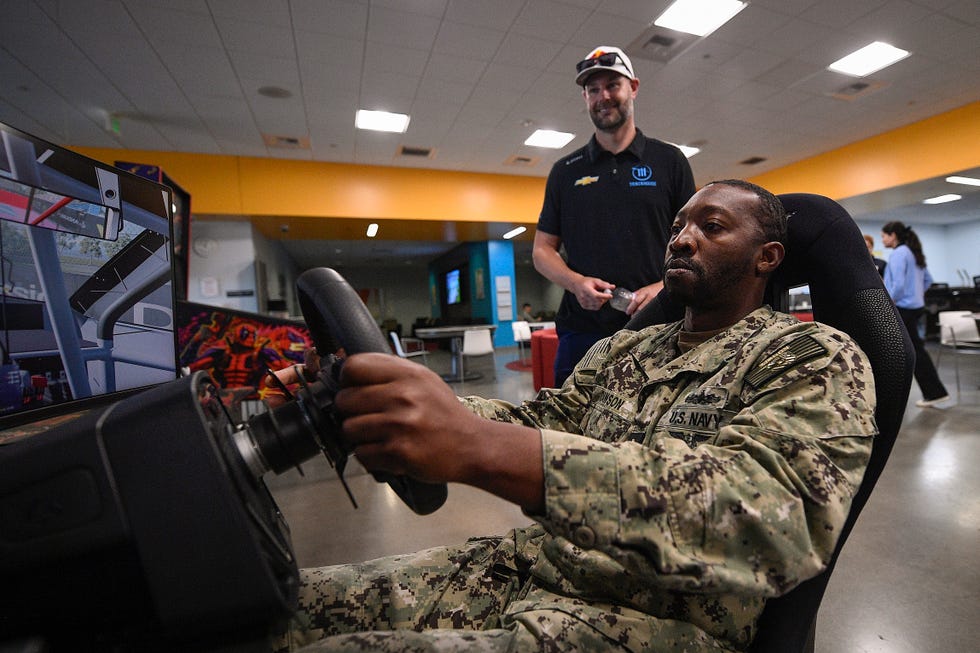 Orlando Ramirez//Getty Images
Shane van Gisbergen watches a US Navy service member drives the NASCAR San Diego course simulator at the Naval Base Coronado.
Spotter locations are turn 2 atop about a barracks building, double-decker busses in turns 5 and 8, and a building by the chicane. Turns 3 and 4 pass by the USS Carl Vinson, a nuclear-powered supercarrier that’s the flagship for Carrier Strike Group 1. Turn 4 has crane rails that have been made smoother. Some pavement was added there as well as in the chicane. The chicane was installed to slow cars for the pit road entrance. The course goes past residences and office buildings. Turn 7 takes the course along the shoreline. Turns 8 through 13 are on the flight line that’s normally home to various equipment, including helicopters and Ospreys.The alternate start/finish line is after turn 15. The restart zone is in turn 16. They can begin racing as soon as they exit it.The choose mark is just before turn 8.
Chase Briscoe considers it the “most technical race track that I’ve ever ran on in my career.”
“You go to some road courses and there’s just some corners that don’t really matter,” Briscoe says. “Like everybody’s going to be the exact same speed through them. San Diego, there’s not a single corner that is not like a massive time game or loss that just compounds the next one. There’s no flow. Every corner is so opposite of the one before it.”
Briscoe has actually had to change his driving style.
“There’s not a single corner that is not like a massive time game or loss that just compounds the next one. There’s no flow. Every corner is so opposite of the one before it.”
“Even sometimes using two or three different driving techniques for two or three different corners in a row,” Briscoe said. “It is an extremely challenging race track.”
Due to the Qualcomm Circuit being on the Naval Base Coronado flight line, its roughness and the big gaps in the concrete remind Shane van Gisbergen of Sebring International Raceway, which was Hendricks Field during World War II. The military base was deactivated in 1946 and the first race held on the concrete runways in 1950.
Van Gisbergen said he had turned some laps on the Naval Base Coronado course on iRacing. He described the layout as “pretty cool”.
 Google Earth
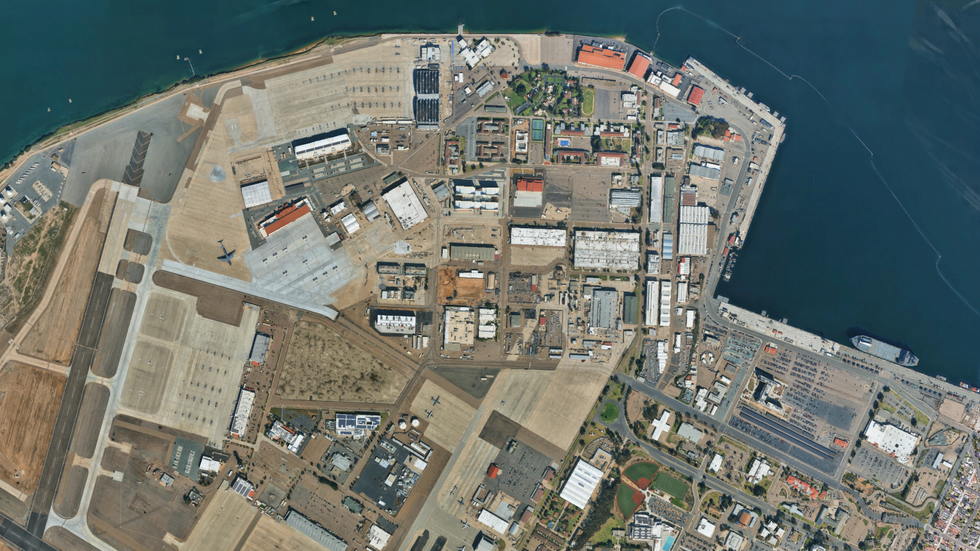
An overview of the area where the course is laid out.
 NASCAR
A map of the course as it runs through the base.
“It’s gonna be really rough and technical,” Van Gisbergen said. “When there’s bumps, it’s all about the car. You’ve got to have good suspension set up, soft and compliant.”
When the course was being developed, NASCAR consulted with various drivers who would go to its research and development center in Concord, North Carolina, to use the iRacing format program. Jerry Kaproth, NASCAR managing director of track development, said the final configuration was close to the one with which they started.
“As we kind of landed on the configuration, we’d go back to the drivers and meet with them regarding some of the competitive locations,” Kaproth said. “We’ve also had drivers on the scene. Once we identified the locations where we wanted some tire packs, we refined that with the UNL (University of Nebraska at Lincoln) staff.”
Bryon noted the Chicago Street Course had several 90-degree turns but was pretty simple in terms of layout, just tight. However, that’s not the case with the San Diego course.
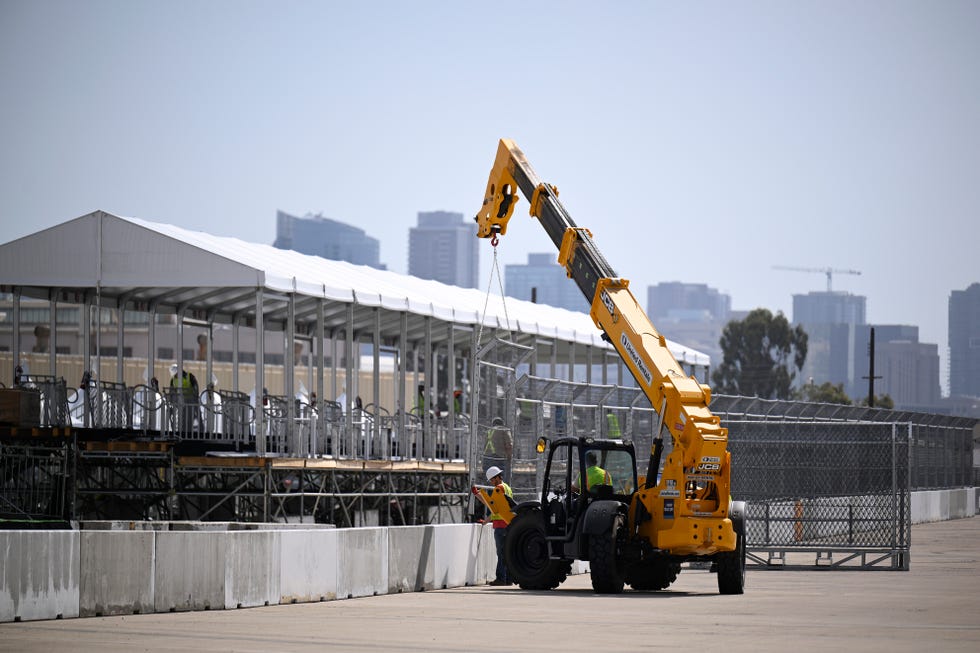 Orlando Ramirez//Getty Images
Construction workers installing fencing.
“San Diego is tight, but also very technical,” Byron said. “I feel like it’s going to be really detrimental if you push too hard in certain sections.”
Jeremy Casperson, NASCAR senior director of design and development, said NASCAR began moving equipment onto the base on May 25. Part of the airfield was closed along the front stretch and construction started on the grandstands and a large hospitality facility on the frontstretch. On June 1, track wall construction began. Casperson said that on June 16, about 98 percent of the right wall was installed and 95 percent of the left wall.
Tim Bermann, NASCAR managing director of competition operations, said caution periods during the race would be “quickie yellows”. The Southern California Association with the SCCA Corner Workers will be used. A blue flag will be waved by the corner workers for a local caution as well as a full course caution.

A North Carolina native, Deb Williams is an award-winning motorsports journalist who is in her fourth decade covering auto racing. In addition to covering the sport for United Press International, she has written motorsports articles for several newspapers, magazines and websites including espnW.com, USA Today, and The Charlotte Observer. Her awards include the American Motorsports Media Award of Excellence, two-time National Motorsports Press Association writer of the year, and two-time recipient of the Russ Catlin award. She also has won an award in the North Carolina Press Association’s sports feature category. During her career, Deb has been managing editor of GT Motorsports magazine and was with Winston Cup Scene and NASCAR Winston Cup Scene for 18 years, serving as the publication’s editor for 10 years. In 2024 she was inducted into the NMPA Hall of Fame.