
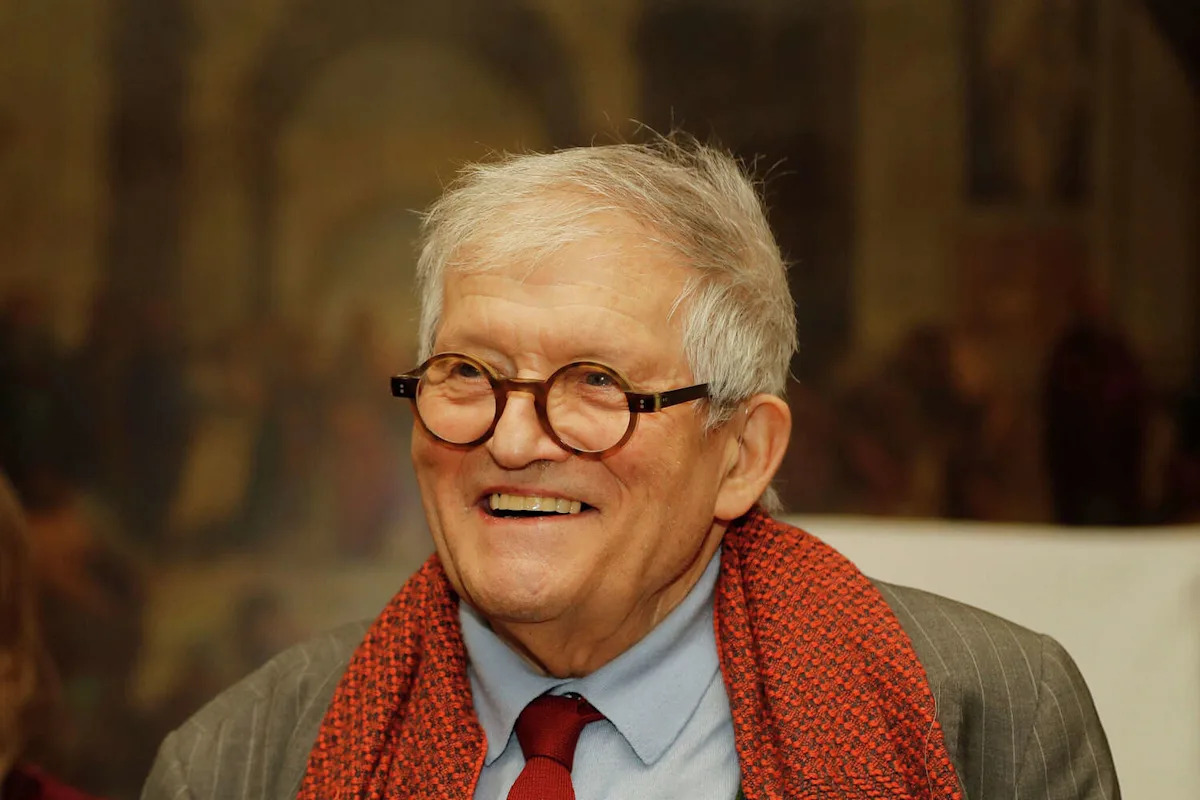
David Hockney will always be linked to Los Angeles, where his paintings of swimming pools, palm trees and modernist homes helped define the image of modern California.
But the British artist, who died June 11 at 88 years old, also left a vivid San Francisco legacy through major exhibitions at the de Young Museum and decades of stage designs for San Francisco Opera.
His work gave Bay Area audiences a Hockney they could not only look at, but also step inside.
Over a seven-decade career, Hockney became one of the most recognizable artists of the postwar era, working across painting, drawing, printmaking, photography, collage, stage design and digital media.
He was famous for his California pool paintings and portraits, but he was also a restless experimenter who moved from acrylics to Polaroids, fax machines, photocopiers, video, iPhones and iPads without abandoning the old discipline of looking closely.
That made San Francisco a fitting place for his work to take root. The city saw both sides of Hockney: the painter whose large museum exhibitions invited viewers into his shifting sense of vision, and the stage designer whose colors, angles and theatrical scale turned opera into a walk-in painting.
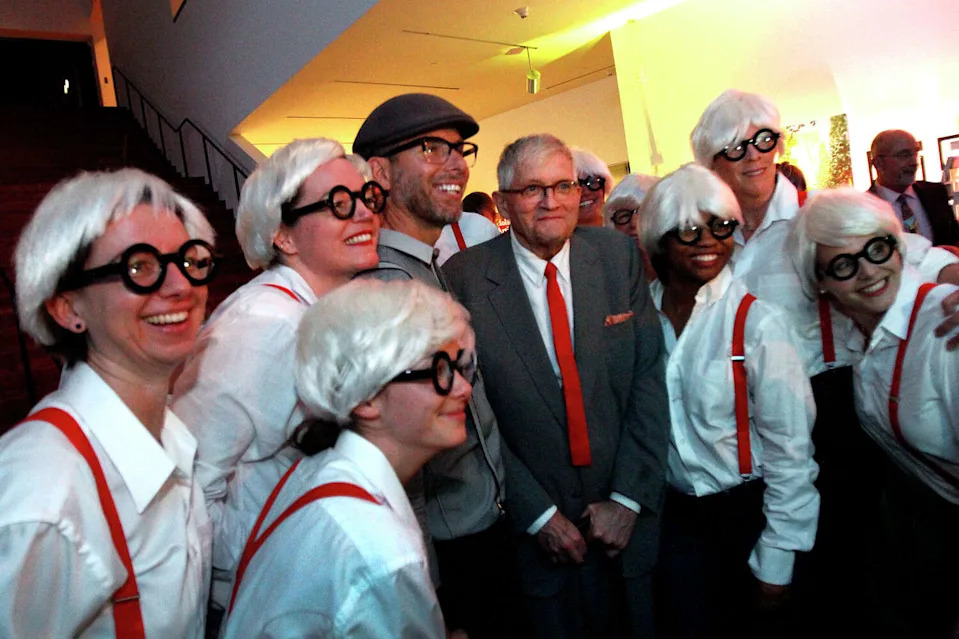
The artist David Hockney poses for a photograph with a group dressed like him at the de Young Museum in San Francisco, Calif., on Thursday, October 24, 2013. (Sarah Rice/Special to The Chronicle)
At San Francisco Opera, Hockney’s work became part of the company’s visual identity for more than 40 years, beginning with “The Rake’s Progress” in 1982.
Audiences saw his set and costume designs for Stravinsky’s “The Rake’s Progress,” Mozart’s “The Magic Flute” and Wagner’s “Tristan und Isolde,” as well as his set designs for Puccini’s “Turandot” and Strauss’ “Die Frau ohne Schatten,” according to the company.
“David Hockney spent a lifetime at the very front edge of artistic possibility,” San Francisco Opera General Director Matthew Shilvock said in a statement after Hockney’s death. “He was as groundbreaking in his 80s as he was in his 20s, and it’s thrilling to feel that immediacy on the opera stage.”
Shilvock said the opera stage was a natural canvas for Hockney’s “bold embrace of color,” explorations of perspective and “fusion of the intimate and epic.”
“There was something so natural to David about the canvas of a 50-foot-wide stage,” Shilvock added. “It was the perfect place to bring to life his bold embrace of color, his groundbreaking explorations of perspective, and his fusion of the intimate and epic.”
In 2017, after a performance of “Turandot,” Shilvock presented Hockney with the San Francisco Opera Medal, the company’s highest honor.
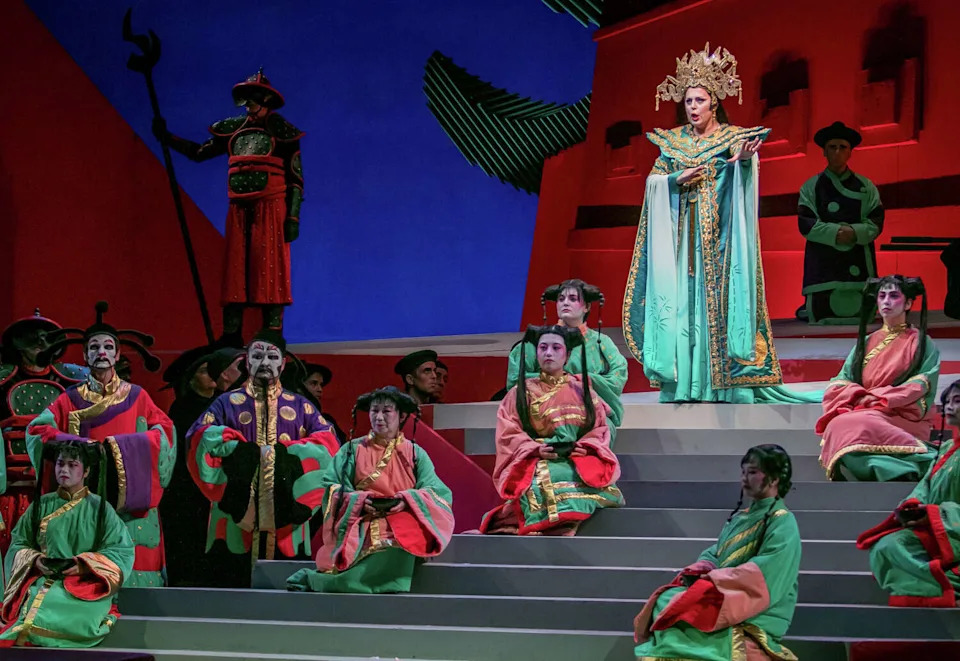
Turandot at the Opera House in San Francisco, Calif., is seen on September 5th, 2017. (John Storey/S.F. Chronicle)
But Hockney’s San Francisco connection extended beyond the opera house.
In 2013, the de Young Museum opened “David Hockney: A Bigger Exhibition,” a major survey of more than 300 works, including paintings, watercolors, charcoal drawings, digital works and multiscreen videos. The exhibition focused on Hockney’s recent work and his use of new technology, including drawings made on iPhones and iPads.
Born July 9, 1937, in Bradford, England, Hockney grew up in an industrial city in West Yorkshire and studied at the Royal College of Art in London. He emerged in the 1960s as one of the best-known figures associated with British pop art, though his work never fit comfortably inside a single movement.
He first visited Los Angeles in the 1960s and found a subject that would help define him. Southern California’s hard light, clean architecture, swimming pools and freer social atmosphere gave him a visual world far removed from postwar Britain. His paintings of pools and modernist homes became icons of California leisure, but they also carried something more personal: a vision of desire, domesticity and freedom.
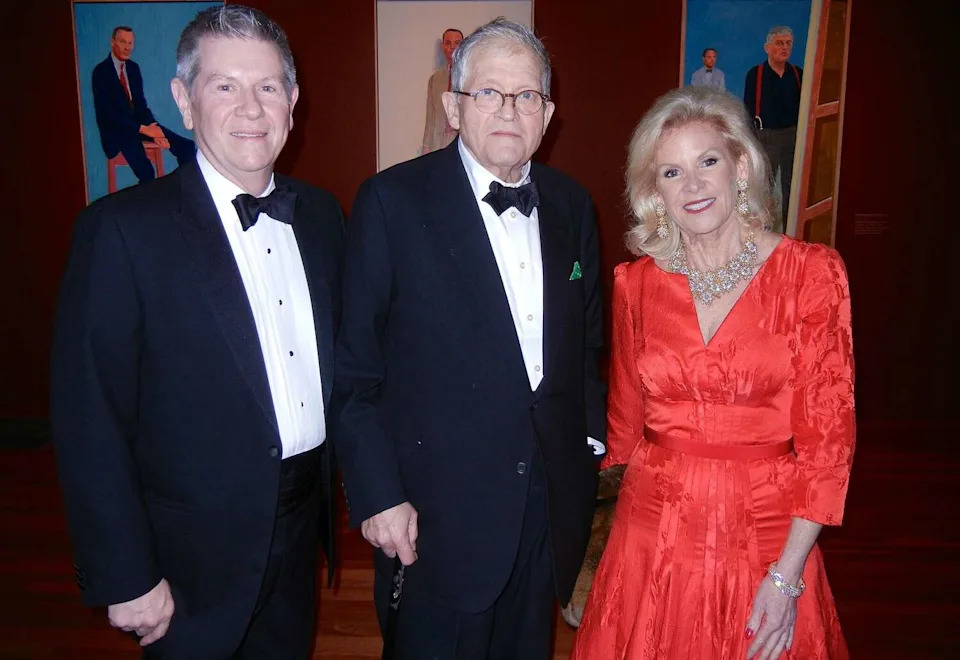
Fine Arts Museums Deputy Director Richard Benefield (at left) with artist David Hockney and FAM Board President Dede Wilsey at the de Young Museum. Oct. 2013. (Catherine Bigelow/Special to The Chronicle)
At a time when homosexuality was still criminalized in Britain, Hockney’s early work treated gay life not as a coded secret but as a visible subject. His paintings and drawings of men, lovers and friends helped make him an important figure in queer art history as well as contemporary painting.
He later became known for psychologically acute portraits of friends and family, experiments with Polaroid collage, theories about optics and Old Master painting, stage designs for major opera houses, vast landscapes of Yorkshire and Normandy, and digital drawings made on phones and tablets.
“It’s my work that keeps me young,” Hockney told the Sun newspaper in 2017. “I’ve been a professional painter for 60 years. Sixty years of getting up every day and doing exactly what I want to do.”
His 1972 painting “Portrait of an Artist (Pool with Two Figures)” sold at Christie’s in 2018 for $90.3 million, a record auction price for a living artist at the time.
Hockney’s fame never seemed to harden him into one kind of artist. He kept shifting medium and methods, but the through line was always perception – how a person sees, how a picture changes what can be seen, and how technology can expand rather than cheapen the handmade image.
In San Francisco, his designs gave audiences a Hockney they could walk into. Color rose above singers, tilted beneath dancers’ feet and stretched past the edge of the stage.
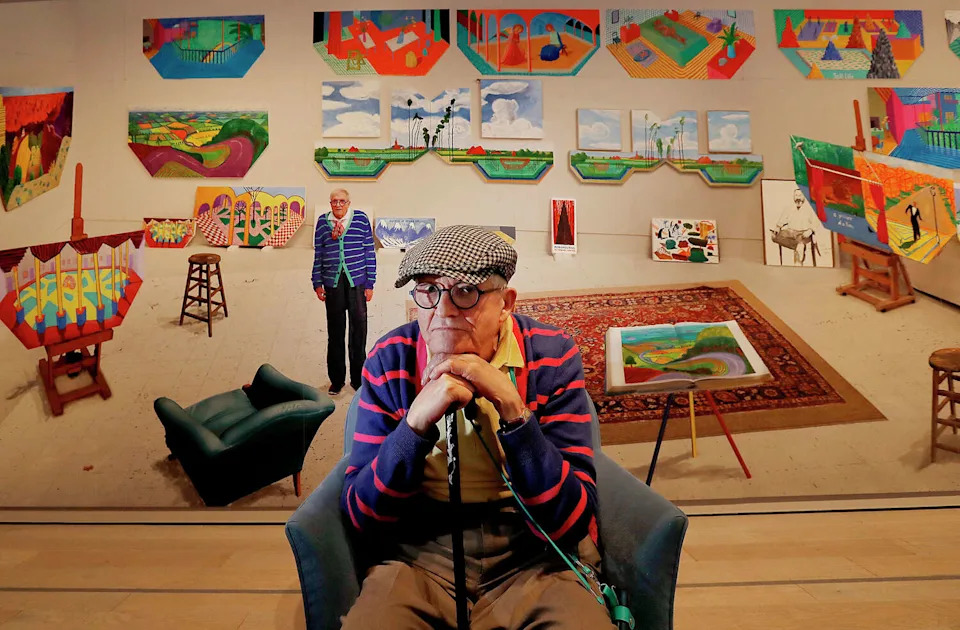
Artist David Hockney at the Los Angeles County Museum of Art in Los Angeles, California on April 11, 2018. (Luis Sinco/TNS)
After Hockney’s death, Shilvock said the artist’s work had filled the War Memorial Opera House “with color, light, love, and the most glorious storytelling” for more than 45 years.
“It has been an extraordinary privilege to have his work fill our theater with color, light, love, and the most glorious storytelling for more than 45 years,” Shilvock said. “His visit in 2017, and the generosity with which he spent time with so many of us backstage, is a wonderful memory that we will hold close in our hearts.”
Gov. Gavin Newsom and First Partner Jennifer Siebel Newsom also issued a statement remembering Hockney, a California Hall of Fame member, as an artist whose work reflected the state’s warmth.
“David Hockney was immensely creative, curious, and generous with his art, inspiring countless artists and viewers over the decades,” Newsom said. “A British transplant to Los Angeles, he soaked up the California sunshine and gave that warmth back to the world tenfold. He will be deeply missed.”
Subscribe
There’s more to San Francisco with the Chronicle. Subscribe today for just 25¢.
This article originally published at David Hockney, who made California glow, left a vivid mark on San Francisco.