
LOS ANGELES — The Holocaust Museum Los Angeles is the oldest museum in the country. It’s dedicated to preserving, protecting and sharing the devastating history of Jewish life under Nazi rule.
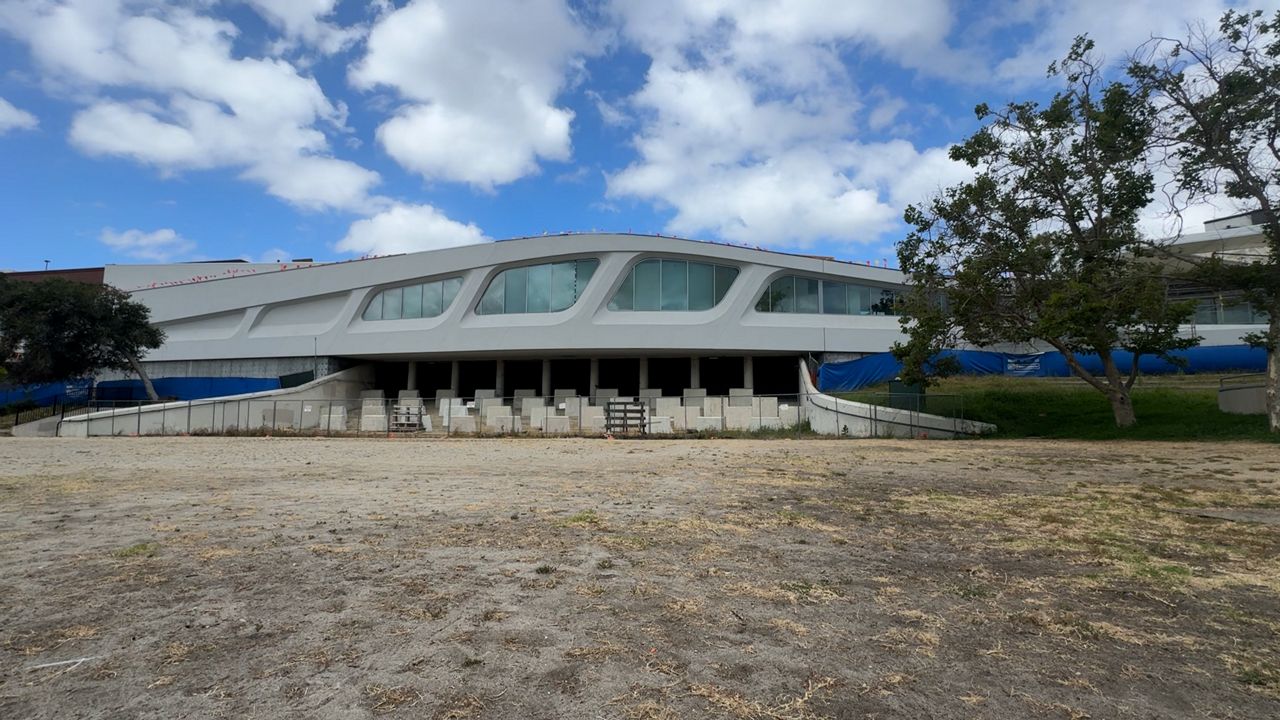
The museum was founded in 1961, and this summer, an extensive expansion of the museum, The Goodrich Cultural Center, is set to open. The Goldrich will double the museum’s space and will be able to welcome 500,000 visitors per year. The former footprint welcomed 75,000 visitors per year.
The new modern space is connected to the original museum, both designed by architect Hagy Belzberg. The original museum space is mostly underground, while the Goldrich sits above ground — light pours into the main exhibit space through floor to ceiling windows.
“We opened it up to the park, so that as you are viewing the exhibit, you are also seeing the park at the same time. There’s this wonderful dialog that can take place,” Belzberg said on a recent site visit.
Belzberg and museum CEO Beth Keane were touring the site as it neared completion.
“This is the vision of our founders. We are really building on their vision. Jona Goodrich was one of our founders, and he was a true visionary. He always said, ‘We need to teach the younger generation about the worst atrocity that existed,’” Keane said.
Central to the museum’s growth is the addition of historic artifacts, including a boxcar, a piece of the massive network of trains that travelled throughout Europe during the Holocaust and brought Jewish people to concentration camps.
The boxcar that is now at The Holocaust Museum arrived in 2024, donated by a descendant of Holocaust survivors. Belzberg designed a room around the boxcar. It’s one of just thirteen boxcars like it in the U.S.
“What we do here is we bring you from below so you see the size, the enormity of it all, and we slowly bring you up and around so you are level with the entry of the boxcar itself. To see one of these in real life, it’s shocking, it’s gutting. I mean, these transported hundreds of people to their death,” Belzberg said.
For the LA-based architect, working on this large-scale project has been personal. Many of Belzberg’s own family members were sent to concentration camps.
“My father lost his entire family in the Holocaust, other than his mom. They escaped from Poland. He lost aunts, uncles, cousins, other relatives, friends.”
Belzberg believes his relatives would find solace in the fact that there are places like the Holocaust Museum LA dedicated to preserving this history.
“I think they would be so happy that there are some opportunities to have conversation, about how this can never happen again to any group of people,” Belzberg said.
A key piece of that dialog will take place thanks to extraordinary technological innovation. The museum has partnered with the USC Shoah Foundation, which has collected many hours of interviews from Holocaust survivors. The interviews, recorded using natural language technology, a type of AI, allow viewers to ask survivors questions in a new, state-of-the-art theater.
Belzberg said he hopes the building, exhibits and artifacts in it foster conversation about tolerance and respect.
“It’s not a Jewish story, it’s a humanity story,” he said. “We are using the Holocaust as a case study so that we ask the question, why? And ask how to prevent this.”