
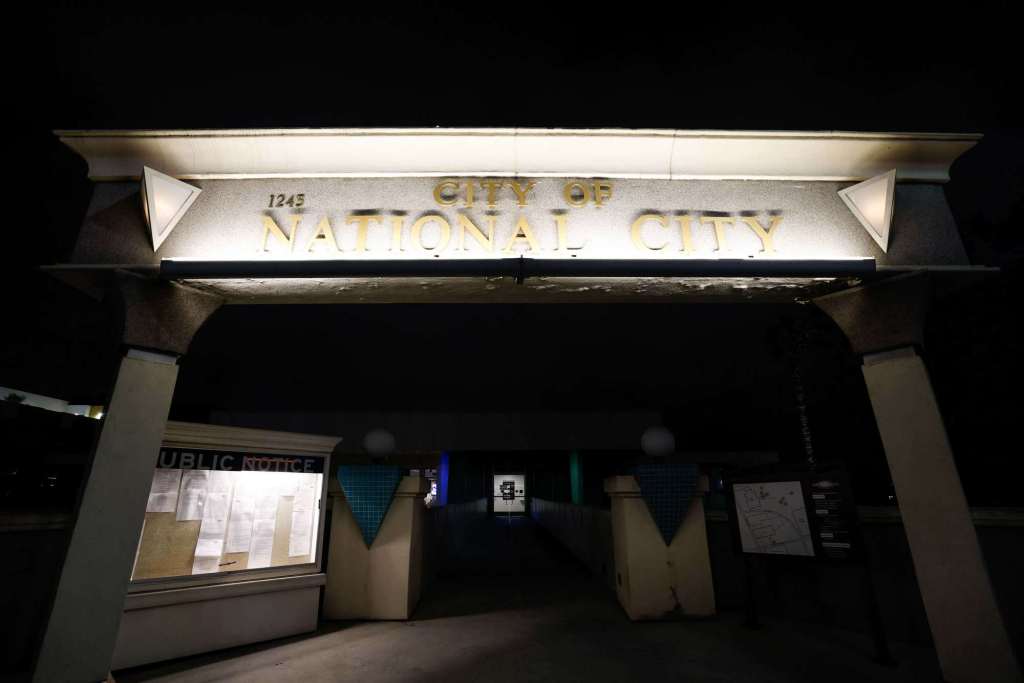
National City is a working-class community of roughly 56,000 residents spread across 7 square miles. Most residents are focused on paying their bills, raising their families and getting through another workweek. They should not have to become budget experts to understand when their city is facing financial trouble.
Yet that is exactly where National City finds itself today after its leaders approved an $89.1 million budget for the fiscal year that starts July 1.
After reviewing the budget, city audits and financial reports, and listening to council discussions, one conclusion stands out: National City faces significant fiscal challenges that deserve an honest public discussion, not political spin.
The city’s adopted fiscal year 2026-27 budget projects a structural deficit of approximately $12.7 million. At the same time, residents are being told not to worry because the city has nearly $100 million in investments.
But this claim is misleading. Investments do not necessarily mean money is available to spend. There are many restrictions on their use. The city’s investment portfolio is not a surplus. It represents the city’s total investment position, much of which is legally restricted, committed, assigned for specific purposes or needed for day-to-day operations. Those restrictions matter. These funds cannot simply be treated as an unlimited source of money to cover recurring deficits.
What concerns me even more is the growing effort by some elected officials to dismiss basic governmental budgeting concepts altogether. Phrases such as “scarcity mentality” and other distorted comparisons are being used to portray reserves as unnecessary stockpiles of cash rather than essential financial safeguards.
Government reserves exist for a reason. Some reserves are legally restricted. Others are committed or assigned for specific obligations, emergencies, economic uncertainties, infrastructure needs or future liabilities. Only a small portion is truly unassigned and available for unexpected events.
These distinctions are not accounting jargon. They are the foundation of responsible financial management.
Yet some elected officials appear to be escalating the narrative by treating all reserves as interchangeable in a failed attempt to imply the city has more discretionary funds than it actually does. If every reserve dollar is considered available for spending, reserve policies become meaningless. I refer to this mindset as “reserve denial accounting” — the belief that restrictions do not matter, emergencies never happen and every dollar can be spent today.
The number residents should be paying attention to is not the city’s total investments. It is the general fund’s unassigned reserve balance. That is the city’s primary financial safety net.
Current projections presented at the city’s May budget workshop indicate that balance could fall to $487,598 by June 2027. For a city operating with a general fund budget approaching $89.1 million, that is an extraordinarily thin cushion against emergencies, economic downturns, public safety incidents, or unexpected costs.
The Government Finance Officers Association recommends, at a minimum, that governments maintain unrestricted reserves equal to no less than two months of general fund operating expenditures. For National City, that benchmark would be roughly $15 million — not less than $500,000.
Meanwhile, personnel costs continue to rise, pension obligations continue to grow and projected revenue growth remains modest. The city is increasingly relying on future revenue initiatives and assumptions that have yet to materialize.
The real issue is governance.
Long-term financial commitments have been approved while recurring revenues have struggled to keep pace. Structural deficits have become recurring rather than temporary. Difficult decisions have repeatedly been delayed. That is why hearing elected officials dismiss or redefine fundamental reserve concepts is troubling. Reserves are not the problem. The inability to align recurring spending with recurring revenues is the problem.
Residents deserve more than competing political narratives. They deserve transparency, accountability, measurable goals and a realistic plan to restore the city’s financial stability.
Good intentions are not a financial strategy. Political slogans are not a budget plan.
Ignoring a structural deficit does not eliminate it. Redefining reserves does not create new money. Eventually, financial reality catches up.
National City’s residents deserve leaders willing to confront that reality rather than explain it away.
Nieto is a retired governmental accountant who lives in National City.