
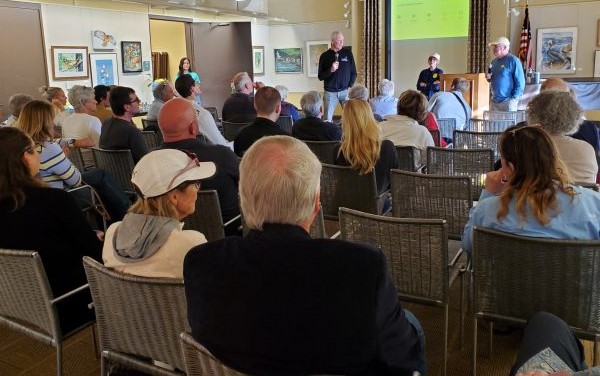
It’s been a busy month for organizers of La Jolla’s cityhood effort.
Members of the Association for the City of La Jolla, who have been working for nearly five years to have La Jolla detach from San Diego and become its own city, learned this week who will be leading the required comprehensive fiscal analysis on the proposed city’s feasibility and received an updated timeline for when the report may be completed. And they were handed a penalty for filing late monthly campaign statements.
Fiscal analysis
ACLJ announced June 17 that London Moeder Advisors, led by Gary London, was selected by a committee of the regional Local Agency Formation Commission to conduct the comprehensive analysis on the likely financial impact of a La Jolla secession.
The selection committee consisted of representatives of ACLJ; San Diego LAFCO, which provides guidance to communities seeking to become cities; the San Diego mayor’s office; the San Diego Municipal Employees Association and the San Diego Regional Chamber of Commerce.
London “is one of San Diego’s most respected and most candid real estate economists,” ACLJ said in a statement, and his appointment offers “an independent voice with the standing to be believed.”
London said in a statement that “we recognize that no city in California has previously formed when part of an existing city. As such, we are committed to conducting a fair and independent fiscal analysis which carefully addresses fiscally sound approaches to how to achieve this should San Diego voters favor the proposal.”
An election on the cityhood application, should LAFCO approve it, would require a majority of voters both in La Jolla and the rest of San Diego to give their blessing. ACLJ has said it hopes to have the matter on the ballot in 2028.
The planned city of La Jolla would have about 38,000 residents over 14 square miles, largely aligning with the 92037 ZIP code. The boundaries would stretch north-south from Del Mar to Pacific Beach and east-west from Interstate 5 to the ocean, excluding UC San Diego.
Members of ACLJ have met since September 2021 and been a frequent presence at community meetings and events.
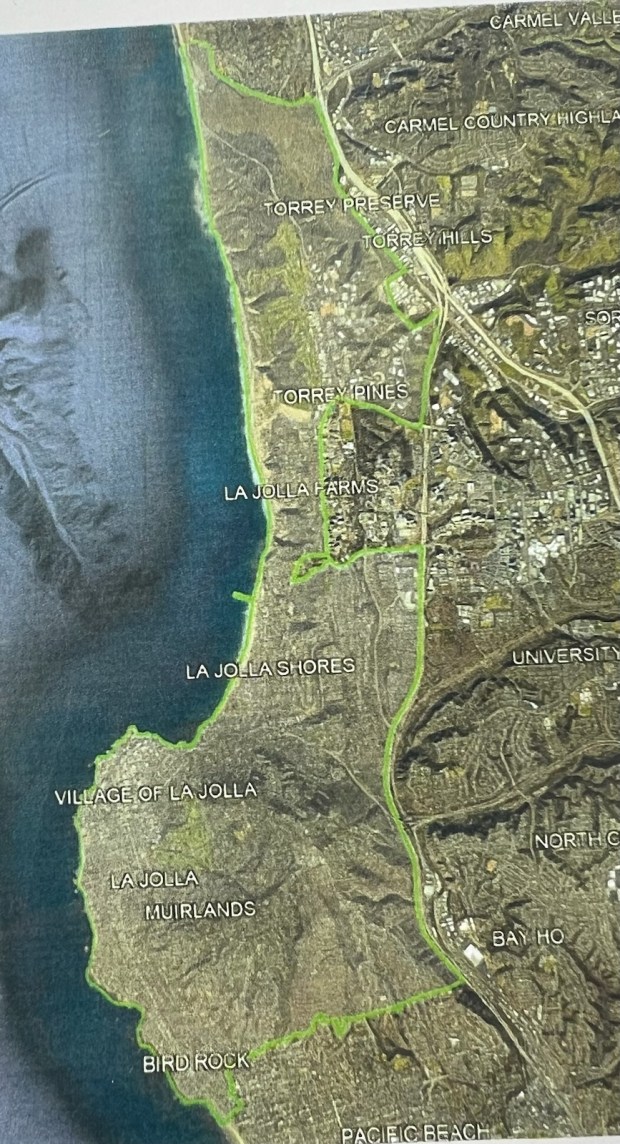 The map of a potential city of La Jolla largely aligns with the 92037 ZIP code, stretching north-south from Del Mar to Pacific Beach and east-west from Interstate 5 to the ocean, excluding UC San Diego. (Association for the City of La Jolla)
A preliminary fiscal analysis completed last year by Richard Berkson of urban economics company Berkson Associates estimated San Diego would lose $8.5 million in annual revenue as a result of La Jolla’s departure.
That raised the possibility that La Jolla would need to make annual mitigation payments, or “alimony,” to San Diego, since “state law prohibits LAFCO from approving and incorporating [La Jolla] if it causes adverse financial impacts on another public agency, in this case the city of San Diego, and unless there is an agreement in place between La Jolla and San Diego,” the report stated.
The analysis did not estimate the amount of any such payments, saying it would “be negotiated between the two cities during the LAFCO process.”
Though Berkson’s preliminary analysis painted a fairly optimistic picture — projecting a first-year city budget for La Jolla of $74.8 million and a surplus of $8 million — the final report will dive deeper into the facts and figures.
Story gallery: “Leaving San Diego?” A series about potential La Jolla cityhood
Updated timeline
In announcing London’s involvement in the comprehensive fiscal analysis, LAFCO said it expects the project to kick off next month and continue until June 2027, when the draft CFA would be given to the city of San Diego and made available for public view.
Following community workshops, the final report would be expected around January 2028, though that is subject to change.
The comprehensive fiscal analysis serves the purpose of “independently verifying [the preliminary report’s] assumptions rather than adopting them wholesale,” according to LAFCO.
La Jolla resident and former San Diego city manager Jack McGrory, who now is ACLJ’s chief negotiator and strategic adviser, said in April that the CFA is “a tough study.”
“[The analysis] will have to go into the city budget, extract all the information for La Jolla … across all the city departments,” McGrory said.
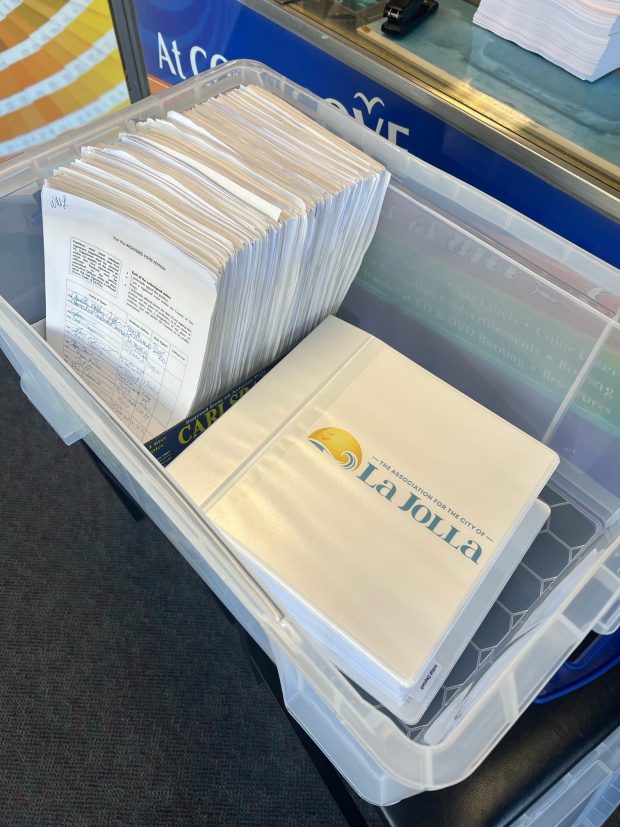 An application was submitted in January 2025 to the San Diego Local Agency Formation Commission by a group of La Jolla residents as part of an effort to turn La Jolla into its own city. (Association for the City of La Jolla)
Late campaign statements
The Association for the City of La Jolla will have to fork over a $2,500 penalty to the state over a failure to produce monthly campaign statements. The group blamed a “technical error” caused by mixed messaging.
According to the California Fair Political Practices Commission, ACLJ “failed to timely file monthly campaign statements, in violation of Government Code Section 84252,” from May 1, 2024, to Nov. 15, 2025.
Section 84252 stipulates that committees formed to support or oppose a LAFCO matter must file all required statements “on the 15th day of each calendar month, covering the prior calendar month, with the clerk of the county in which the measure may be voted on.”
Nineteen campaign statements were not filed on time, according to the FPPC. In nine of those months, there were no expenditures or contributions.
“We’re trying something that really hasn’t been done before, so there’s a great deal of confusion on how to do it,” said ACLJ President Diane Kane.
She added that the distinction was unclear between what is considered political and non-political activity.
“We’re finding that we’re making the playbook up as we go and we’re getting caught in between various entities that will give us information telling us to do one thing and then that will be contradicted by another source,” Kane said.
When ACLJ became aware of the violation, it self-reported it to FPPC and the issue was corrected Dec. 16, according to a commission report.
The maximum penalty for similar violations is $5,000. But by reporting the error themselves and not having previous violations, cityhood advocates instead will pay $2,500.
The FPPC report states “the committee was cooperative during the investigation and exhibited their intent to resolve the issue expeditiously.”
The commission approved the penalty June 18.
The road to today, and the campaign to come
At a community meeting April 28, McGrory said he expected the cityhood effort to face more challenges in coming months and years.
The city of San Diego filed a lawsuit in June 2025 calling on LAFCO to rescind a ruling allowing the effort to move forward. LAFCO had issued a “certificate of sufficiency” indicating ACLJ had gathered the number of signatures required on a petition to keep the movement alive.
ACLJ responded with a court motion arguing that the city’s case was a strategic lawsuit against public participation, or SLAPP, calling it a “meritless attempt to obstruct democratic participation and silence a public interest effort through costly litigation.”
In October, Superior Court Judge Judy Bae granted ACLJ’s motion, dismissing the city’s lawsuit and allowing LAFCO to move to the next steps in the process, including the comprehensive review of the proposal’s feasibility.
San Diego decided not to appeal the judge’s ruling, though the city attorney’s office did not comment further.
The city had argued in its lawsuit that LAFCO overstepped in the process of verifying the petition signatures and that the La Jolla cityhood review process would impose “substantial irreparable harm” on San Diego due to the costs associated with staff time required for the next steps.
McGrory said he expects more conflicts with the city. “There is going to be a lot of litigation, and the city is going to be all over us,” he said in April.
Another challenge for ACLJ is that it would have to persuade a majority of voters not only in La Jolla but also throughout San Diego to approve the detachment.
McGrory said in April that the association was “exploring other paths” to determine whether a citywide vote actually would be needed, but he did not elaborate.
The association is raising funds for future expenses and to this point has $174,000 in the bank and an additional $200,000 in community pledges, according to ACLJ Vice President Ed Witt.
The group is setting its 2026 fundraising goal at $1 million.
— La Jolla Light staff writer Ashley Mackin-Solomon contributed to this report. ♦