
Is it any surprise that San Francisco — The City that nurtured abstract expressionist legends like Clyfford Still and Jay DeFeo — was at one time the epicenter of partisan gerrymandering?
One notorious U.S. House district, which one might call “the Pollock,” splashed from Vallejo through Marin, hopped the Golden Gate, hugged San Francisco’s industrial east side, then jackknifed into Daly City. The late, great Philip Burton, maestro of the map, designed it for his brother John; Barbara Boxer later won the seat after a bruising primary, and the rest is congressional history. The lines were shameless, the logic ruthless, the results brutally effective.
In the early 2000s, California produced even more avant-garde maps, punctuated by Congresswoman Lois Capps’ 23rd District. Commonly known as the “Ribbon of Shame,” the district stretched some 200 miles down the central coast from Cambria to Oxnard, narrowing to 2 miles wide at points. The infamous ribbon was a key contributor to then-Gov. Arnold Schwarzenegger’s reform agenda, which successfully wrestled the pen from politicians and put it in the hands of an independent commission. For a decade, we held ourselves out as the republic’s redistricting adults.
Sensing an open playing field and a midterm threat to their power, Republicans have sprinted back to the redistricting easel. In Texas, Indiana, North Carolina, and Ohio, Republican legislatures are sculpting safe seats at a pace that would make Michelangelo blush, all in a cynical effort to lock in a House majority for 2026. This is not conjecture; it is the strategy. After President Donald Trump’s “stop the count, count the votes” carnival failed in 2020, the game moved upstream: If you can’t conjure ballots, conjure districts.
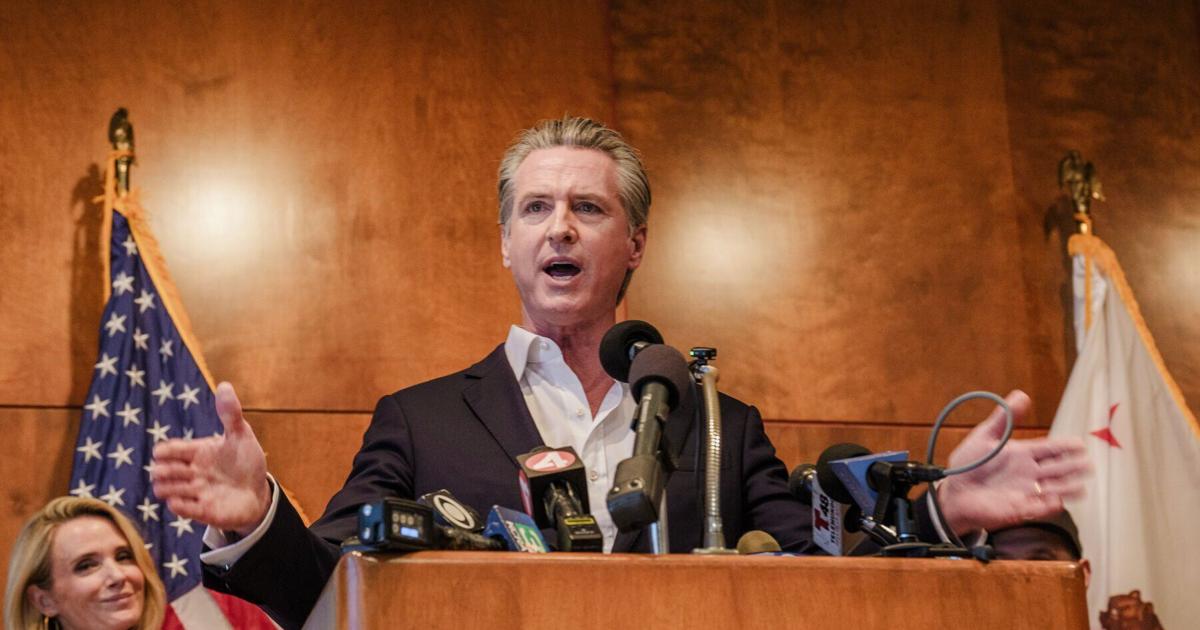
Enter Proposition 50, Gov. Gavin Newsom’s bid to call the bluff. The measure would create five new Democratic-leaning districts in California, a surgical strike to offset the GOP’s map-rigging elsewhere. Is that pretty? No. Is it necessary? In a knife fight, you don’t lecture about table manners.
Spare me the handwringing about the ends not justifying the means. High-minded stands on principle aren’t always smart politics, and unilateral disarmament in the face of potential annihilation is not virtue; it’s delusion.
California’s commission was designed for a world in which both parties played by the rules. In 2025, Republicans have flipped the table and sent the game board flying.
When Texas stretches districts beyond geometry and shame, California has a choice: Preach purity while losing the House, or push back — within the law — to keep Congress competitive.
That is the point of Prop. 50 — not to canonize gerrymandering, but to neutralize it. You don’t win a tug-of-war by loosening your grip, and you don’t serve the interests of California by letting an emboldened, artificially inflated Texas GOP run roughshod over everyone else.
Newsom has treated the measure as more than housekeeping. With a lean, relentless campaign — San Francisco-based Bear Flag Strategies on message, fundraisers Kristin Bertolina and Stefanie Roumeliotes fueling the engine, and the governor’s small-dollar network humming — Prop. 50 has become a protest vote with teeth. Republican money is drying up. The chief provocateur in the White House has gone curiously quiet. Forget partisanship; Californians are poised to give Prop. 50 the green light on Election Day as a matter of self-defense.
Forgive me if I don’t sympathize with the pearl-clutchers bellowing about hypocrisy. California’s original sin in redistricting is no secret; we confessed it, reformed it, and lived by the reform. What has changed is not our standards, but the other side’s.
When your opponent moves the baseline, the only principled response is to move it back. “We played fair” is not a political strategy; it’s an epitaph.
Nor is Prop. 50 a triumphalist fantasy. It’s a stopgap and a signal. The stopgap: Blunt the worst of the GOP’s cartographic spree before the 2026 midterms. The signal: If Congress won’t pass national redistricting rules, the states will escalate until Washington notices. California would rather lead by example; failing that, it will lead by resistance.
The Burtons understood power. They knew how to build it, and they also knew how to exercise it effectively. They would recognize the stakes today. Trump-world is not finessing the frame; it’s torching it. The choice for California is not between the angels and the knaves; it’s between a naïve self-denial and a calibrated counterpunch.
Pass Prop. 50. Then press on for national standards that make such measures unnecessary. Until Congress imposes a uniform rule — independent commissions, compactness metrics, respect for communities of interest, real courts with real timelines — we live in the world we have, not the world we want.
The Burtons, San Francisco’s old masters of reapportionment, are gone. But if you listen, you can hear them from beyond, not praising chicanery, but applauding nerve. In a rigged game, courage is the first reform. Prop. 50 is its instrument.