
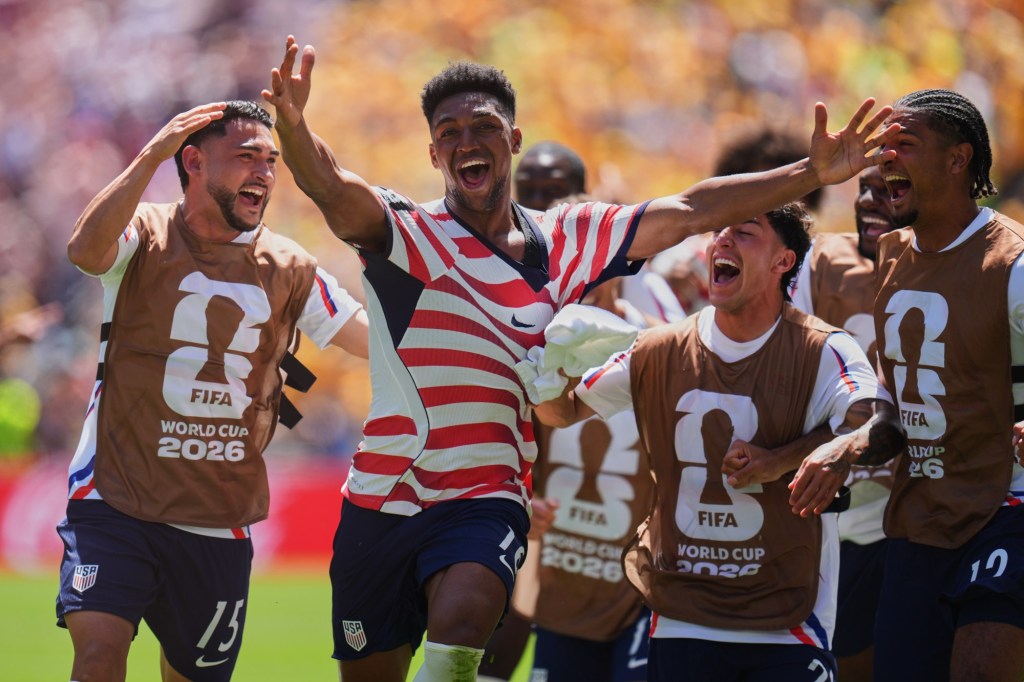
SEATTLE – Three thoughts on the U.S. national team’s 2-0 World Cup win against Australia on Friday at Lumen Field:
1. Like father, like son
In 1996, Green Bay Packers receiver Antonio Freeman caught a pair of touchdown passes in a 31-10 victory against the Seattle Seahawks in the since-demolished Kingdome.
Thirty years later, his son scored a World Cup goal in a different NFL stadium on the same site.
“For me, it’s a full-circle family moment,” U.S. defender Alex Freeman said. “It shows how great the family tree is, and it shows he can be great, but I can great in my own way as well. That just shows how amazing it is to have a dad who is so successful and can mentor me, to be ready for moments like these.”
It also shows Mauricio Pochettino’s eye for talent.
The 6-foot-2 Freeman grew up in South Florida but didn’t make the youth academy of Major League Soccer club Inter Miami, instead accepting a spot at Orlando City and living with a teammate’s family. He spent three years with Orlando City’s MLS reserves before finally breaking into the first team in 2025.
His first career start came that March. By May, the U.S. coach had summoned him to the full national team, something Freeman called “an unexpected surprise.”
Freeman started all six matches in the Concacaf Gold Cup. By January, he was sold to Spanish club Villarreal for $4 million plus another $3 million in performance-based add-ons.
Now, two World Cup starts and a goal at age 21.
“It’s hard for me to kind of take it all in,” said Freeman, whose size also allows him to be deployed in central defense and his speed on the right wing. “It’s good, also, to go through these challenges at such a fast pace at a young age. For me, it’s just going to make me a better player to adjust to different atmospheres and adjust to different circumstances.
“It shows how I’ve made it, kind of, in my way.”
Much of the U.S. roster was handed to Pochettino from the previous World Cup cycle. His two big finds have been Freeman at right back and Matt Freese in goal ahead of 2022 starter Matt Turner.
“The evolution is massive,” Pochettino said. “He’s an amazing player for me (and has) the potential to be one of the best players in his position in the world.”
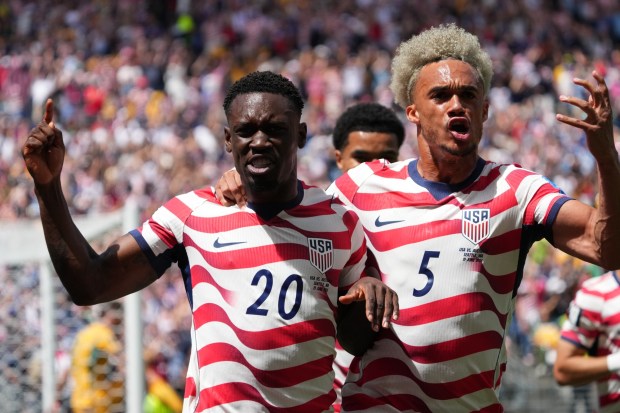 Folarin Balogun (20) and Antonee Robinson (5) celebrate after an early own goal by Australia’s Cameron Burgess in their World Cup match in Seattle on Friday. (AP Photo/Ted S. Warren)
2. Good fortune
Pochettino left Lumen Field contemplating a tricky decision about four starters who have received yellow cards, whether to play them Thursday in the final group match against Turkey at the risk of getting another yellow and having to sit out the round of 32.
By the end of the night, that was no longer an issue.
Paraguay, despite playing the entire second half with 10 men, beat the Turks 1-0 and mathematically eliminated them from advancing. It also clinched the top spot in Group D for the Yanks and rendered Thursday’s match at SoFi Stadium completely, utterly meaningless (sorry to all the folks who shelled out $1,000 for tickets).
Pochettino can now rest Folarin Balogun, Tyler Adams, Chris Richards and Antonee Robinson without consequence and have them ready for the knockout stage, when yellow cards reset.
It’s just the latest ray of good fortune shining on the U.S. men, who have twice been the beneficiary of an early own goal that settled nerves, boosted confidence and energized fans. It came in the seventh minute against Paraguay, in the 11th minute against Australia.
That makes it five opponent OGs in their World Cup history, second all-time behind France’s six, although the Yanks have played just 38 matches to 74 for the French.
As hosts, they already had several advantages baked into the schedule: a manageable group with no one in the top 20 of the FIFA world rankings; staying on the West Coast with milder weather and shorter travel; getting a third-place team instead of a second-place team in the round of 32 if they finished first; starting the tournament early and regularly having more rest than opponents; the familiarity factor of round of 16 and quarterfinal matches in stadiums where they’ve already played.
It could get even better, too.
Belgium was slated to be Team USA’s Round of 16 opponent and Spain in the quarterfinals — a tough ask for a national team program that has lost nine straight in all competitions against European opposition and won one of 20 in the World Cup since 1990.
But that presumes Belgium and Spain win their groups. Unexpected draws in their openers — 1-1 by the former against Egypt, 0-0 by the latter against Cape Verde — put that in jeopardy.
Imagine this gift draw to the semis for the 13th-ranked Americans: No. 64 Bosnia and Herzegovina in the round of 32, No. 30 Egypt in the round of 16, No. 18 Uruguay in the quarterfinals. (Meanwhile, Germany and France are on a collision course to play in the round of 16.)
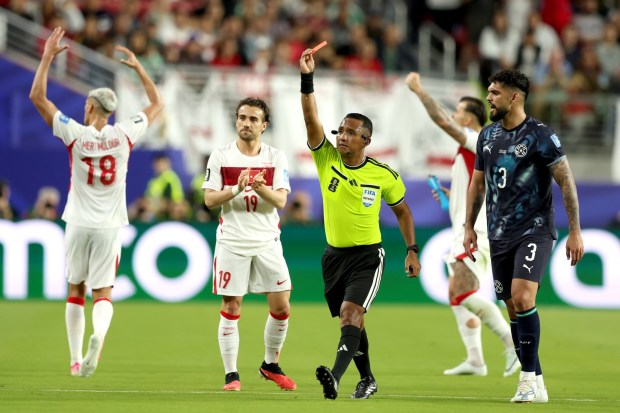 eferee Iván Barton shows the red card to Paraguay’s Miguel Almiron (10) during the first half of a FIFA World Cup match against Turkey at Levi’s Stadium on Friday, June 19, 2026. (Ray Chavez/Bay Area News Group)
3. Red dawn
The only real officiating drama Friday at Lumen Field was when 45-year-old German center ref Felix Zwaye went down in second-half stoppage time with a leg cramp.Balogun stretched his calf, and the fourth official ran out with a shot of pickle juice, which is filled with natural electrolytes that theoretically help reverse the cramping.
The sight of an official on his back drew a gasp from the 66,925, but that was nothing compared to the reaction in the day’s other Group D match, six hours later in Santa Clara, when El Salvadoran referee Ivan Barton showed his red card to Paraguay’s Miguel Almiron late in the first half.
Almiron’s crime? Covering his mouth with his hand while addressing an opponent.
Barton is no stranger to losing control of matches, flashing red cards and enforcing new, controversial rules. In the 2023 Concacaf Nations League final between the U.S. and Mexico, he handed out four red cards when it devolved into a shove-fest, then ended it early — following oft-threatened but rarely enacted protocol for repeated homophobic chants from Mexican fans.
Now he became the first referee to eject a player under the new FIFA rule that prohibits covering your mouth “in a confrontational situation with an opponent.” Players were warned before the tournament, but did anyone actually believe it would happen?
The red card could have changed the complexion of Group D had the Turks come back and won with a man advantage — giving U.S. and Turkey something to play for in Thursday’s group finale.
A VAR review was followed by Barton examining replays on a sideline monitor, followed by him reaching into his pocket for a red card. What, if anything, Almiron said was inconsequential; the mere act of covering his mouth, confirmed by video, was enough.
“The rules are made to be respected,” Turkey coach Vincenzo Montella said, “and so it was only natural.”
Paraguay coach Gustavo Alfaro had a different take, launching into a six-minute rant in his post-match news conference.
“A yellow card is enough,” Alfaro said. “There are things that are punished too harshly, and my fear is that we will lose the essence of football. Football is characterized by friction, contest, struggle, courage, composure, throwing oneself to the ground, fighting, going in for a header.
“It’s a beautiful, wonderful sport, and we need to keep making it better and better. The spectacle was brilliant, and the organization was extraordinary. Now, let’s not let the rules get in the way. They shouldn’t.”
Cramping their style, you might say.