
BOGOTA, Colombia — Political outsider Abelardo de la Espriella held a razor-thin lead in Colombia’s presidential election with nearly all the votes counted Sunday in a runoff marked by people’s fears of a renewed internal conflict.
A victory by De la Espriella, who was endorsed by President Trump, would amount to an indictment of the policies of outgoing President Gustavo Petro, whose protege, progressive lawmaker Iván Cepeda, had promised to continue his agenda if he defeated his rival.
De la Espriella, a business owner and lawyer who had never run for office, led with 49.7% of the votes, with 99.9% complete results released by electoral authorities. Cepeda earned 48.7% support. Election officials have not formally announced a winner.
“I appear before you tonight to announce the most important news of my life: The Colombian people have entrusted me with the supreme honor of serving them as their next president of the Republic of Colombia,” De la Espriella told thousands of supporters as he stood behind bulletproof glass in the northern city of Barranquilla.
“I will govern for all Colombians. … There will be no retaliation, no persecution, because in a democracy there are no irreconcilable enemies,” he said.
Cepeda told supporters that his campaign considers the count “unofficial and nonbinding” and that his team will challenge results from more than 30,000 voting stations. No recount has flipped the results of a presidential election in Colombian history.
“We will not allow … the rollback of the social gains we have achieved,” Cepeda said. “We will not allow democracy to be violated.”
Petro also vowed to challenge the outcome.
People in the streets of Bogota yelled, “Petro out! Petro out!” and honked car horns.
The candidates pitched voters on vastly different strategies to prevent the South American country from experiencing intractable violence, such as car bombs, kidnappings, disappearances and forced displacements, that Colombians lived with for decades.
Sunday’s winner will begin a four-year term Aug. 7.
Tough-on-crime approach
De la Espriella, 47, promised a heavy-handed approach to crime-fighting, including drug trafficking. He also said he planned to end Petro’s attempts to establish parallel peace negotiations with multiple armed rebel groups — an effort that has largely failed under Petro — and build 10 mega-prisons, emulating Salvadoran President Nayib Bukele aggressive policies. Those tactics have lowered homicide rates in the Central American country but have resulted in reports of human rights abuses.
De la Espriella, nicknamed “El Tigre,” holds dual Colombian and U.S. citizenship. He’s a Trump supporter and a member of the Republican Party.
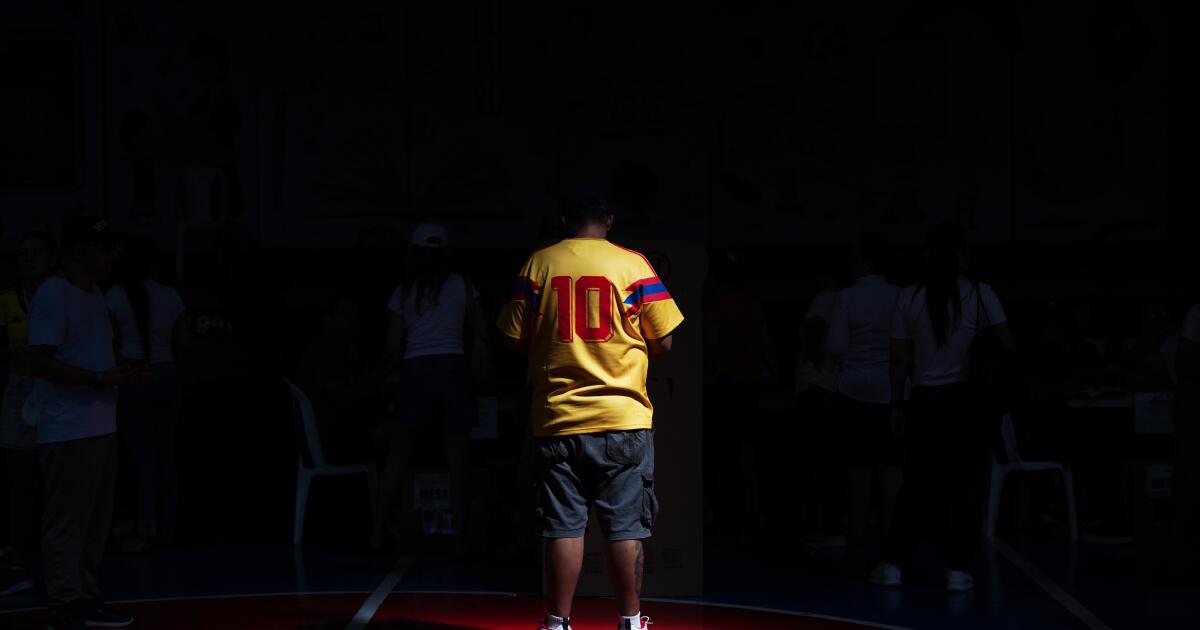
“We have had an armed conflict and a drug trafficking problem for too long, and this has greatly polarized the country,” retired economist Víctor Duque, 72, said while wearing a national soccer team jersey at a voting center in the capital, Bogota. “I believe it is one of the most important elections that has taken place in Colombia this century.”
U.S. Secretary of State Marco Rubio and Presidents Javier Milei of Argentina and Daniel Noboa of Ecuador were among the political leaders to first congratulate De la Espriella.
“The Trump Administration looks forward to working closely with your incoming administration to advance regional security cooperation, end illegal immigration to the United States, and strengthen our economic ties,” Rubio said on X. “Colombia’s best days are ahead.”
“He Won, BIG!” Trump later said on on his social media platform.
President again sows doubts in the results
In the first round, Cepeda earned 41% of the vote, while De la Espriella finished first with 44%, according to official results. Petro, without evidence, sowed doubts in the results after Cepeda, who had consistently led polls ahead of the May vote, came in second.
Yolanda Hernández, 49, voted early Sunday before she started selling black ink pens outside a Bogota voting center. Clients, she said, buy the pens because ink cannot be erased from paper ballots, which reduces the possibility of fraud.
Hernández, who recycles trash for a living, voted for Petro in 2022 but cast her ballot for De la Espriella this time. Though she said that congressional gridlock was to blame for Petro’s inability to deliver on promises meant to help the poor, she said Colombia cannot afford another four years under his vision for the country.
“We want change in Colombia because it’s always the same violence, always the same thing,” Hernández said. Petro, she added, “said he was going to lower the cost of services, that he was going to lower the price of food, and everything is more expensive.”
Will Freeman, a fellow for Latin American Studies at the Council on Foreign Relations, said Sunday’s result shows the country “has not shifted overwhelmingly or decisively” against Petro’s project or for De la Espriella’s “iron fist showmanship.” Freeman added that the result also underscored Colombia’s regional divisions.
“It’s regional, not just ideological polarization; or rather, the two overlapping,” he said. “Ironically, De la Espriella’s iron-fist message performed best in the core of the country, not the periphery, which bears the brunt of Colombia’s violence.”
Fighting between rebel groups
The election comes 10 years after Colombia signed a historic peace pact with guerrillas of the Revolutionary Armed Forces of Colombia, or FARC, that had offered hope to break the nation’s vicious cycle of fighting between rebel groups and the government.
But violence has since roared back, particularly as most rebel groups abandoned their ideologically driven fight for the financial benefits of drug trafficking. Colombia’s illegal groups have more than 27,000 members.
Last year, authorities recorded 14,780 homicides, the most since at least 2015 and driven by clashes among illegal armed groups. Among those killed was conservative presidential hopeful Miguel Uribe. Extortion has also soared, reaching 13,417 cases in 2025, more than double the number tallied in 2015.
Cano and Suárez write for the Associated Press.