
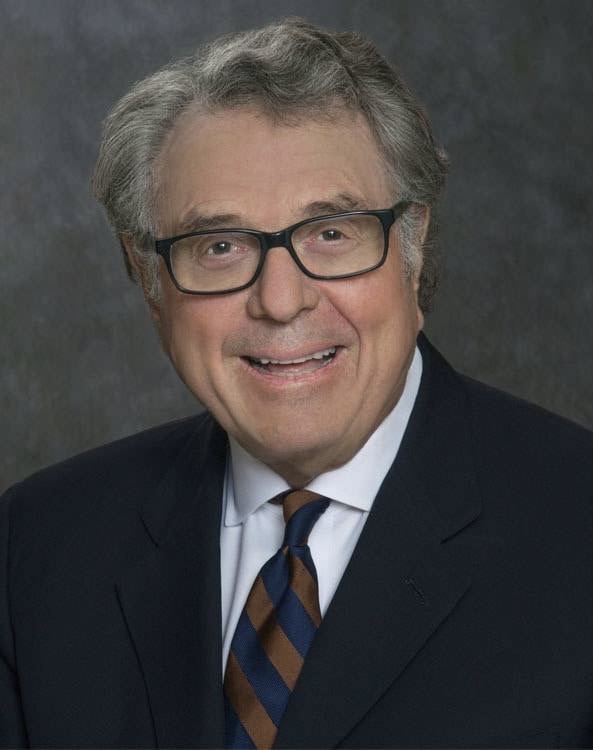
A decade ago, La Jolla resident Gene Barduson made what he calls a “miraculous” recovery from Stage 4 melanoma. Now, after years of advocating for cancer research, his focus has shifted to another issue.
Addiction has torn through tens of millions of families, including Barduson’s. Barduson, 86, is himself a recovering alcoholic, sober for the past 41 years. His father was an alcoholic, too, and his son, Tommy, died as a result of alcoholism in 2016.
Reeling from that tragedy and overcoming his cancer diagnosis in the 2010s, Barduson found that fighting addiction lacked the institutional support of the effort against cancer, he said.
When he was diagnosed with melanoma — considered the most serious form of skin cancer — he was given only an 11% chance to survive beyond a year, Barduson said.
But his recovery made him think about the other malady that rocked his life.
“I never looked at alcoholism as something that had a cure up until my experiences [in] 2015-16 and that period of time,” Barduson said. “I then became very convinced that this is a disease that has a cure.”
In June 2020, Barduson led the formation of the Addiction Research Institute, a nonprofit organization based in La Jolla, with the goal to “support breakthroughs to cure the disease of addiction and funding research to create life-changing cures for substance-use disorders,” according to the group’s website.
 The Addiction Research Institute is a nonprofit organization intended to help fund research on a cure for alcoholism and other substance-use disorders. (Addiction Research Institute)
ARI isn’t doing the research but instead works to equip others to do so.
The discrepancy between alcohol and cancer research is stark, Barduson says. The National Cancer Institute had $7.2 billion in available funds in 2025. The same year, the National Institute on Alcohol Effects and Alcohol-Associated Disorders had less than $600 million to work with.
“The disparity is just incredibly large, and that’s the gap we need to fix,” Barduson said. “The research that’s going on is … many times on a shoestring and constantly trying to get grants here and there and wherever.”
ARI particularly seeks to understand how people’s unique genetic wiring influences their substance-use disorders to provide a better idea of how to counter or avoid those influences.
“The money has been spent in addiction on the symptoms of the disease, not on the root problem of the disease,” Barduson said. “The place we’re taking in this universe is to fund research that finds the root problem.”
La Jollan George Vukcevich met Barduson for lunch at Harry’s Coffee Shop on Girard Avenue in November and joined the Addiction Research Institute’s board. He says he sees the American Cancer Society as an eventual model for ARI’s fundraising.
“The American Cancer Society raises billions of dollars annually, and addiction is something that gets swept under the rug sometimes based on the stigma behind it, but it affects a lot of people,” Vukcevich said.
“The optimal goal for us is to be able to have a donation pool as large as the American Cancer Society that we can have an advisory board determine what are the most viable projects that we can fund.”
Another La Jolla resident, Holly Robinson, was inspired to pitch in after watching a news report about the institute late last year.
“Come to find out we all live in La Jolla, we all are absolutely passionate about this endeavor and truly believe there is a cure in sight,” Robinson said.
“I’ve personally been very touched [and] lost a family member to this disease,” she said. “It’s given me a purpose, and I am so excited to see what is happening right here in San Diego with this research.”
Since they joined, Vukcevich and Robinson have helped take the institute’s mission into the community, from house visits to an upcoming trip to the Rotary Club of La Jolla.
Barduson estimated ARI has brought in $400,000 so far. But its work is “just getting off the ground,” he said.
Eventually, the board will determine which projects it will support.
ARI’s group includes Jessica Rosenberg, co-founder and strategic adviser; Scott Swartzwelder, a clinical psychologist, neurobiologist and professor at Duke University; and Danielle Dick, director of the Rutgers Addiction Research Center and a professor at Rutgers University’s Robert Wood Johnson Medical School.
Barduson, who during his career has held chief executive and board positions for health care companies, is a member of Scripps Health’s board of trustees and the Rutgers Addiction Research Center’s leadership council.
“Once you really start talking about it and talk about it from the heart, we’re learning that people either have been affected, know somebody who’s been affected, they have family members [who have been affected],” Barduson said. “It’s all this trickle-down effect that really reaches us all.”
For more information, visit addictionresearchinstitute.org. ♦