
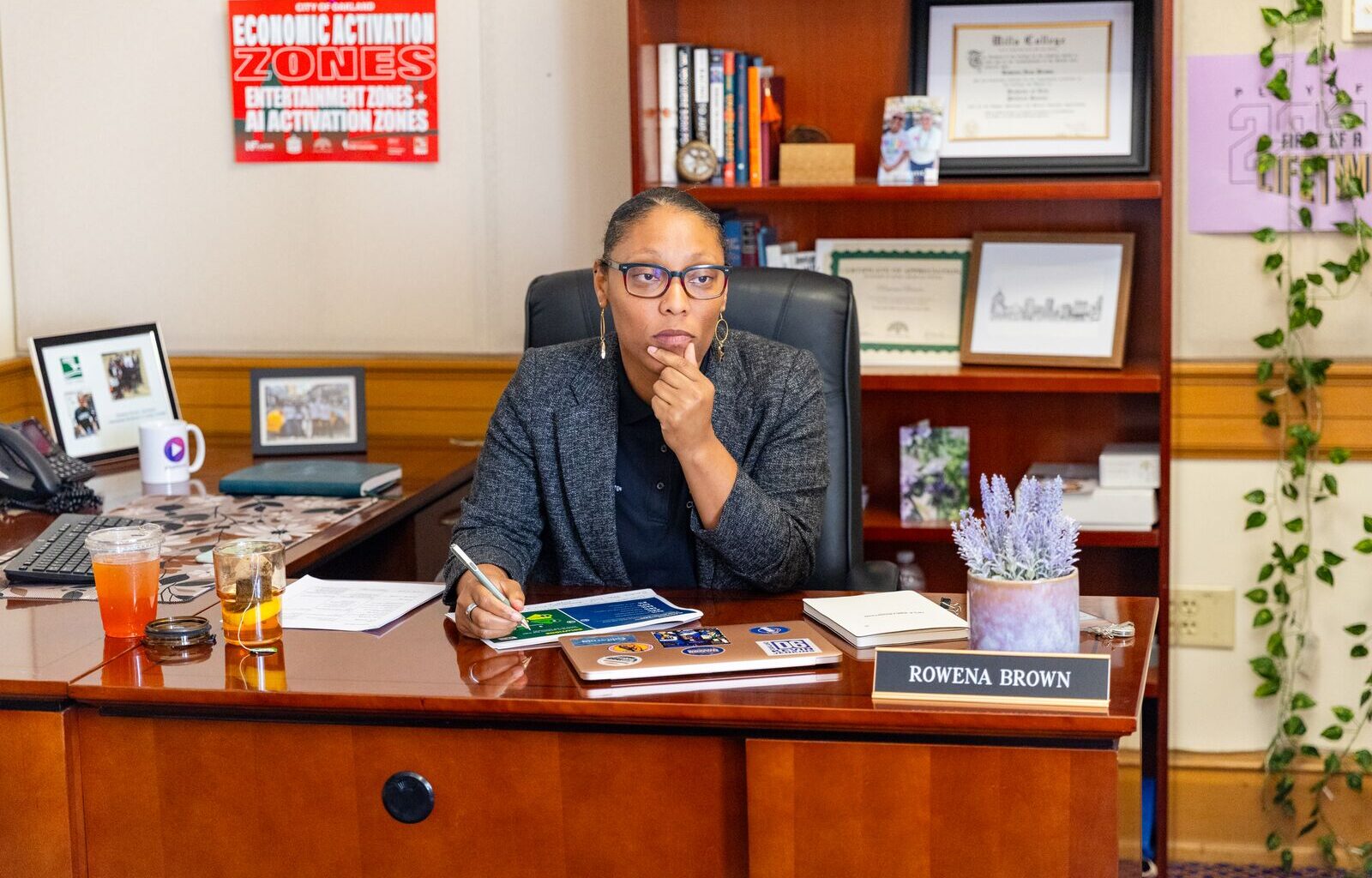
An old Oakland City Council district map is tacked to the wall across from Rowena Brown’s desk on the second floor of City Hall.
The map predates her 2024 election, so her name isn’t listed anywhere on it. But the modest office it hangs in is unmistakably Brown’s: books about law and racial justice are tucked neatly on shelves, a Mills College diploma is displayed in a frame, and a Steph Curry bobblehead is frozen mid-dribble.
It’s in this office that Brown starts off her busy week. With a couple of her staffers seated around the room, she rattles off their to-do list.
The conversation moves seamlessly between issues big and small. After sorting out the details of a meeting with a lobbyist, Brown quizzes her team about a direct message she received on Instagram from someone needing assistance with a parking ticket. They haven’t seen it, so Brown urges them to check it out.
“It may be a little complicated,” she says, adding that they should maybe help the constituent figure out a payment plan.
Responding to constituents is a major part of the job, and Brown has many more of them than her colleagues on the eight-person council. The other seven councilmembers represent districts, dealing with everything from construction to traffic to restaurants in their unique corner of town.
As the sole at-large member of the Oakland City Council, Brown’s role is less circumscribed. Instead of a slice, she serves the whole city. It’s up to her which neighborhoods to focus on, which meetings to take.
Earlier this year, it looked like the at-large seat was going to be cut. A proposal to overhaul Oakland’s government structure would have slashed Brown’s position (though probably after her term concluded). To Brown’s relief, that idea was scrapped from the ballot measure that voters will weigh in on in November. But while the position has been preserved for now, it’s not always clear to the public what the at-large councilmember actually does.
“I think community members are still learning how to really engage with the at-large councilmember,” Brown told us. To do her part, she went on an “engagement tour” after she took office in early 2025.
Last month, we decided to follow Brown around for a couple of days to learn more about how she starts and ends a typical week. And to show the public what, exactly, one of their most powerful representatives does in her quest to work for them.
Divide and conquer
 At-Large City Councilmember Rowena Brown, center left, and District 2 Councilmember Charlene Wang, right, speak to students from Crocker Highlands Elementary School at Oakland City Hall on Monday, May 4, 2026. Credit: Estefany Gonzalez for The Oaklandside.
Brown has found ways to streamline the inundation of messages from her 441,000 constituents. At this Monday morning meeting, she tells her staff she’s getting emails about the Feather River Camp, the summery Sierra retreat run by the city and a nonprofit for the benefit of adventurous residents. Brown instructs them to respond to all of the missives with the same message: she fully supports legislation that would provide funding to replace the camp’s septic and water filtration systems.
Brown has two email accounts that she uses for official city business. According to her, each of them receives at least 15 emails per day from constituents. This might not sound like a lot, but many are complicated or urgent requests for help. Brown previously worked as a constituent liaison for former Councilmember Loren Taylor, so she knows how important it is to stay on top of these.
“It’s obvious if you’re not checking your emails,” Brown says.
She often gets looped into communications between constituents and their district representative.
She likes collaboration, so it suits her to float around and offer assistance.
“That’s really how we divide and conquer,” Brown says.
Brown’s colleagues often work with her on community events. Like this Monday morning, when she teams up with Charlene Wang to chat with a gaggle of second graders on a field trip to City Hall. Brown encourages the shy students and congratulates them on good questions.
To teach the kids about the painful choices legislators have to make, Brown and Wang ask them to stand on different sides of the council chamber if they want to build more housing or protect the environment. All of the children march over to the environment side.
“If we don’t protect our environment, we won’t have a bunch of space, and probably we’ll go extinct,” one kid says matter-of-factly.
Later, the kids ask how the councilmembers plan to fix some of Oakland’s bigger problems. Brown, wearing a blazer over a city of Oakland polo, leans on the dais with a hand in the pocket of her slacks. She puts on a somber face as several students ask her what the city is doing to reduce trash in public spaces.
“It’s a great question,” Brown says, before giving the kids a quick recap of the city’s enforcement and preventative measures to stop illegal dumping. “We’re working double-time, overtime to make sure our streets are clean and beautiful.”
Brown is a former middle school civics teacher, so this is familiar territory for her. But she has a tougher time answering a question about why housing is so expensive. After explaining that this issue is tied to income, she pivots to say that numerous elected officials are working on it.
“We can’t just do it at the local level,” she says, adding that it will take a team of officials on the state and federal level, too.
Housing, trash, and the environment, coincidentally, will be the themes of the rest of Brown’s day. But she’ll spend it talking to grown-ups, most of whom want something more from her than encouragement and a quick civics lesson.
Eat, meet, repeat
 At-Large City Councilmember Rowena Brown enters Oakland City Hall while on a phone call on Monday, May 4, 2026. Credit: Estefany Gonzalez for The Oaklandside.
Brown is a product of the Bay Area. She lived in Pinole as a child and graduated from Mills College in the Oakland hills. Her master’s of legal studies is from UC Law in San Francisco. She taught middle school in Fruitvale.
Before entering politics, Brown worked in retail management for several years. Her first gigs in the public sector were in Taylor’s council office and as campaign manager for Mia Bonta, who ran for the California Assembly in 2021. Bonta won, and Brown joined her staff, where she became the district director and worked until her 2024 city election.
She’s a busy person. Brown has a gym in her apartment so she’ll try to squeeze in a workout when she can. Sometimes she’ll arrange walking meetings so she can move her body. The 39-year-old says an underappreciated burden of being a councilmember is how much time is spent sitting.
Finding time to eat is also tricky. Brown jokes that she doesn’t eat, even though she orders food “a lot,” often salads from Ladle and Leaf or a sandwich combo from Farley’s East. It’s tough to find time to cook.
“I’m also very simple, so I can eat the same thing over and over,” Brown says.
On her desk this Monday are two teas — one hot, one iced — and a mug that possibly contained a third at some point.
The iced tea is from the downtown Highwire Coffee, where she had plans to meet with the new director of the West Oakland Environmental Indicators Project, a prominent environmental justice group fighting for a neighborhood disproportionately polluted by diesel trucks and metal shredders.
Oops. It turns out the plan was for a different Highwire. Brown has a call with Carroll Fife in mere minutes, but she tells Veronica Eady to come anyway. They end up having a rapid-fire meet-and-greet, standing in an outdoor courtyard. Eady lists off her priorities: air quality monitors in schools, electrifying the Port of Oakland, getting the community more involved in their work.
“We have so many newcomers in West Oakland who are young, who are Gen Z, so I’m like, how do we channel that energy and combine it with the people who have been through the many decades of ebbs and flows?” she says.
Brown talks on her cellphone with Fife as she dashes back to City Hall for a meeting with Waste Management. Two of her staffers trail behind, carrying their teas and hers.
Talking trash with the experts
 At-Large City Councilmember Rowena Brown meets with representatives Waste Management to discuss illegal dumping on Monday, May 4, 2026. Credit: Estefany Gonzalez for The Oaklandside.
Brown’s next meeting is with one of Oakland’s biggest contractors.
It’s early afternoon now, and two men from Waste Management — Alex Oseguera and Warren Chu — along with their lobbyist, Isaac Kos-Read, take seats at the round table.
Brown and Chu go way back. He tells her he wants to chat with her because “your concern is always with the big picture.”
But what they really seem to want to discuss are specifics — namely, Waste Management’s contract for curbside garbage and compost collection in Oakland, which expires in 2030 — and what they think the city could be doing differently to stop illegal dumping.
A recent city audit found that Oakland residents pay a lot more for trash services than people in other cities, even those that contract with Waste Management. Auditor Michael Houston urged the city to renegotiate the contract to make disposal more affordable for residents — or to consider using a different contractor.
But it also found Oakland neglects to use all its resources, like dumpsters provided by Waste Management, and that everyone from city staff to the district attorney falls short on catching dumpers.
Oseguera says small changes can make a big difference. The company had a pilot where they placed larger bins (64 gallons) in front of every customer in a given area.
“Just immediately, you see no more overfilling containers, that trash on the street that’s causing blight,” he says. Waste Management is talking with the city about how to upgrade those residential containers and charge customers less for the even bigger, 96-gallon ones.
Another issue is businesses piling their waste on the street. The audit found that at least 2,500 businesses aren’t signed up for pickup service. With residential customers, if they stop paying their trash fees, Waste Management’s trucks will still come by to collect their bins. The city will pay for that service and collect the customer’s debt. But when commercial customers don’t pay, their service simply stops.
“I think that’s the gap,” Brown says. The men agree in excitement.
This should have been in their long-standing contract with Oakland, they say, arguing that their company has been working in the city for decades, yet illegal dumping is a relatively new problem. There must be issues with the contract structure or city enforcement, not their work, they posit.
Brown assures them the city is ramping up enforcement. The council recently increased fines for dumpers and spent $150,000 on AI-powered drones to catch violations. She touts her own investment in the last budget cycle in the Oaktown PROUD anti-dumping campaign.
“I think we’re doing all the good work to let the folks who are the bad actors know, hey, we’re not going for it anymore,” she says.
On their way out, the men compliment staffer Rachel Holmstrom’s tie — “the green of sustainability.”
A check-in with an important department
 Rowena Brown’s office at Oakland City Hall on Monday, May 4, 2026. Credit: Estefany Gonzalez for The Oaklandside.
Housing — one of the top issues Oaklanders care about — unsurprisingly occupies some of Brown’s Monday.
She has a call with the Oakland Housing Authority, the city’s public housing provider.
Then she chats on video with leadership from the city’s Housing and Community Development Department, which funds affordable building in Oakland and oversees renter protections. It’s a regular check-in, since Brown chairs the council’s Community and Economic Development Committee, where most housing legislation comes before it’s ready for a full council hearing.
Director Emily Weinstein gives Brown a “sneak peek” at data she’ll soon share publicly.
They consider the progress on Measure U, a voter-approved bond which, at $350 million, injected Oakland with its largest affordable housing investment ever.
So far it’s funded 2,300 new homes, and there’s $100 million left. “We’re outpacing our projections,” Weinstein says. The city is also ahead on creating homeless housing, thanks in large part to a state program called Homekey.
She displays a map of affordable housing across Oakland. Aside from a concentration in District 3 — West Oakland and downtown — the buildings are pretty spread out, despite frequent complaints of disparities.
Brown doesn’t have many questions, but she has a lot of encouragement.
“I like it!” she comments, and, “Very, very good!”
There’s another positive update for the city: A hearing officer agreed with Oakland that the landlord of a building that caught fire in January owes his tenants money to relocate. But that landlord still isn’t paying out.
“So we are stepping in and cutting those checks, and then we will be liening the property for the money that we are putting out,” Weinstein reports.
Brown’s glad they’ve budgeted for that.
“Those residents would just be out of luck.”
A night at the gala with allies
In most interactions, Brown is friendly but fairly reserved.
That changes at her Friday afternoon meeting with the K. Stewart Foundation.
The nonprofit supports Black and brown LGBTQ community members — especially queer women and parents.
Brown is one of three out queer members of the Oakland City Council. The foundation representatives tell her they’d like to honor her at their gala this year.
“Are you kidding?” Brown asks.
“You’re really in the streets getting it done at the local level,” says COO Kira Lee. “Something as simple as trash cans, you know, like the everyday impact…You get that piece in a really cool way.”
The invitation sets the tone for an effusive brainstorming session where offers and requests fly on both sides, largely around a series of events related to Pride celebrations in Oakland. Brown and her Richmond-based visitors agree: San Francisco should no longer be the default destination for LGBTQ activities.
“We’re gonna go big,” says Brown of Oakland’s August Pride events. She invites K. Stewart Foundation to help out with a queer film screening (“We’ll happily co-promote; think of us as your second marketing outlet,” Lee responds) and a queer job fair she’s hosting in June.
The foundation offers to donate legal consultations. “Throw our logo on there,” adds Lee.
K. Stewart Foundation also wants the councilmember to speak on a panel and support their Pride events, like a parade.
“This will be an all-eyes-on-us moment, nationally, and you’re our girl,” Lee says.
For the upcoming gala, “Is there any capacity for the city to help us with the fundraising for this year?” Lee asks. “If you guys know donors or small businesses that support this type of work.”
“I’ll see who I can introduce you to,” Brown says.
“If we could list the city as an official partner for both events, that would be helpful,” Lee adds.
“It’s a little wonky with the entire city,” Brown hedges, “but you can always use my logo.”
While the councilmember is happy to help the foundation — and get help from it — the K. Stewart pleas are just some of the many requests for funding, presence, or policy support that Brown receives in a given week.
Asked if she feels pressure in the job, she says yes. “I often say, ‘I need to think about that,’ because not every request should get an immediate answer.”
Goodbye to a busy week and to interns
As Brown’s week draws to a close, she has to bid her two interns, Tristan and Michelle, farewell.
Michelle and Tristan have prepared presentations about what they learned and did. Their work varied from managing Brown’s social media accounts to doing graphic design work and research on policies and legislation.
Michelle says she spent time attending council meetings, which made her appreciate the array of views on policy issues. As an example, she points to one of the most contentious meetings of 2026: a hearing where Brown and other councilmembers weighed whether to impose a nearly $1 million fine on a couple who illegally chopped down a hillside of trees. The meeting turned into an impassioned fight about the rule of law, allegations of racism, and Oakland’s tree canopy.
“I thought that was a really interesting meeting,” Michelle says.
The interns had a good time working at the center of Oakland’s government. Tristan, a freshman at Northeastern University, says it was fun and a little surreal going to City Hall. It was also challenging managing his workdays with a college schedule, and sometimes he struggled to figure out how to get transportation to work.
Tristan helped Brown with policy research for legislation supporting a truck ban on I-580. It took him some time to figure out how to change his writing style.
“You wouldn’t word a social media post like you would policy research,” Tristan observes. Brown, munching on some lunch, smiles.
Both of Brown’s interns want to go into work where they can help people. Michelle is interested in healthcare (Brown advises her to check out Roots Community Health). Tristan, who served in the student government at Northeastern, is looking at a legal internship.
No ‘clocking in and out’ on City Council
 At-Large City Councilmember Rowena Brown, left, meets for coffee with Veronica Eady of the West Oakland Environmental Indicators Project near Highwire Coffee Roasters on Broadway on Monday, May 4, 2026. Credit: Estefany Gonzalez for The Oaklandside.
We only get a slice of Brown’s week. Some of the people Brown met with asked that we not attend their meetings, so we weren’t present for all of her business. That included a walk-and-talk with Congresswoman Lateefah Simon, where the officials visited Yemeni-owned businesses, a conversation with the mayor, and the call with the housing authority.
But the nature of Brown’s job means a lot of her work plays out in public. An easy way to see her in action is to take a squeaky velvet seat in the overheated council chamber at City Hall.
On Tuesday, we watch Brown sit through a five-and-a-half-hour council meeting. Some of the things she has to weigh in on, like the aforementioned $1 million tree fine, which Brown opposes, take hours to resolve. Other decisions happen fast, like the vote to approve 30 pieces of legislation on the consent calendar. At the end of the meeting, there’s an open forum, where speakers can — and usually do — give councilmembers a piece of their minds. Visibly drained, Brown and her colleagues drift out of the chamber at 8:59 p.m., finally done.
But two days later, Brown and her colleagues schedule roughly two dozen more pieces of legislation for committee and council meetings. The process will repeat ad infinitum, just like the emails that trickle (and sometimes flood) into her inbox every day, or the meetings that stack up on her virtual calendar.
Most councilmembers also sit on commissions and boards outside of the council chamber. On Friday, Brown has a regular meeting of Oakland Thrives’ Youth Ventures Joint Powers Authority, of which she’s a trustee; on Saturday, she shows face at a town hall with Wang and Supervisor Lena Tam.
“This is not a role where you clock in and clock out,” Brown says. “It is demanding, and it does require personal sacrifice. But I do this work because I deeply love Oakland.”
As the at-large councilmember, Brown is theoretically at the beck and call of everyone who calls Oakland home. Figuring out who to spend her limited time talking to is a complex problem with no easy solution. She doesn’t have an explicit rule of thumb on who to prioritize, she insists to us, but she needs to triage somehow.
“I try my best to accommodate everyone,” Brown says. But it’s “not strictly first-come, first-served. I try to balance accessibility with urgency, city business, and community needs.”
“*” indicates required fields