
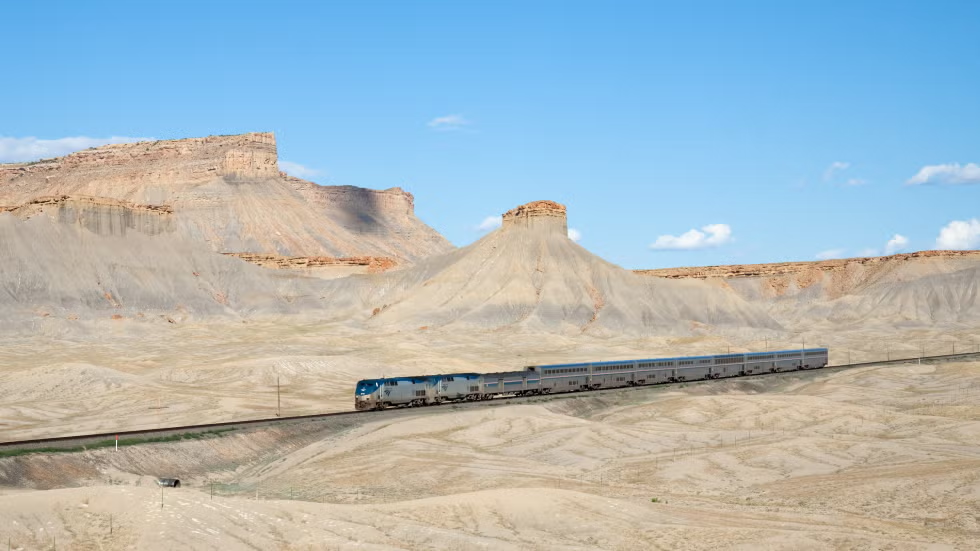
For train aficionados, the very mention of Amtrak’s California
Zephyr, a 2,438-mile route connecting Emeryville and Chicago, is
likely to send lightning strikes of joy coursing through their
bodies. Tell them you have snagged a ticket on this train ride
and you can almost see their inner eyes lingering over the
landscape, through epic mountain ranges and sea-like deserts. It
is an unparalleled smorgasbord of beauty — and for Capital Region
residents, it can begin or end right in downtown Sacramento.
My wife and I chose the latter route in late May of this year,
when we flew to Denver and caught the 8:46 a.m. Zephyr west to
Sacramento after spending a few days in and around the city with
friends. At the beautiful Union Station, which combines late
19th-century Romanesque flanking wings with a Beaux-Arts Great
Hall built in 1914, we sat in comfortable, plush armchairs for an
hour before lining up on Platform 4 to await the arrival of the
train. As it slowly pulled into the station, one could sense the
frisson among the waiting passengers.
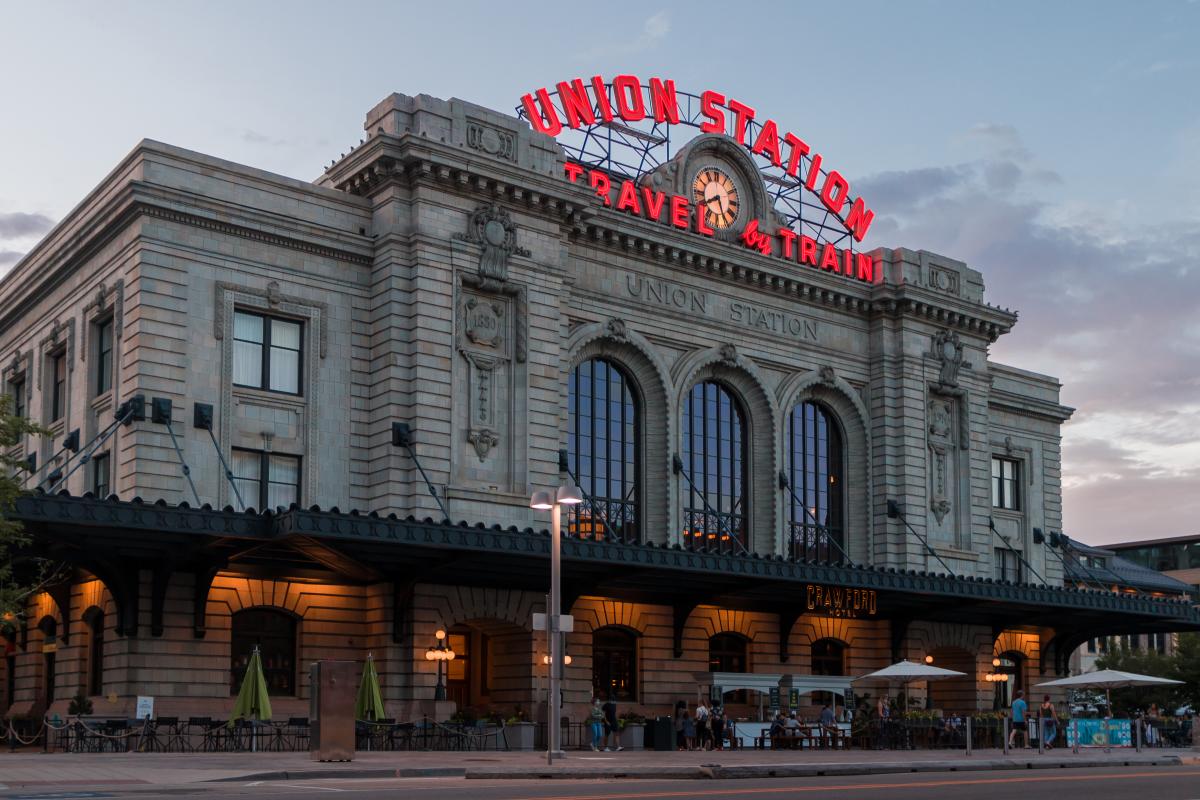
Denver’s Union Station was constructed in 1914 in a Beaux-Arts
style. (Shutterstock photo)
We had booked a Roomette, a tiny two-person sleeper with seats
that convert into a bunk bed. On the top level were straps to
keep the person up there so he or she wouldn’t jolt out and onto
the floor should the train jerk suddenly during the high-speed
overnight jag through the desert flats. The ticket included our
five meals over the course of the 33 hours that it would take to
get us over the Rockies.
The train reaches an altitude of nearly 10,000 feet and traverses
26 tunnels cut through a 10-mile stretch of particularly
intransigent mountains; through the red rock canyons pinning the
Colorado River into its route on the western side of the
Continental Divide; along hundreds of miles of orange and red
cliffs, many of an astounding height, and scrublands in Utah; out
into the duller-orange and brown desert expanses of Nevada;
through Reno and over the lush Sierra Nevada north of Lake Tahoe.
Finally, it picks up speed to begin the journey down the
foothills and into the Sacramento Valley.

A Roommette seat in daytime configuration on the California
Zephyr. (Photo by Sarah Stierch via Wikimedia Commons, licensed
under CC BY 4.0)
During our day-and-a-half journey, we
hop-scotched the seasons. Atop the Rockies, on the soaring peaks
that stood like sentinels high above the train tracks, there were
still the snowy remnants of winter; in the desert lowlands and
valleys, it was already deep into the hot and arid summer.
What makes the Zephyr journey so overwhelming, from a sensory
point of view, is the fabled glass observation car: a long
carriage lined with tall windows curving upward toward the
ceiling. Fans of train travel the world over wax rhapsodic about
this carriage. Sitting in the car, wherever you look, there is
scenery. Turn your head, and you see rivers and horses, herds of
free-range cattle or bison, the backyards of houses that the
train passes, fishermen and rafters — some of whom have
ritualized the practice of standing up and mooning the passing
Zephyr — trees and stark rocks. Look upwards through the curved
top-level windows, and you see soaring cliffs and vast Western
skies. You are both on the ground and aloft,
simultaneously.
It’s a form of cinema vérité that is particularly slow-moving,
vivid and, at times, intimate. The train moves slowly enough that
you can see into bedroom windows as it passes small wooden houses
and dilapidated trailer parks along the tracks. You can see
individual pieces of garbage discarded in garbage dumps. You can
see fishermen throwing out their lines on calmer stretches of the
Colorado River and families waiting patiently at rail track
crossings for the Zephyr to pass by.

The California Zephyr passes along the Colorado River. (Photo by
Tony Webster via Wikimedia Commons, licensed under CC BY-SA 2.0)
As a passenger, you experience a sort of enforced relaxation,
made possible by the extraordinary hard work of the conductors,
engineers, attendants, chefs and other members of the crew that
keep the whole operation running smoothly. The world goes by at a
thoroughly human pace, and unlike airports and airplanes, where
one generally dreads enforced interactions with other stressed
passengers, crews and security officials, on the train you meet
happy people.
These people lean in not just to the destination but to the
journey along the way. They want to talk and have interesting
stories to tell. There’s a sort of instant-mix camaraderie. You
meet the same people again and again — after all, there’s only so
many social permutations possible on a train, only so many places
you can end up; you walk up the train or down the train, into the
dining car or into the observation car, and that’s about it. And
when you meet them, you talk.

The Sightseer Lounge on the California Zephyr.(Photo by Sarah
Stierch via Wikimedia Commons, licensed under CC BY 4.0)
At meals, the tables seat four people, and so, if you’re
traveling as a couple, you’re immediately sat down with two
others — and, in the normal course of things, you chat with those
two others, find out their stories and share travel anecdotes.
What you find is that whether this is a person’s first
long-distance Amtrak ride or their 20th, they have a sense of awe
of both the landscape and the engineering feats that put in place
the cross-country tracks over such rugged, challenging scenery.
Over the course of Saturday and the first half of Sunday, we met
retired teachers, a public relations person, a couple on the way
to Portland, Oregon, to take part in a cross-country bike
expedition, a retired couple on the way back from a
granddaughter’s high school graduation in the Midwest, several
train aficionados who just enjoyed the romance of long distance
travel on the rails, and an older lady traveling back, solo, from
an academic gathering in Chicago.

A hallway in the California Zephyr. (Photo by Sarah Stierch via
Wikimedia Commons, licensed under CC BY 4.0)
On one level, each of these conversations was deliberately,
studiously, casual. On the other hand, you can find out an awful
lot about a person over the course of a two-hour dinner
conversation. During one of the more improbable interactions, I
discovered that I shared several friends in common with the
person I was chatting with. Sacramento is, apparently, at heart
still a small town.
It’s easy to mock the American passenger train network. Compared
to those in Europe or Asia, there aren’t enough trains, and those
that there are are impossibly slow, prone to delays and
ludicrously overpriced. All of that is true. Yet at the same
time, there are still moments of magic to be had on the Amtrak
routes. And, luckily for Sacramento, the most wondrous of all of
those Amtrak moments, riding the California Zephyr, leads into
and out of California’s state capital.
–
Never miss a story: Get Comstock’s weekly newsletter delivered to your
inbox.