
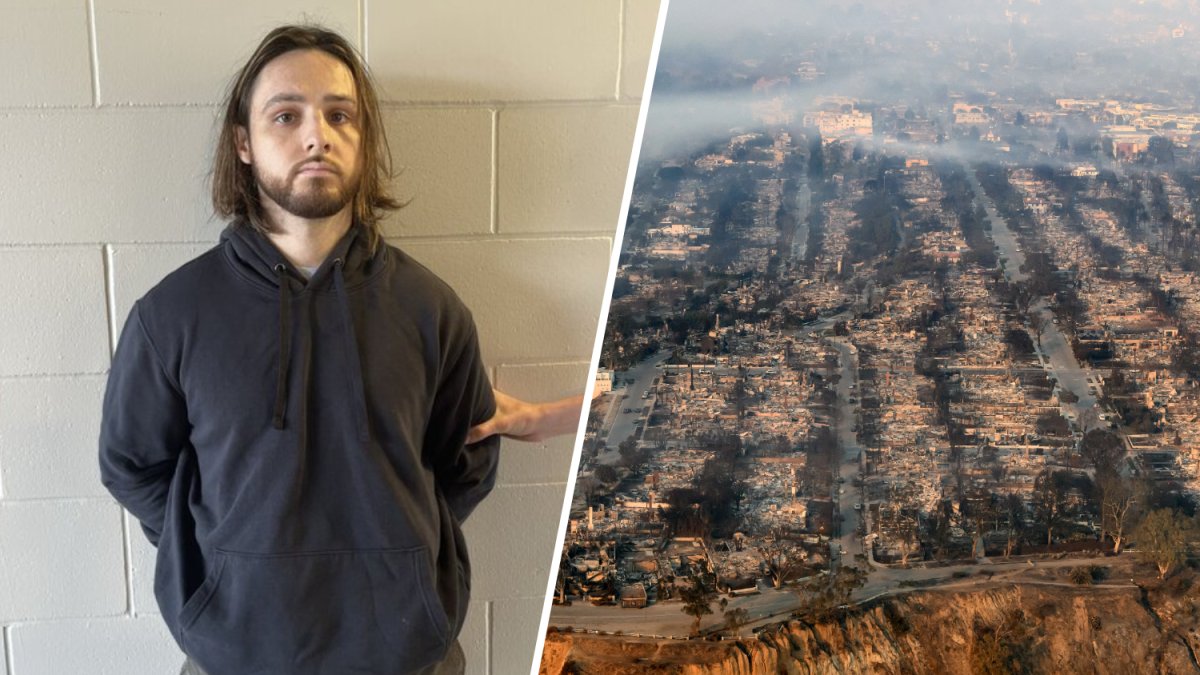
Closing arguments started Tuesday in the federal arson trial of a Florida man accused of starting a fire that became the deadly January 2025 Palisades Fire.
Dual French and U.S. citizen Jonathan Rinderknecht faces up to 45 years in prison if convicted of three arson counts — destruction of property by means of fire, arson affecting property used in interstate commerce, and timber set afire.
Witness testimony continued early Tuesday before U.S. District Judge Anne Hwang delivered instructions to the jury, which will consider each count separately. After the defense and prosecution conclude their final arguments, jury deliberations in the three-week trial are expected to begin.
Rinderknecht, 30, has been present in the courtroom, but did not testify.
On Monday, firefighters were asked about a smaller fire called the Lachman Fire that the federal government accused Rinderknecht of starting Jan. 1, 2025 in the coastal LA County neighborhood. The fire re-ignited in a powerful Santa Ana windstorm Jan. 7, 2025 and became the Palisades Fire.
Prosecutors have spent the duration of the trial painting Rinderknecht as a vengeful, mentally unstable arsonist who was angry at society. They brought expert witnesses who testified the fire cause was “incendiary,” or caused by an open flame.
Rinderknecht’s attorney Steve Haney has repeatedly posited that investigators missed one simple explanation: fireworks. Haney called two firefighters to the stand who delivered contradicting accounts of the evening.
One firefighter told the court that he heard fireworks before the blaze started, but another said he did not.
Los Angeles Fire Department firefighter Robert Appleford, stationed in the Pacific Palisades, testified to seeing flashes of light and hearing fireworks before and after midnight that evening. Minutes later, the department received a call about the brush fire that Rinderknecht is accused of sparking.
But Appleford’s captain, Dave Sanders, later testified that he did not see or hear any fireworks. When Haney asked if Sanders recalled being interviewed by fire investigator Kyle Brown and telling him that he heard fireworks that night, Sanders said no.
Haney declined to comment on Sanders’ testimony.
The witness testimony was a blow to the defense, who also called two of their own expert witnesses to cast doubt on the federal investigation and testify that fireworks were the most likely cause of the fire. Prosecutors spent hours questioning their credibility on cross examination.
Haney also asked a Pacific Palisades resident who lost his family home in the fire to testify about hearing fireworks on New Years Eve. Veterinary student Ari Sallus said he was hiking up a nearby hill with his girlfriend when he saw a flash of light and heard a loud bang from behind him.
He kept hiking and reached the top of the hill minutes later. In the same direction that he heard the bang earlier, he spotted a “little orange light” that was growing steadily and called 911.
On Thursday, Haney had called to the stand a security guard for the neighborhood and another resident who lived close to the hiking trail leading up to the clearing that the government has said was the origin point of the fire. Both said they heard fireworks and saw a group of teenagers running down the trail after.
Monday’s trial proceedings demonstrated the impact of some of the limits placed on the defense, who initially planned to argue that it was the fire department’s fault for not putting out the Jan. 1 fire.
Haney had wanted to use depositions from a firefighter and a state park ranger that the Jan. 1 blaze was still visibly smoldering when first responders left. The firefighter alerted his supervisors of so-called hot spots in the burn area. That testimony was gathered as part of a lawsuit filed by fire victims against the city.
However, Hwang ruled that any evidence or argument of LAFD negligence in their response to the Jan. 1 fire could not be used at trial. She said it was irrelevant and could confuse the jury.
“Theoretically, they could conclude that he was not responsible for Palisades, but the problem here is that the judge has prevented the jury from hearing most of the evidence that would suggest it was the firefighters’ fault,” said NBC4 legal analyst Royal Oakes. “So that’s probably a long shot for him to be guilty of Lachman, but not guilty of Palisades.”
The Palisades Fire is the most destructive wildfire in City of Los Angeles history. More than 23,400 acres burned with 6,800 structures destroyed.
Twelve peopled were killed.