
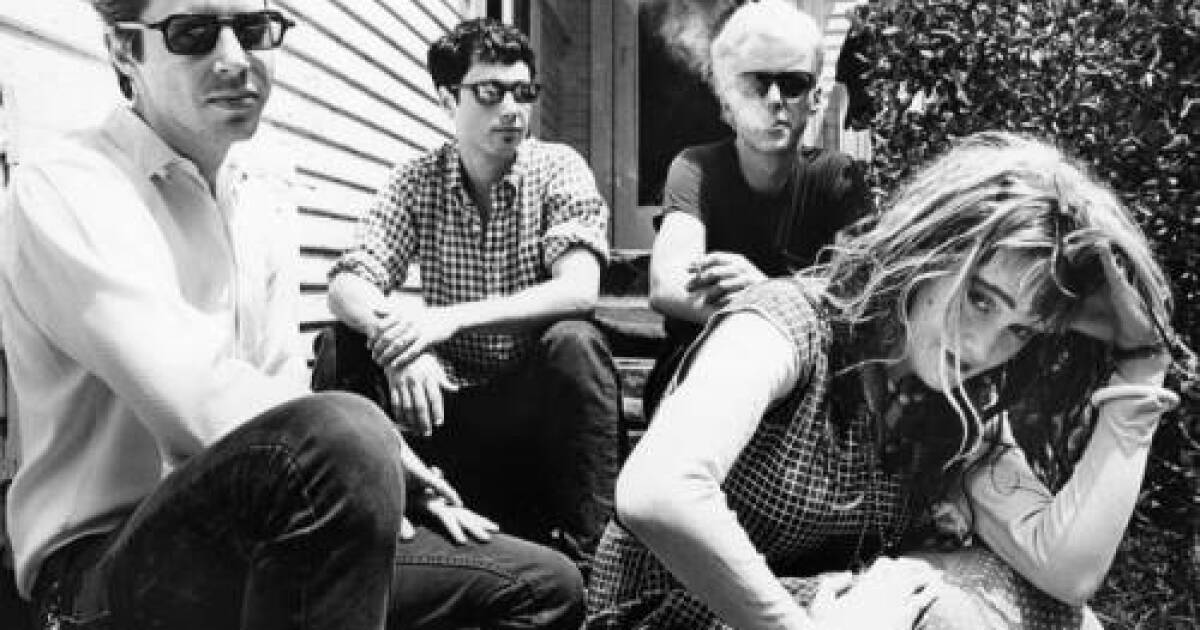
SoCal History: Skirball’s latest exhibit explores LA’s Punk culture
Guest: Cate Thurston, chief curator at Skirball Cultural Center
Punk rock — known for its fast, aggressive sound — evolved out of an underground anti-establishment subculture in the 1970s and 80s. Bands like the Black Flag, The Ramones, and X led the way, particularly in Southern California.
While the anniversary of punk’s inception is contested, the Skirball Cultural Center is celebrating the 50th anniversary in the United States, exploring how a generation of misfits challenged the rules and helped reshape culture from the margins, with its latest exhibit titled “Outsiders, Outcasts, Rebels and Weirdos: Punk Culture 1976–86.”
Cate Thurston is the chief curator of the exhibit. She joined AirTalk, LAist’s daily news program, to talk about how the local punk scene played a pivotal role in shaping the genre.
L.A.’s punk wave
It wasn’t until the mid 70s that L.A.’s punk scene took off, partially because popular venues were still banking on the mainstream soft rock scene of the time.
Keep up with LAist.
If you’re enjoying this article, you’ll love our daily newsletter, The LA Report. Each weekday, catch up on the 5 most pressing stories to start your morning in 3 minutes or less.
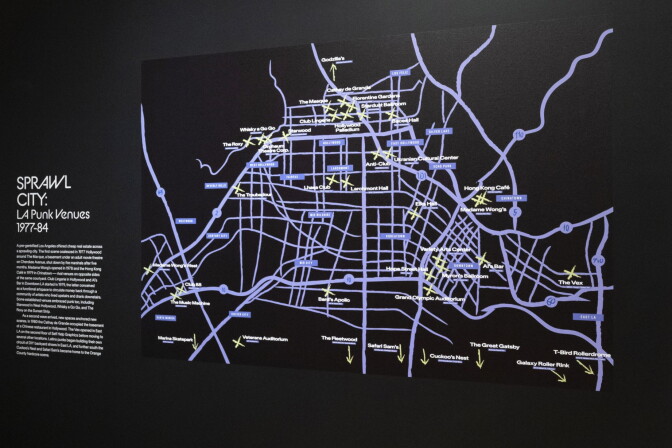
Map of the robust Punk scene across the LA Basin, featured in the Skirball exhibit.
(
smg photography/Sarah M Golonka
/
http://www.smg-photography.com
)
“There wasn’t the traditional club infrastructure for it,” said Thurston, adding that punk bands would play wherever they could, including places like the Ukrainian Cultural Center and even more unorthodox venues like roller rinks.
Hong Kong Cafe vs. Madame Wong’s
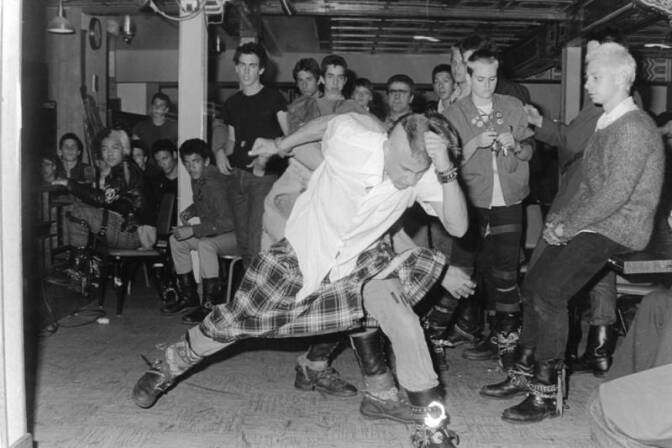
Performer at the Hong Kong Cafe in Chinatown on Nov. 7, 1981.
(
Los Angeles Photographers Collection
/
L.A. Public Library
)
In the late 70s, two Chinese restaurants — Hong Kong Cafe and Madame Wong’s — sat directly across from each other in L.A.’s Chinatown. These venues led the local punk movement and even had a well-documented rivalry, which you can see reported in the L.A. Times.
Amy in Fullerton called into AirTalk to share that her brother actually started the Hong Kong Cafe.
“We were the first club outside of the Masque to play bands like Fear, X, Black Flag, the Germs, and art bands like Nervous Gender, The Bags, and Alice Bag,” she said.
“Both the Hong Kong Cafe and Madame Wong’s were considered institutions in the L.A. punk scene that paved the way for all sorts of punk bands with different styles,” Thurston said.
Madame Wong’s closed its doors in 1985, and Hong Kong Cafe followed a decade later, shutting down in 1995.
Rooted in rebellion
Americans in the mid 70s felt the weight of economic uncertainties, including high gas prices and inflation — not unlike today.
Thurston said this is part of the reason punk rock was born, out of a form of resistance to the overproduced, corporate music in the mainstream at the time.
“ I was a UCLA student at the end of the ’70s, and I was in a band with my best friend. I remember there was just a summer with all these people there…pierced flesh, big paperclips… and we kinda thought, who are these people? We realized that we were the band that was on the way out and said, ‘You know what? I think we ought to just graduate and go to law school.’” — Michael in Santa Monica
Bondage pants, leather jackets, and torn T-shirts
A red parachute anarchy shirt from1977, designed by Vivienne Westwood and Malcolm McLaren.
(
Courtesy of the Skirball Cultural Center
)
Young punk outfits on display.
(
Sarah M Golonka
/
Courtesy of the Skirball Cultural Center
)
Stage diving at a Circle Jerks concert at the Country Club in Reseda in 1982.
(
Ann Summa
/
Courtesy of the Skirball Cultural Center
)
Assorted punk pins.
(
Sarah M Golonka
/
Courtesy of the Skirball Cultural Center
)
Alice Bag of the Bags in Los Angeles in 1978.
(
Melanie Nissen
/
Courtesy of the Skirball Cultural Center
)
Thurston said the punk movement was just as important off the stage as it was on.
“ This is a story of the children it didn’t get better for, who created their own world where they fit in and where they found a place for themselves,” she said. “ It was visually different than anything out there at that moment.”
“Outsiders, Outcasts, Rebels + Weirdos: Punk Culture 1976–86” is on display at the Skirball Cultural Center through September. Learn more here.