
East County News Service
June 23, 2026 (San Diego County)— State and local agricultural officials have significantly expanded a Mexican fruit fly quarantine in San Diego County following new detections of the invasive pest during routine inspections in El Cajon and Spring Valley.
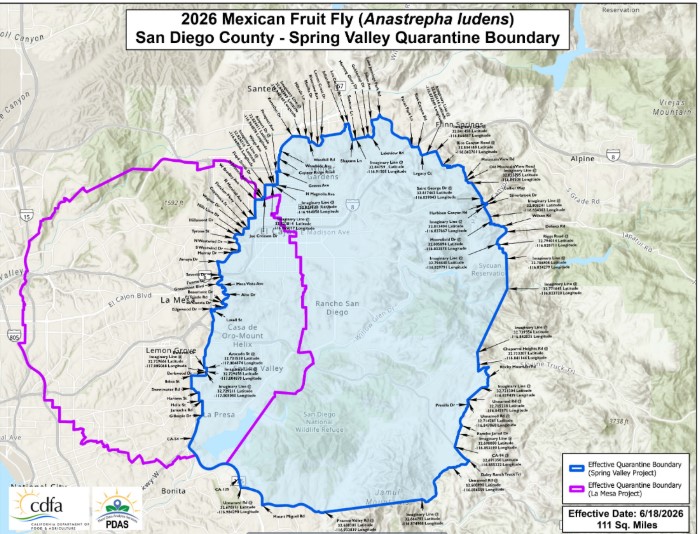
The expansion, announced Tuesday afternoon by the California Department of Food and Agriculture, grows the restricted zone to approximately 111 square miles. The newly expanded boundaries now overlap with an existing quarantine area in La Mesa, creating a sweeping zone of restriction across East County and parts of San Diego.
According to officials, the updated quarantine boundaries are now defined by state Route 67 to the north, Proctor Valley Road to the south, state Route 125 to the west and Riggs Road to the east.
The expanding agricultural lockdown directly impacts residents and businesses across El Cajon, La Mesa, Lemon Grove, Santee and portions of the city of San Diego.
An alliance of state, federal and local agencies — including the CDFA, the United States Department of Agriculture and the San Diego County Agricultural Commissioner — has been mobilized to contain the infestation. Together, they are working to provide support to commercial growers, wholesalers, retailers and neighborhood home gardeners caught within the zone.
To aggressively combat the spread, agricultural teams are deploying a multi-pronged eradication strategy, including sterile fly releases where sterile male Mexican fruit flies are put into the quarantine area to disrupt the pest’s breeding cycle. There will also be targeted treatments of properties located within 200 meters of a confirmed detection — to be treated with an organic formulation of Spinosad, a naturally derived treatment used to control harmful pests. Teams will also employ fruit stripping, in which crews will conduct mandatory fruit removal within 100 meters of any location where live larvae or adult flies have been discovered.
CDFA officials say that using a science-based approach represents the safest and most effective method available to decimate invasive fruit fly populations before they can take a permanent foothold.
The Mexican fruit fly is considered a severe threat because it can infest more than 50 different varieties of fruits and vegetables. A widespread infestation poses a catastrophic risk to California’s multi-billion-dollar agricultural sector, local food supply chains and residential backyard gardens.
For commercial growers, wholesalers, retailers, and nurseries, the quarantine strictly restricts the movement of all host fruits and plants.
However, state officials emphasize that everyday residents play a critical role in stopping the pest. Home gardeners within the 111-square-mile zone are urged to consume all homegrown produce on their own properties and they state that under no circumstances should residents transport homegrown fruit off their property.
Agricultural experts note that while invasive fruit flies pose the greatest threat to commercial farming, most initial detections actually occur in suburban and urban neighborhoods. The pests typically enter the state by “hitchhiking” on un-inspected fruits or vegetables brought back illegally by travelers.
To prevent future outbreaks, the CDFA is urging the public to strictly adhere to “Don’t Pack a Pest” guidelines when traveling.
Residents who suspect that fruits or vegetables in their backyard gardens have been infested are advised not to throw them away casually, but to immediately call the state’s toll-free Pest Hotline at (800) 491-1899.
An interactive quarantine map and further regulatory updates can be found on the CDFA website at www.cdfa.ca.gov/plant/mexfly/regulation.html.