
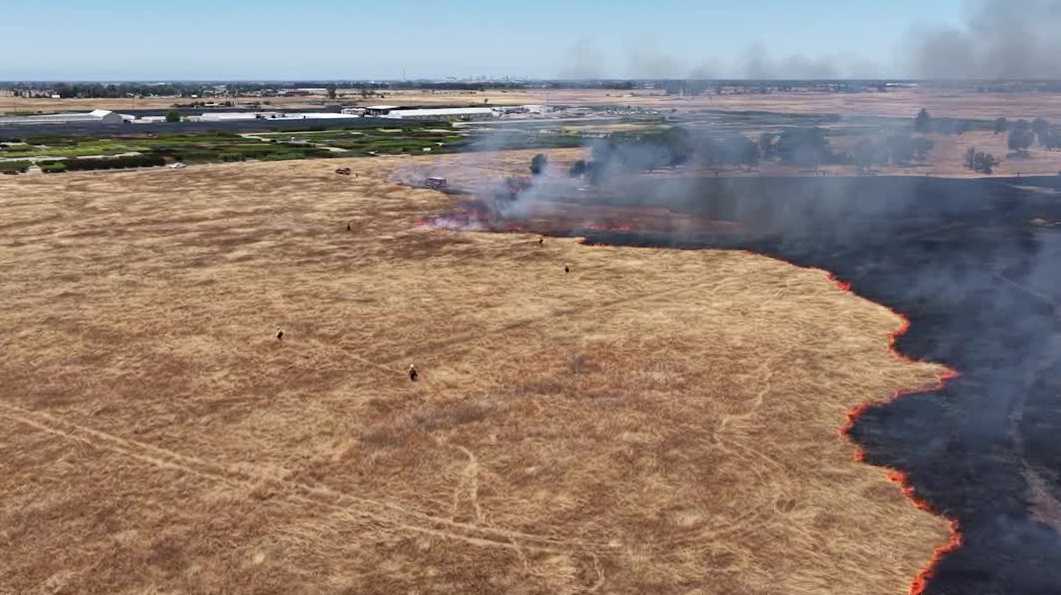
Sacramento Metro Fire crews set a 250-acre field on fire at Gene Andal Park off Florin Road on Tuesday morning as part of a controlled burn for wildfire training and environmental restoration. The fire provided crews with an opportunity to train in a real-world environment. “In this case, we’re lighting the fire and then we’re having our personnel control that. Whether through cutting line, using hose lines or fire engines or actually using more fire to influence the direction and speed of the fire,” said Chris Vestal, a Metro Fire Battalion Chief.The burn also helped to clear invasive species from the field. “It consumes the invasive seeds of the non-native and invasive grasses that are out here that are kind of detrimental to the vernal pools and the native species,” said Zachary Skalak, a natural resources specialist at the Sacramento County Regional Parks Department. The fire allows native species, which are more resilient to fire, to grow back stronger. “It’s really important to work on most of the non-native species of vegetation. Those types of grasses and non-native plants can overtake and really prevent the native grasses from burning, which are more resilient to fire,” Vestal said. “They grow back better the next year. So, by reducing those which steal water from the good plants, we’re actually creating a more fire adapted community for years to come.”For those who frequent the park, including its model airport, the burn has additional benefits. “I think it’s fantastic,” Jeff Montrose, president of the Sacramento Air Modelers club, said. “When it’s burned down, there’s two things. One, we can’t catch it on fire. And two, if a plane does crash, which happens once in a while, we can find it really easy. It’s not three-foot tall grass.”The flames also serve as a tool to reduce the impact of future wildfires in the area. “We’re doing these in areas that have had fires in the past,” Vestal said. “We’re reducing that threat, not eliminating it, but we’re reducing that impact that those fires could have if one were to start.”Metro Fire officials said this was their fourth and final, as well as their largest, wildland fire training of the season. Crews from across the region participated, with officials noting that training alongside unfamiliar teams can make a significant difference during larger incidents.See more coverage of top California stories here | Download our app | Subscribe to our morning newsletter | Find us on YouTube here and subscribe to our channel
SACRAMENTO COUNTY, Calif. —
Sacramento Metro Fire crews set a 250-acre field on fire at Gene Andal Park off Florin Road on Tuesday morning as part of a controlled burn for wildfire training and environmental restoration.
The fire provided crews with an opportunity to train in a real-world environment.
“In this case, we’re lighting the fire and then we’re having our personnel control that. Whether through cutting line, using hose lines or fire engines or actually using more fire to influence the direction and speed of the fire,” said Chris Vestal, a Metro Fire Battalion Chief.
The burn also helped to clear invasive species from the field.
“It consumes the invasive seeds of the non-native and invasive grasses that are out here that are kind of detrimental to the vernal pools and the native species,” said Zachary Skalak, a natural resources specialist at the Sacramento County Regional Parks Department.
The fire allows native species, which are more resilient to fire, to grow back stronger.
“It’s really important to work on most of the non-native species of vegetation. Those types of grasses and non-native plants can overtake and really prevent the native grasses from burning, which are more resilient to fire,” Vestal said. “They grow back better the next year. So, by reducing those which steal water from the good plants, we’re actually creating a more fire adapted community for years to come.”
For those who frequent the park, including its model airport, the burn has additional benefits.
“I think it’s fantastic,” Jeff Montrose, president of the Sacramento Air Modelers club, said. “When it’s burned down, there’s two things. One, we can’t catch it on fire. And two, if a plane does crash, which happens once in a while, we can find it really easy. It’s not three-foot tall grass.”
The flames also serve as a tool to reduce the impact of future wildfires in the area.
“We’re doing these in areas that have had fires in the past,” Vestal said. “We’re reducing that threat, not eliminating it, but we’re reducing that impact that those fires could have if one were to start.”
Metro Fire officials said this was their fourth and final, as well as their largest, wildland fire training of the season.
Crews from across the region participated, with officials noting that training alongside unfamiliar teams can make a significant difference during larger incidents.
See more coverage of top California stories here | Download our app | Subscribe to our morning newsletter | Find us on YouTube here and subscribe to our channel