
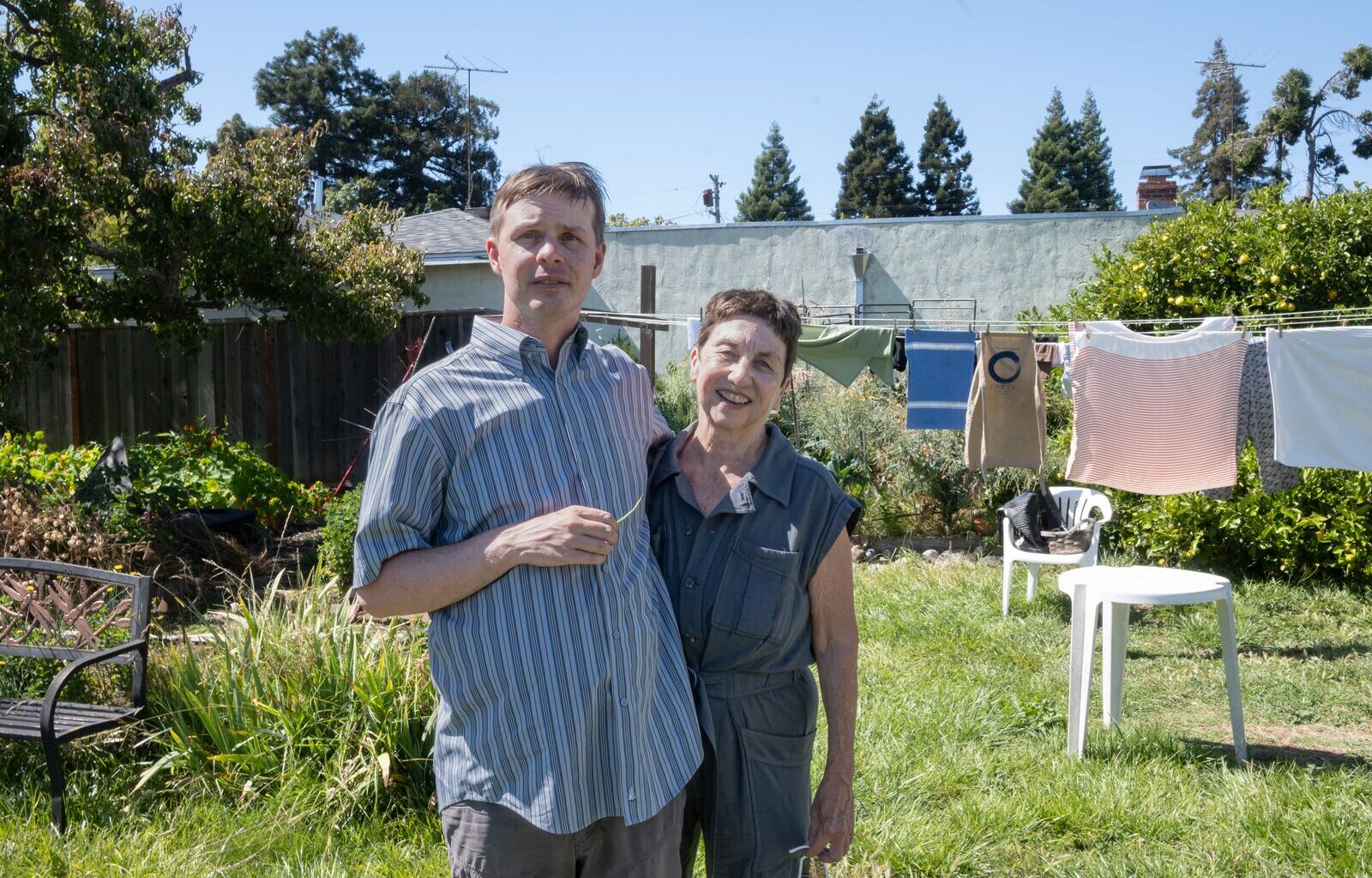
 Raymond Kohl-Grant and his mother, Jeannie Kohl, stand in the communal backyard of the housing complex on Sacramento Street where they have lived for decades. The property went on the market earlier this year. Credit: Hope Muñoz/Berkeleyside
Jeannie Kohl always knew she could count on her neighbors in the row of apartments stretching back from Sacramento Street to keep an eye out for her son as he grew up with autism. Now 36, Raymond Kohl-Grant spends time at the Bancroft Community Garden a few blocks away, and volunteers at the arts nonprofit Creative Growth. The two of them live next door to one another in the rented duplex where Kohl-Grant grew up, the two units linked by a door built into his closet.
But after the 23-unit property where they live went on the market in March, Kohl worries she might lose her home of 43 years. Decades of rent control mean the retired educator pays far below Berkeley’s market rate; like her neighbors, many of whom are also retired, Kohl fears where her family might end up if a new owner were to push them out.
“I couldn’t stay in Berkeley,” she said, “and Raymond’s life is in Berkeley.”
A local land trust is hoping the city will step in and provide funding that could be used to buy the Sacramento Street property under a program in which Berkeley helps nonprofits purchase and fix up older buildings with low rents. Supporters say the program protects tenants from displacement while turning privately owned properties that provide what housing experts call “naturally occurring affordable housing” into a dedicated stock of below-market-rate units.
Mayor Adena Ishii has proposed putting $1.3 million from Berkeley’s pool of affordable housing funds toward the city’s “Small Sites” acquisition program. When combined with another $2.5 million the program has available from past budgets, that could go a long way toward buying Kohl’s building.
The strategy has its skeptics, however. The City Council narrowly voted to pull $1.4 million from the Small Sites program last year, as members said they believed Berkeley’s affordable housing money would be better spent on new below-market-rate developments, rather than acquisitions of existing housing.
That debate is shaping up to be one of the key questions before the council when it meets Tuesday to adopt the city’s budget for the next two years.
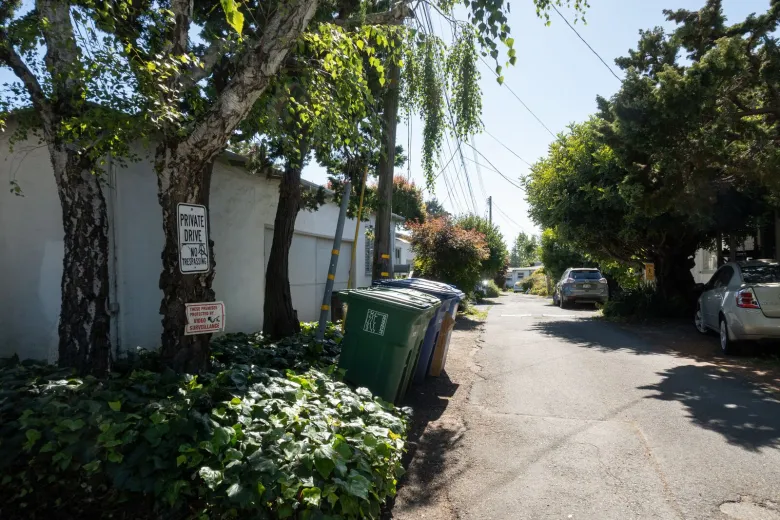 The 23-unit complex is mainly made up of duplex cottages that line a driveway leading back from Sacramento Street. The one-acre property has been listed for $3.2 million. Credit: Hope Muñoz/Berkeleyside
What comes after ‘community-oriented’ landlords?
Ruth and Henry Frantz were the kinds of landlords who would invite you to stay for a gin and tonic after you dropped off your rent check, Kohl recalls. They built the complex in the late 1950s, a row of cottages lining a driveway that leads to the house where they lived at the back of the one-acre lot. The house looks out onto a quiet communal lawn, a world away from the racket of busy Sacramento Street, where tenants gather for an annual “0 party” to celebrate whoever is turning a multiple of 10.
“They have been a lot more community-oriented than they have been profit-motivated,” another tenant, Kristine Larsen, said of the Frantzes, who later passed the property on to their niece.
The railroad-style one-bedroom units are simple and small; tenants who wanted to raise a family would typically leave in search of more space. But the community is the kind of place where people stick around. Once they took down a wall and converted their cottage’s garage into a bigger living room, Kohl and her then-husband found it was the perfect place for their two children.
“It can be very isolating, raising a kid with severe autism — and I never felt isolated because I had the community around me,” Kohl said. “I felt like I was a part of something, and I know a lot of people don’t have that, who live in single-family homes.”
The Japanese maple tree she planted outside her front door for Earth Day when her daughter was a fourth-grader now towers over her home, while the duplex, where the two of them live along with one of Kohl-Grant’s caretakers, gives her son the support he needs while letting each of them have their own space.
The property has an asking price of $3.2 million, according to a listing that describes it as an “add value opportunity with below market rents.”
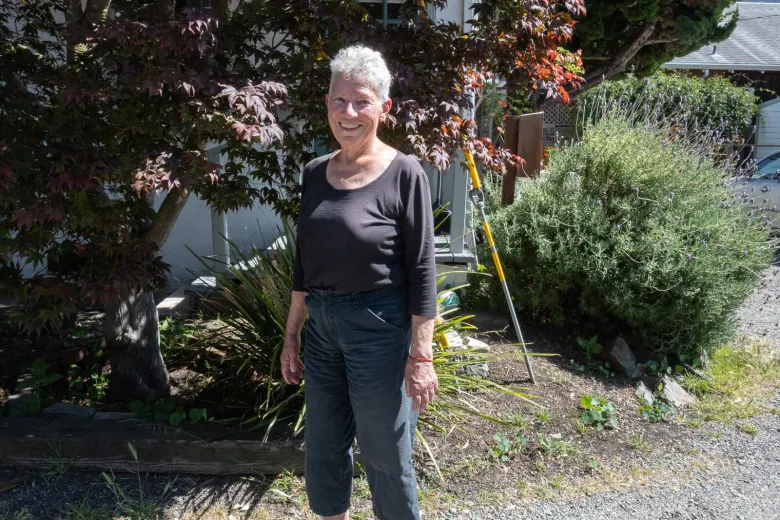 Like other tenants at the Sacramento Street property, Kristine Larsen fears she may not be able to find a similarly affordable place to live if she has to move. Credit: Hope Muñoz/Berkeleyside
Local laws would protect Kohl and other tenants from many changes under a new owner: Their units will still be subject to rent control, and they can’t be evicted unless the owner cites circumstances that meet Berkeley’s “just cause” standards. Still, the property’s tenants fear a new landlord might move — legally or otherwise — to push them out in search of higher rents, meaning they would lose the affordable corner of Berkeley they’ve held onto through a spiraling affordability crisis.
“The Small Sites program was designed exactly for situations like this,” said Matt Gustafson, organizational director for the Bay Area Community Land Trust, which hopes to buy the building.
Berkeley has used the program to help land trusts acquire three properties, including a 13-unit building on Solano Avenue where tenants faced eviction from their landlord. Existing tenants are allowed to stay in buildings bought through the program, but if they leave their units will be dedicated as affordable housing for low-income renters.
Gustafson and other backers of the acquisition strategy note it’s typically much cheaper to buy and fix up an older property than it is to build new affordable housing, and instead of waiting years for affordable projects to break ground, deals to buy buildings can be done in a matter of months. According to data from the city, the three buildings acquired through the Small Sites program cost $459,000 per unit to buy and rehabilitate on average, less than half the cost of recent newly built affordable developments Berkeley has funded, which averaged $930,000 per unit.
But while Berkeley is one of several cities that have launched acquisition programs, the strategy hasn’t gotten much support from the state and federal government, which provide the bulk of funding for affordable housing.
Critics point out that means local governments wind up on the hook for a bigger share of the cost to buy existing buildings, since newly built affordable projects are far more likely to get money from Sacramento or Washington. Even though the Small Sites homes were cheaper overall, the city’s data showed they were 37% more expensive to Berkeley: each unit required about $286,000 of local funding on average, whereas units in new buildings cost the city $209,000.
Gustafson said the land trust believes it could cost as much as $6 million to buy the Sacramento Street property and rehabilitate its nearly 70-year-old units. The trust is hoping to receive up to $4 million from Berkeley for the property, which would mean each unit could cost the city about $174,000.
The proposed boost in Small Sites funding wouldn’t be specifically allocated to the complex where Larsen and Kohl live — another land trust is also seeking help from the city to buy a different property, Gustafson said, and Ishii’s proposal wouldn’t provide enough money to make both purchases. If the council votes to provide the funding, it would then be up to city staff to evaluate the proposals and decide which receives it.
City Council will decide on program’s future
Ishii describes the Small Sites program as a critical but neglected piece of the housing strategy she and others often refer to as the “three P’s”: production, meaning a “yes-in-my-backyard” approach to new development; protection, though rent control and other tenant rights; and preservation of existing affordable housing.
“We want people to be able to live in the communities and neighborhoods they’re a part of, and not be forced to move,” Ishii said. “If we’re only thinking about building new housing, we’re not thinking about how we support the community that already exists.”
The $1.3 million Ishii has budgeted for the program comes from Berkeley’s Housing Trust Fund. The money can only be put toward affordable housing programs, so it couldn’t be used to patch other holes in the city’s budget, which faces a nearly $30 million deficit the council wants to bridge with a mix of service cuts, layoffs and increased sales taxes.
That’s a change from last June, when the council voted 5-4 to cut $1.4 million that had been allocated to the Small Sites program from Measure U1, a business tax pitched to voters in 2016 as a funding source for affordable housing, though the money it raises is not legally restricted to that purpose. The council instead used the funding to address a deficit in the general fund.
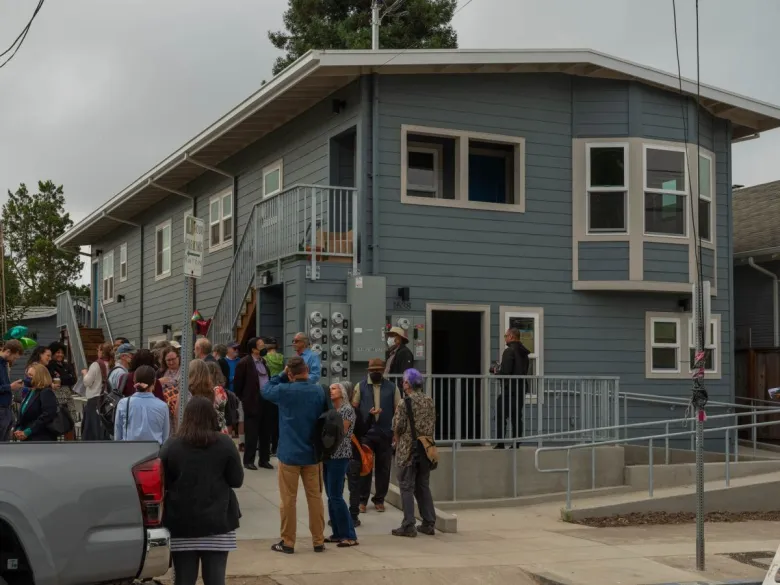 People gather for the 2022 opening of the Stuart Street Co-Op apartment building, an affordable housing acquisition funded in part by Berkeley’s Small Sites program. Credit: Ximena Natera, Berkeleyside/CatchLight
Councilmember Rashi Kesarwani, one of the leading voices for redirecting money from the Small Sites program last year, remains unconvinced that it represents the best use of Berkeley’s affordable housing funding.
New construction expands the city’s supply of affordable housing, Kesarwani said, and there are affordable projects — such as a below-market-rate building in the planned development atop the North Berkeley BART station, and another on a blighted lot at San Pablo Avenue and Delaware Street — that also need funding to break ground.
“We have scarce resources, and we have to make tough tradeoffs about how we want to spend our money,” she said. “I’m trying to create new affordable housing units for people who don’t live in our community yet.”
And Kesarwani said she is dubious that Berkeley needs to buy the Sacramento Street property to protect its tenants, since the city already provides robust rent control and eviction protections, funds legal aid for tenants facing eviction and has the Rent Stabilization Board to handle problems between tenants and landlords.
“That is how we protect tenants,” she said.
Despite Kesarwani’s concerns, there may be more appetite on the council this year to fund the Small Sites program: Councilmember Ben Bartlett, one of the five who voted to cut the program’s funding last June, spoke in favor of Ishii’s proposed allocation during a budget discussion last week. (Councilmembers Brent Blackaby, Mark Humbert and Terry Taplin also voted to reduce the program’s funding; Ishii joined with Councilmembers Cecilia Lunaparra, Shoshana O’Keefe and Igor Tregub in voting against the cut.)
Gustafson says he agrees that building new affordable homes is critical to addressing the housing crisis. But he argues acquisition programs such as Small Sites, and properties such as the cottages on Sacramento Street, should be part of Berkeley’s housing strategy too.
“People who are low-income should not only have the option to live in … large developments that are along major corridors,” Gustafson said. “They should have options, including interior neighborhoods and smaller properties that have trees and sunlight and gardens.
“People should be able to stay in the homes where they’ve lived for 40 years.”
“*” indicates required fields