
Good morning,
The Padres are looking a little bit like the team that won so many games it seemed they could not possibly win back in April.
Much like then, the fact they have problems to address is readily and rawly apparent.
But they also clearly still have the will to win.
Give them that.
“It’s not easy to go out there and look good every single day,” Fernando Tatis Jr. said. “But we’re staying together as a team. It’s as simple as that. We are working together.”
They are at least doing so increasingly lately, and they did so last night in the second inning, when six consecutive players reached base with one out as they scored five runs a half-inning after the Braves scored four.
You can read in my game story (here) how last night’s wild walk-off win went down.
We might overuse the word “wild” when describing a game. But this one was.
(I was driving home listening to the Sirius XM MLB highlight show, and I heard Jesse Agler’s magnificent call of Manny Machado’s game-winning single. He called it a “madcap night.” All I could think was, “Dangit. I wish I’d thought of that word.” Madcap, indeed.)
Before I got into all the craziness, my game story led with the big-picture issue, which is that the Padres starting pitching continues to be a problem. We will discuss that more later in the newsletter.
But we should also appreciate what this victory was, because it was indicative of what the Padres seem to be.
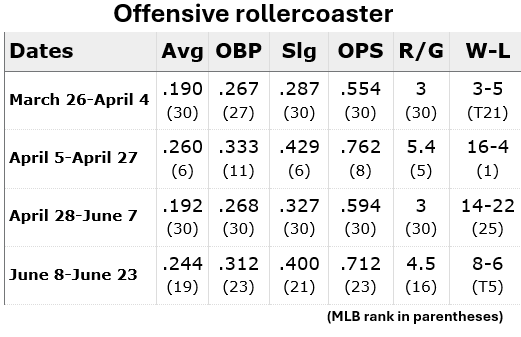
Maybe you forgot during the month of malaise that began in late May. But this was how the Padres built what was one of the major leagues’ best records for most of the season’s first two months.
When Gavin Sheets hit a three-run homer in the ninth inning and the Padres beat the Brewers 3-1 on May 13, it was the Padres’ eighth victory earned in their final offensive half-inning and their 13th victory decided in the seventh inning or later. They were 25-17 at the time, meaning more than half their victories were decided late and nearly a third were decided as late as possible.
The Padres have gone 16-20 since then. Last night was just the third time in those 36 games they won in their final offensive half-inning and the fifth time they have decided a victory in the seventh inning or later.
We all knew at the time that what they were doing the first 40 or so games was unsustainable.
But that doesn’t mean it wasn’t meaningful. It appears to have laid a foundation of belief that they are capable of coming from behind.
Last night was the Padres’ 20th comeback victory, their sixth from at least four runs down. Just four teams have more than 20 comeback victories. None have as many from four runs down.
“Just kind of what we’ve been doing all year,” manager Craig Stammen said. “We’ve been getting down, and then we’ve been coming back. And we haven’t had a ton of offense over the whole year, if you look at it, but we always tend to bounce back and come back in some form or fashion.”
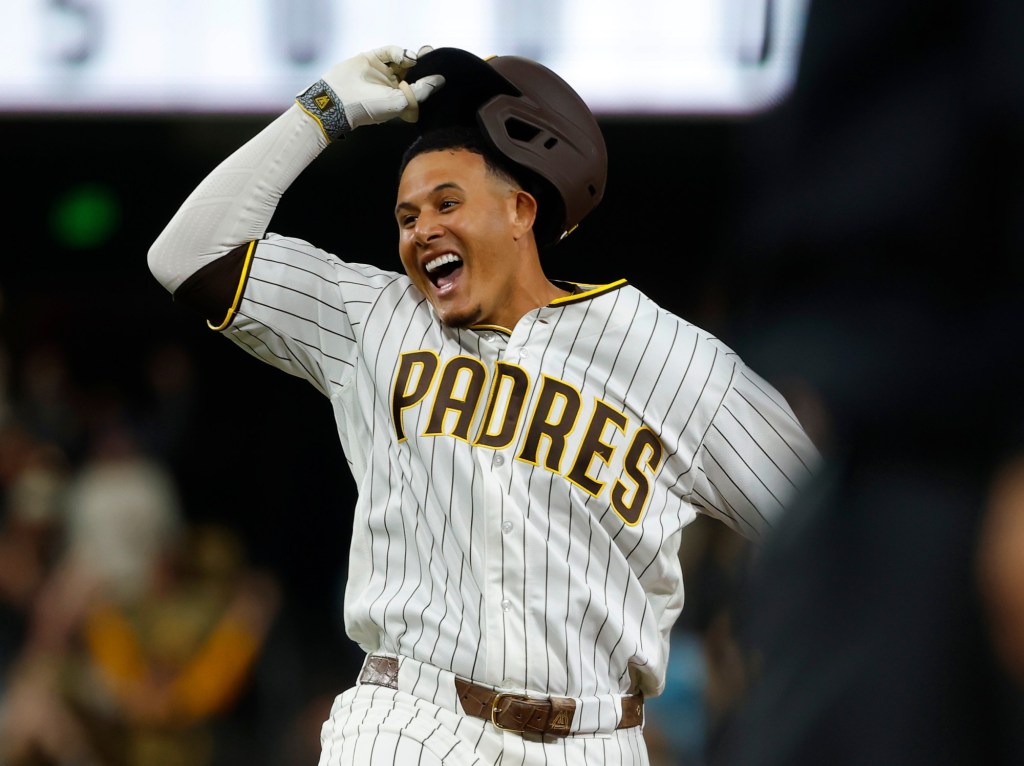
Machado bravado
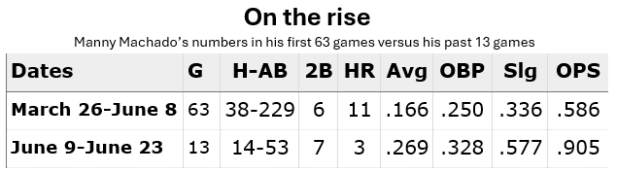
Machado’s night was sort of like his season.
He finally came through after failing his first four times up, all with a runner in scoring position.
He made the final out in the first and second innings with Samad Taylor on second base. He made the first out in the fifth inning after Jackson Merrill’s leadoff double. He again made an out in the seventh with Taylor on second.
But then Machado ripped the first pitch he saw from Braves closer Raisel Iglesias up the middle in the 10th inning for his third game-winning hit in the past four games.
Machado said after his three-run homer in the 10th inning Saturday in Texas: “Key situations when I’m up there, you still gotta be afraid. I can do damage like I did today. It doesn’t matter, you see those numbers up there, you know, you see the back of my jersey and you’re gonna know who I am.”
Stammen said after Machado’s solo homer that was the only run in Monday’s victory over the Braves: “What we believed about Manny for a really long time. And you guys didn’t really believe me, but hopefully I’m starting to prove myself right.”
And last night, Mason Miller had this thoughtful analysis: “I don’t think that at any point during the season, regardless of numbers, that anybody felt bad when Manny was up at the plate. We have way more images in our head of him succeeding than him failing.”
Machado’s “know who I am” comment from the weekend could go down as his new “Because I’m f—ing Manny Machado.”
That was what he said when he was not hitting all that well in August 2022, and then he almost immediately went on a heater that lasted pretty much until the end of the season.
Or maybe it will go down as his new “I’m just too f—ing good” from June 18, 2024, when he explained how his recovery from elbow surgery was hindering his swing. His vow that day: “I will figure it out. Even if I blow my f—ing elbow out again, I will figure it out.” The next day, he began a stretch that lasted to the end of season in which he had a .917 OPS.
No.3, and it’s OK
Tatis did that thing he used to do a lot and that it is amazing he doesn’t still do more.
He hit a home run.
His 410-foot blast to center field that tied the game 6-6 in the seventh inning last night was hit off his bat at 107 mph.
It was the 52nd ball Tatis has put in play with an exit velocity of 105 mph or greater. That is tied for sixth most in the major leagues.
The other 13 players who have put at least 42 balls in play that hard this season all have at least 10 home runs.
As you probably know, because it has not been difficult to keep count, last night’s homer was Tatis’ third of the season.
“Contact point,” Tatis said when asked the difference between that ball and all the other hard hits. “If I would have been doing that every single day, I’m the best baseball player in the world. But it’s a challenge every single day, and we go out there to compete.”
That is what it has come down to for Tatis and the Padres.
It seems no one is trying to fix his swing anymore. Not with him hitting like he is.
He also doubled last night, has reached base in 17 consecutive games and is batting .366/.400/.527 over his past 27 games.
The idea has been for some time to just let his swing eat. He tinkered all April and into May trying to get more balls in the air. Then he stopped searching and just started hitting.
“The home runs will come,” Tatis said last night. “And if not, whatever. But we’re here to play good baseball. Obviously, homers are a great part of it. But I’m gonna keep going out there, get on base for the team, feel good, have good at-bats out there and just try to hit the ball hard all around the field.”
Tatis has raised his average 48 points over the past 27 games and is now batting .286/.348/.370 for the season.
He spoke last night about the focus on being OK with who he is.
“It’s a part of maturity,” he said. “And it’s not easy to accept that, especially because it’s been a big part of my game for my entire career. So it’s a challenge. But you’ve got to stick with it and just got to find a way to play good baseball.”
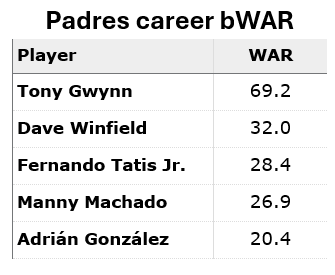
The home run was the 155th of Tatis’ career. That placed him fifth on the Padres’ all-time list, one ahead of Dave Winfield and one behind Phil Nevin.
Tatis has a 1.1 WAR this season, as calculated by Baseball-Reference. Should he start hitting more homers, he could conceivably pass Winfield for second-all time among Padres players by the end of this season.
For starters
Now, about the Padres’ biggest problem.
Griffin Canning was the opposite of unhittable again last night, as he entered the game at the start of the second inning and allowed four runs on three singles, a double, a walk and a hit batter.
Tuesday was Canning’s second time working after an opener. He got the win six days earlier in St. Louis, following Bradgley Rodriguez and allowing one run over 4⅓ innings.
He also allowed the Mets just one run in five innings in a start on June 8 and the White Sox one run in five innings in his Padres debut on May 3.
But in his other six starts, he has allowed 28 runs in 27⅔ innings.
This would be concerning if he was the only starter struggling. That he is merely one flat tire on the struggle bus is beyond alarming.
Counting the two times Canning has worked after an opener and the two times Lucas Giolito has worked after an opener, members of the Padres rotation have a 5.14 ERA over the past 25 games.
A Padres starter has lasted even five innings in just 16 of those games. They have four quality starts in that span. Starters have departed 12 of those games with the Padres trailing and another eight with the game tied.
To be fair, the starting pitchers have not been greatly supported by runs from the offense.
But the offense is picking up. Last night was the ninth time in 14 games the Padres had at least nine hits. It was the eighth time they scored at least five runs.
Rotation machinations
You can read in my story from yesterday afternoon (here) about the move to put Giolito on the injured list with elbow inflammation.
The Padres believe he can be throwing again soon after a few days rest.
The story talked about the upcoming stretch of 17 games in 17 days and how the Padres might navigate that stretch.
With Giolito going down, the rotation was altered.
Primarily, Randy Vásquez was moved back a game to Friday against the Dodgers. What that also did was move Walker Buehler back a day, so he is now lined up to face the Dodgers in both of the teams’ upcoming series.
Left-hander J.P. Sears was called up to replace Giolito and will start today against the Braves, whose best hitters bat from the left side.
Open-ended issue
The first three times the Padres used an opener, their bullpen was not overly taxed.
Giolito went five innings once and four innings the next time he followed Wandy Peralta.
With Canning having gone 4⅓ last Wednesday, that meant the Padres got at least to the sixth inning with their bulk reliever each time. In those three games, they never used more than four relievers (including the opener) to cover more than 4⅔ innings.
Last night was an example of how using an opener can backfire, as the Padres had to cover 9⅓ innings with six relievers.
“You lose that one guy that could give you another extra inning by pitching him just in the first inning,” Stammen said.
Then he noted, “You know, we could go a different strategy too. We could let Wandy go a little longer.”
But it’s not that simple. This is one of those cases where the team knows their player better than the rest of us.
Peralta has excelled in three turns as an opener, working a scoreless inning each time.
The veteran lefty has actually has been mostly excellent in every role this season.
His inning last night dropped his season ERA to 1.86 in 33 appearances (38⅔ innings).
Peralta has not allowed a run in 12⅓ innings (10 appearances) in June. He allowed two runs on May 30, which stopped a scoreless streak of 12 innings (nine appearances).
I wrote last week (here) about Peralta’s altered pitch mix and how he is off to the best start to any of the nine big-league seasons in which he has made at least 30 appearances.
But while the Padres are likely to continue to use an opener again for at least a while with at least one of their starting pitchers — they even had Germán Márquez work after one in his rehab start last night — it won’t be Peralta if they choose to have the opener try to get more outs at the start.
It would likely be Yuki Matsui or Kyle Hart, both left-handers, in that case.
“Wandy is very good for one inning,” Stammen said. “Anytime we push him past that … we’re not getting the best out of Wandy. Our job as coaches and the coaching staff is to put guys in the best position to succeed. Wandy pitching one inning, in my opinion, is probably the best position for him to succeed. Anything after that makes it a little bit tough on him. Now, will he have to do that throughout the year? Yeah, he’s gonna have to. But best-case scenario, he goes one inning.”
Closer time
There were a couple times this season that Mason Miller had finished the ninth inning and lobbied to pitch the 10th. Last night, he finally got Stammen to agree.
“Sometimes I’ve meant it, sometimes I haven’t,” Miller said with a smirk. “I think Craig and I both knew today that, short inning, felt good after the ninth, ready to go back out and give us a chance to win.”
Miller was called on to pitch last night’s ninth inning with the game tied 6-6. He finished that inning in 11 pitches. There was no doubt in his nor Stammen’s mind who was pitching the next inning if it was necessary.
“I just asked how he was doing, how he’s feeling,” Stammen recalled. “He goes, ‘Yeah, give it to me.’ So I didn’t really have to ask, like, ‘Do you want to pitch the next inning?’ He was thinking it as he was coming off the mound, as he has a couple other times, and I’ve left him disappointed.”
Miller had pitched twice in the previous three days but had five days off before that and entering last night had pitched just seven innings since May 30.
In this instance, there was virtually no reason to not have the most dominant closer in the game work in an inning that was going to begin with a runner on second base.
“He’s probably the best weapon that you could think of in that situation with the guy on second and nobody out,” Stammen said. “Because he can get so much swing and miss and get the strikeout when he needs it.”
Miller did just that last night. After Austin RIley led off the 10th with a long fly ball to right field that got the runner to third base, Miller struck out Rowdy Tellez before ending the half-inning with a groundout.
It was his first two-inning outing since Sept. 6, 2024, with the Athletics. That was Miller’s first full season in the majors, and he was still fairly fresh off having been a starter. He went two innings six times in ‘24.
More Morejón
Adrian Morejón worked for the third time in four days and was no worse for wear.
He faced four batters in the eighth inning only because one reached on an error.
Morejón hit 100.9 mph with one of his sinkers, tying Miller’s fourth-fastest pitch of the night.
“He’s getting pretty close,” Miller said before adding with a chuckle: “I’m getting a little worried.”
I wrote in yesterday’s newsletter about the Padres relying on Morejón to take down the top of the order in high-leverage situations.
Last night was the 16th time in his past 18 appearances that Morejón has faced at least two of the top four batters in the opponents’ lineup.
Miller is asked to close games, which is considered the hardest role for a reliever. But that means he faces whatever part of the lineup is batting in the final inning. He has faced at least two of the opponents’ top four hitters in just nine of his past 18 appearances.
Not so Brave world
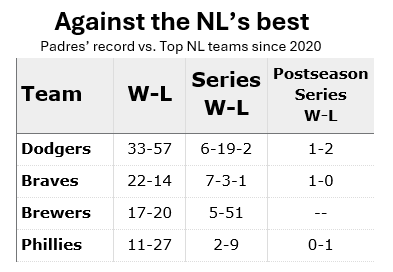
The Padres have the fifth-best winning percentage in the National League since 2020.
In that span, they have generally not fared well against the NL’s better teams — except one.
Last night’s victory gave the Padres their seventh series win in the 11 series they have played against the Braves since 2021. (They did not play each other in the covid-shortened 2020 season.)
Counting the 2024 NL Wild Card Series, last night was the Braves’ eighth consecutive loss at Petco Park.
Tidbits
The Padres are batting .289 with runners in scoring position over their past 15 games, an improvement of 159 points over what they hit with runners in scoring position in their previous 17 games. But that is not the remarkable part. What is most incredible is that they have had 135 at-bats with runners in scoring position in those 15 games compared with 77 at-bats in the previous 17 games.
A night after his hitting streak ended at 12 games, Taylor was back at it. He went 3-for-4 with a walk and is batting .370/.443/.444 in 62 plate appearances since his June 3 promotion from Triple-A. Taylor also stole his fifth base in five tries.
Sung-Mun Song was 1-for-3 with a walk. He is 7-for-24 with two walks over his past nine games after going 2-for-25 with five walks in his previous 17 games. In Monday’s newsletter, Song explained he has always been a slow starter and that his sporadic playing time has made finding his rhythm a challenge.
A night after going 0-for-3 with runners in scoring position, Rodolfo Durán came through with an RBI single his first time up last night. Durán also took multiple foul balls off his mask and one off his shoulder. Good thing for him, Freddy Fermin was activated off the concussion injured list yesterday.
The Padres bullpen’s 3.15 ERA is second in the major leagues to the Braves’ 2.83 mark. It is much closer if you factor in that the Braves have not used an opener this season. When you replace what Canning and Giolito did as “relievers” with what Peralta and Rodriguez did as “starters,” Padres relievers have a collective 2.85 ERA this season.
All right, that’s it for me.
Talk to you tomorrow.