
The family of former NFL player Doug Martin filed a lawsuit Tuesday against the city of Oakland, five of its police officers and a paramedic company in the former All-Pro running back’s October death.
Martin’s mother and father, Leslie and Douglas Martin, claimed in the federal lawsuit that their son died of “restraint asphyxia” while in the custody of Oakland police. The filing — which also faulted a Falck paramedic crew’s “failure to provide timely medical care” — does not list a desired monetary amount sought from each entity or the officers.
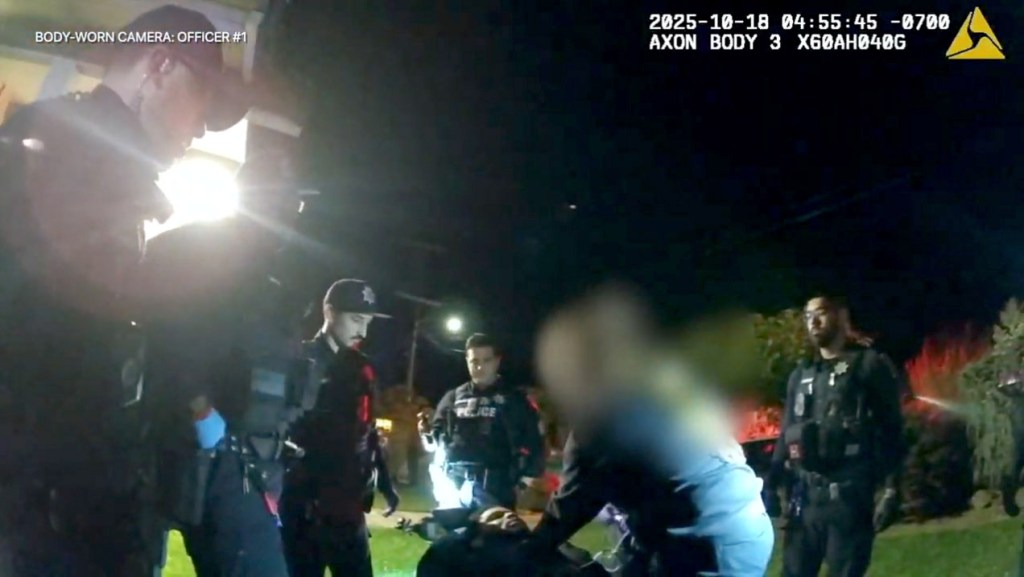
The lawsuit adds a new level of scrutiny to Doug Martin’s death in the predawn hours of Oct. 18, when he was confronted by Oakland police responding to multiple calls of the retired NFL running back breaking into a house near his family’s longtime home on the 11000 block of Ettrick Street, in a neighborhood near the Oakland Zoo.
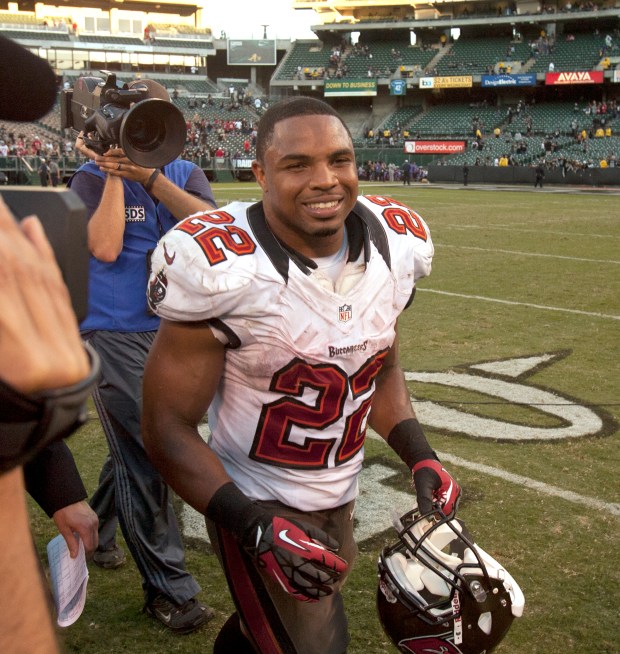 Tampa Bay Buccaneers running back Doug Martin (22) walks off the field after a staggeringly successful day against the Oakland Raiders in an NFL football game, Sunday, Nov. 4, 2012 at O.co Coliseum in Oakland, Calif. Martin rushed for 251 yards and four touchdowns, as the Buccaneers won, 42-32. (D. Ross Cameron/Staff)
Oakland police initially said a “brief struggle” ensued when officers contacted him inside a neighbor’s house and tried to detain him. The agency said Doug Martin then became unresponsive after being taken into custody.
The lawsuit filed this week claimed Doug Martin was “placed face down while one or more officers pressed on his back,” and that “after a period of time” he was rolled onto his side. At that point, “Martin was unresponsive seemingly unconscious; however, the defendant officers initially believed he was sleeping or pretending” to sleep, according to the lawsuit.
At some point, officers called for medical attention. Yet Martin’s parents claimed their son “did not receive immediate medical attention,” and instead “Falck paramedics arrived over 15 minutes after the call for service and, and when they arrived, did not promptly provide medical care.”
The lawsuit specifically named Oakland police officers Riryon Machado, Justin Bermudez, Bradley Potts and Anderson Kitts as defendants, along with a sergeant, identified in the filing only as M. Smith. Also listed as defendants were the city of Oakland and Falck Northern California, along with its parent company Falck USA.
Messages sent Wednesday by this news outlet seeking comment from spokespeople for city of Oakland and the Oakland Police Department, as well as Falck, were not immediately returned.
In March, Oakland police released video snippets of their encounter with Doug Martin, which offered the first window into how the officers tried to subdue him that morning.
The highly-produced video compilation included a seconds-long excerpt of one 911 call, where a woman reported that Martin “takes sleeping pills and he hasn’t slept for three days.” It also included doorbell camera footage from one house, where Martin could be seen approaching and yelling “I see you in there, this is Doug Martin.” He also yelled the words “Tampa Bay and Boise State” — potentially referencing places where he played football in college and professionally — before adding “help me.”
Once inside, Martin could be heard yelling from a bathroom while officers tried to coax him out. When Martin exited the bathroom, one of the officers said “we’re going to help you,” as at least two officers grabbed Martin and took him to the floor a few feet away, the footage showed.
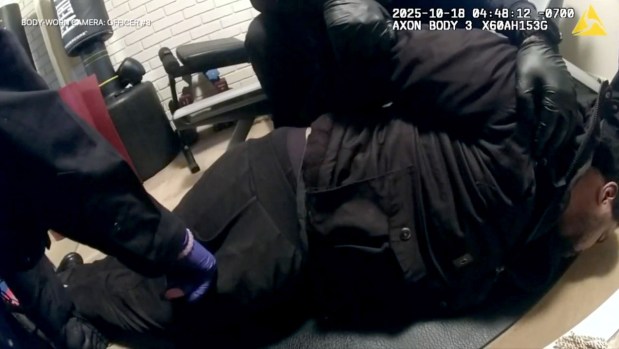 The Oakland Police Department released portions of video and audio captured during the in-custody death on Oct. 18, 2025, of Doug Martin, a former NFL running back. (Oakland Police Department)
There, while laying face-down, several officers gathered around, including at least one who appeared to be positioned on Martin’s back.
“Keep his legs down,” one officer said, while another could be heard yelling at Martin six times to “stop,” as well as to “calm down.” At first, Martin could be heard moaning or yelling, but he appeared to grow nearly completely silent and still as officers handcuffed him.
About eight minutes later — as Martin continued to lay face-down on the floor — an officer inquired about Martin’s status, asking others in the room: “You think he’s playing possum?” One officer said he wasn’t sure, while others could heard recounting how Martin “was like wild, wild, wild,” and “ran straight through that fence.”
“So he could just be tired,” an officer added. At that point, an officer checked Martin’s neck for a pulse, after which a noise resembling snoring could be heard on the video footage.
About 14 minutes after officers handcuffed Martin, officers could be seen carrying Martin out of the house, because, police said, the paramedics’ gurney could not make it inside the home. Outside, someone notified a paramedic that Martin may have been using sleeping pills, after which the paramedic responded, “OK, well, I guess that’ll make it easier.”
At that moment, someone could be heard on the footage asking whether Martin is breathing. One paramedic could then be seen checking Martin’s pulse. It was never clear from the footage exactly when Martin stopped breathing, and authorities have previously said he was declared dead at a hospital.
Oakland police have so far refused to release the entirety of the body-worn video footage captured by their officers during the incident, along with all of the 911 recordings and dispatch logs. The agency has said the encounter did not amount to a “critical incident” — a key threshold that would require the agency to release officer body-camera video.
Doug Martin’s family had previously issued a statement saying they “were actively seeking medical assistance for him and had contacted local authorities for support” before his pre-dawn encounter with police. They added that Doug Martin “battled mental health challenges that profoundly impacted his personal and professional life,” and that he fled his home that night after “feeling overwhelmed and disoriented.”
Neurologists were expected to examine whether Doug Martin suffered from chronic traumatic encephalopathy, or CTE, which is a degenerative brain disease found in a growing number of professional athletes. It remained unclear Wednesday whether that testing had been completed.
Check back for updates to this developing story.
Jakob Rodgers is a senior breaking news reporter. Call, text or send him an encrypted message via Signal at 510-390-2351, or email him at jrodgers@bayareanewsgroup.com.