
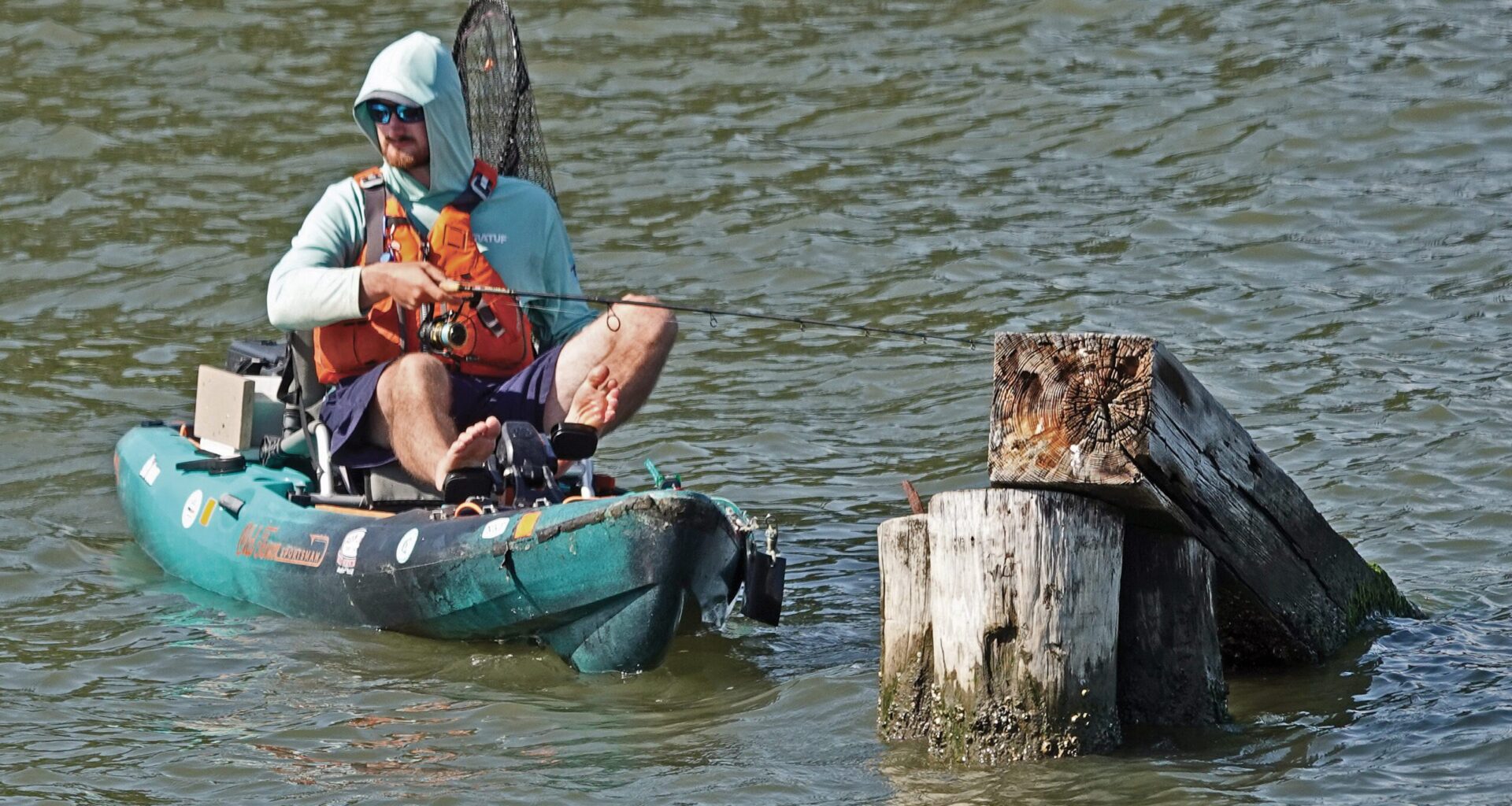
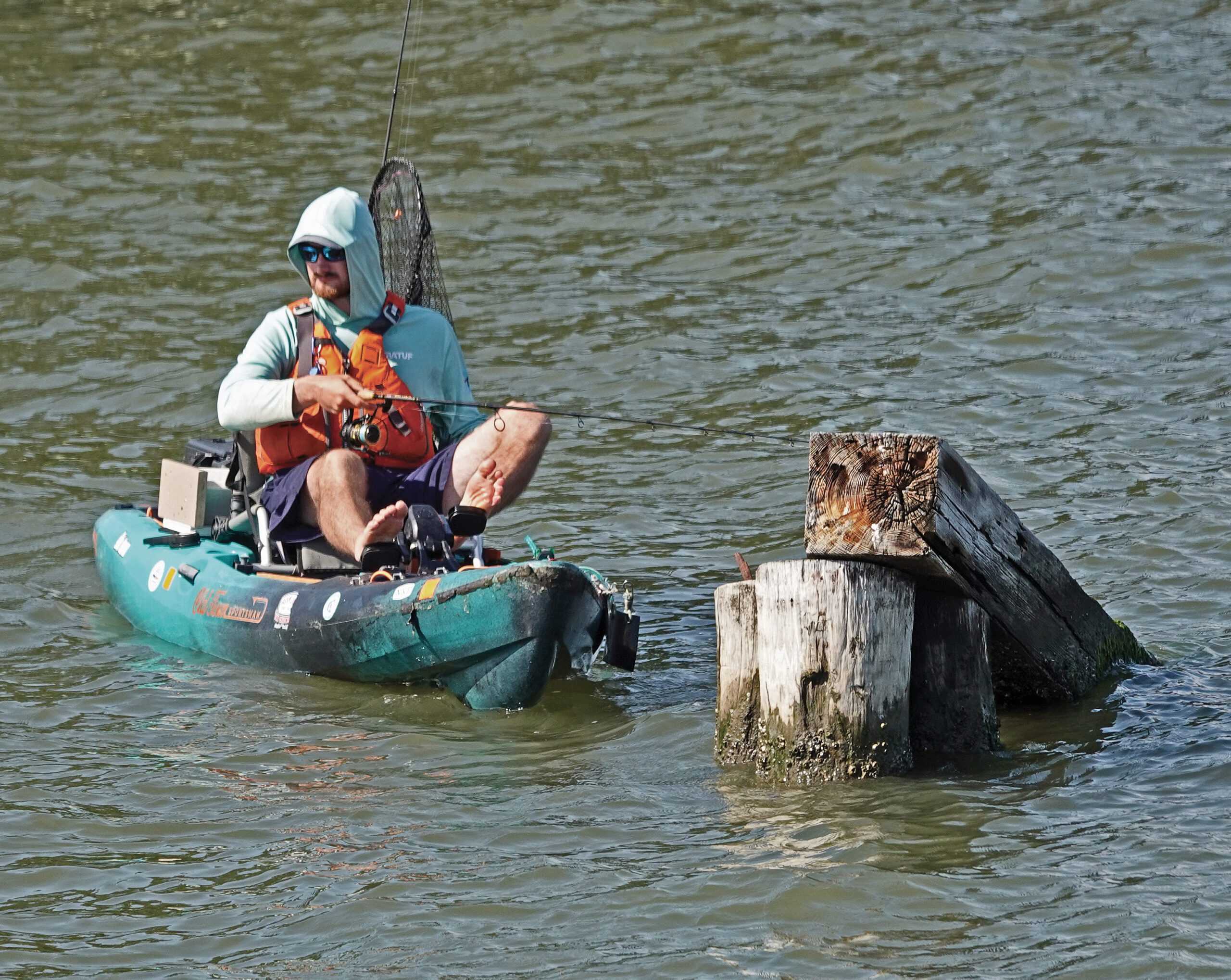
AFTERNOON ’YAK: The bay has been behaving nicely of late, egged on by long stints of fine weather. This offers kayak anglers ideal conditions for some drift fishing in Manahawkin Bay, near the Causeway bridges. The prime target is fluke, though the bases of the bridges traditionally harbor schools of tasty sheepsheads throughout summer. (Photo by Jay Mann)
The new Long Beach Township Beach Patrol drone is set to assist distressed swimmers to the point of dropping flotation devices to them. It can more routinely be used to simply check on the status of bathers, moving in close enough to see facial expressions, including helplessness.
I’m wondering about N.J. soon using drones for shark detection, as is now routinely done, quite successfully, by lifeguard patrols in Callie. We’re also be-sharked along our coastline.
The Eastern Seaboard, specifically Florida, is home to some of the worst shark vs. human events.
New Smyrna Beach in Volusia County is accepted as the “Shark Bite Capital of the World” with black tip sharks leading the way, especially when juicy surfers are in the water, which is almost always.
Although LBI is exactly 1,000 miles from the New Smyrna chomp zone, tropical sharks can travel as much as 100 miles a day with a good tail current, taking them less than two weeks to reach us should they get such a hankering.
Once here, southern sharks find loads of brethren, with 30 different species frequenting our summer waters, and 15 of those considered “very common” by all shark accounts.
Virtually all summer sharks have nary an iota of interest in human bathers, excepting rarish bull sharks and an occasional mainly-for-show great white. However, they are willing to approach swimming areas when in pursuit of prey.
As to lifeguards employing drones to watch swimmers while also checking for any threatening wildlife, that could become a regular part of beachline patrolling.
When looking down from above, there’s probably no summer’s day lacking in shark swim-bys, harmlessly so. It could come down to exactly what types of sharks are being espied. ID’ing is hard even for experts, except with hammerheads.
Those suckers are everywhere out there. It has been said that for every shark you think you’ve seen when swimming, 100 have seen you.
Related: Just last week, a local surf instructor was teaching waveriding to a young lad when the tail of a large thresher came up, all too close up and personal. Been there, seen that. Spooky!
A thresher’s tail is a sight to behold, more so when paddling nearby. It can be 20 feet long, sometimes longer than the shark’s body.
To the tail’s credit, it is lethal to prey, able to thrash the water at 80 mph, generating a hydrological shockwave that stuns, even instantly kills entire schools of forage fish.
Despite its visual awesomeness, the thresher ranks near the top of “harmless” sharks. Just try thinking in those benign terms when a huge tail suddenly breaks water only a shell’s throw away.
In this case, the surf instructor opted to briskly scoot shoreward. Yes, he took the student with him!
BARNEY TAKES A KICKING: Late last Sunday afternoon, a relatively deranged and/or simply disillusioned young man kicked open Barnegat Lighthouse’s locked door, doing egregious damage to the entryway’s old lock system, while smashing a portion of its wooden front panels. The door is the only entrance to the famed monument.
I came upon the scene shortly after the break-in. The unruffled man had exited the lighthouse after a short stay and was nonchalantly seated on a nearby bench chatting with a girl he had just befriended. He told her and other concerned witnesses that he had kicked in the door to look for his girlfriend, who he was certain was “hiding inside.”
Based on a couple accounts, he claimed he was there to propose marriage to the absentee partner.
Impressively fast-arriving Long Beach Township police officers hurriedly detained and handcuffed the still very complacent culprit, who even took a polite moment to apologize to his new friend, saying, “I’m sorry you had to see this.”
During frisking he told police, “I have a ring in my pocket,” possibly confirming his marital intent.
By my quick ex post facto read, he seemed like a nice enough dude – short of his mindlessly damaging a beloved landmark. Some nearby folks even suggested he should just be left alone. That wasn’t happening.
For my part, I accompanied a police officer by walking up a few flights of lighthouse stairs to make sure nothing else was damaged during the intruder’s, uh, visit. I also taped shut the mangled door to await a state investigator.
The door basher made it a long night for both local and state police officers, who kept arriving until well after dark. The authorities knew this was more than simple vandalism, with Barney being involved and all.
LIGHT AND LITERATURE ALIGN: Last Sunday saw literature and astronomy momentarily hook up, at least by my Literature 101 read.
On June 21, the astronomical calendar roughly aligned with the famed Eugene O’ Neil play “Long Day’s Journey Into Night” – alluding primarily to its being the longest day of the year. I’ll forgo bringing in Cornelius Ryan’s book The Longest Day.
Switching over to Astronomy 101, I’ll trivia-ly pass on that the summer solstice on Long Beach Island offered us exactly 14 hours, 58 minutes and 45 seconds of daylight.
For obsessed daylight fanatics, an extra few seconds of daylight could have been gained by rushing from the Island’s south end to Barnegat Light, which is a smidge farther north. The more north, the more daylight.
While at Barnegat Light, even more added daylight time could have been gained by going to the top of the lighthouse and looking west. It’s an altitude thing. However, the lighthouse closed at 3 p.m. The only option would have been to scale it from the outside.
Do not take that seriously, even if you’re a buildering champion.
(Buildering is the official name given to climbing the outside of a building. Going back down is called rappelling.)
On a more worldly scale, the summer solstice drew tens of thousands of modern pagans, tourists and revelers to the annual “Summer Solstice at Stonehenge,” taking place in Wiltshire, England.
Differing from our longest-day solstice perspective, Stonehenge admirers gather before dawn, readying to view the sunrise as it perfectly aligns with the Heel Stone within the Neolithic stone circle.
WORLD CUP GLANCE: In case you’re idly wondering, FIFA is pronounced FEE-fuh. It stands for Fédération Internationale de Football Association. It’s located in Zurich, Switzerland.
I’ve lingered through a goodly number of matches on Fox. Often uncertain as to who I should cheer on, I switch alliances, rooting for the team that has fallen behind.
Recently, I became drawn toward a place called Cape Verde, apparently a viable nation.
Upon Googling, it turns out Cape Verde is a highly isolated republic, located well off the coast of West Africa. It’s comprised of 10 volcanic islands, meaning it could lose a couple to sudden eruptions and still be just fine as a suddenly smaller nation.
As to Cape Verde’s World Cup player pool, its population is almost identical to Ocean County, N.J. That begs the question of what kind of world-class team Ocean County could put together in a crunch.
Focusing on the “beautiful game” with my cynical eye, I see a trend. If you can’t athletically outperform another team, you can resort to theatrically outperforming them. I’m referencing the perpetual injury melodrama – actual injury not required.
It seemingly pays dividends for a team to have a certain degree of whiny Karens.
It’s comical to see a barely nicked player go shriekingly to the grass whilst his team is making a break down the pitch. The ostensibly maimed player is left just lying there, unclaimed.
As often as not, the writher takes a quick peek-about, realizes his Oscar-worthy performance is for naught, and miraculously pops up, soon bolting back to the action, though hellbent on going full Karen on the referee.
OK, back off, futbol aficionados! I’m just leg pulling while fully recognizing there are tons of nasty injuries in the game, many very worthy of writhing.
What’s more, I’ve learned that dives are strategically done to compensate for the lack of official timeouts in the sport. A well-executed pseudo injury allows teammates to grab a breather. It’s simply very hard for American sports fanatics to fathom such theatrics. Historically, we have an entrenched “Suck it up, son!” sports attitude.
RUNDOWN: Although bass of a migratory biomass nature have moved northward, there is a very fine showing of slot-sized stripers in Barnegat Inlet.
I got this highly upbeat Father’s Day e-report from buddy Walt P.
“Fished the north jetty,11:45-12:45, at the start of the water over the rocks. I had 9 spot and boated 7 bass – 5 slots, one slightly over, one slightly under. All released. … Fish & Wildlife checked my boat on pullout at the ramp. Nice guy & no problems.”
I also saw a picture of a fellow (Garrett) coming off the jetty with a fat keeper bass and a cocktail blue. The fatness of the bass is a sign that forage is enough to keep a slew of stripers holding pat in our waters.
Fluking is flapping nicely. Going forward, it will be the prime inshore fishing target until the summer flounder season ends.
As the fluke bite becomes dominated by shorts, anglers must – by law, mind you – display significant release kindness.
Fluke have very minimal protection on their belly side, which is regularly protected by their bottom-hugging lifestyle.
Securing a landed flattie by squeezing it at its internal organs can be a killer, as can dropping it to boat bottom or ground. Even frisbeeing it back into the water can stun it to where frequently awaiting sharks have a field day.
There is thought to be a 10% mortality rate for fluke released by recreational fishermen; that might be way too gratuitous. Of course, even a 20% post-release mortality rate sounds good when compared to the 80% death rate of commercial trawlers’ fluke.
Although a couple inlet bluefish have shown this week, it still might be time to throw in the towel on the season. If so, it was a deplorable spring showing. The worst I’ve ever seen.
There are always those who cheer on a lack of blues, seeing them as little more than meddling bait grabbers. Far more often, they have been the salvation of slow fishing days. I should know.
A real nice late-running black drumfish was taken in the surf, capping an excellent shoreline run of these thick and powerful noisemakers, angrily grunting when caught.
Any black drum caught henceforth are bonuses, though well worth going after by soaking some circle-hooked clams on a dead stick, while casting and retrieving assorted baits and flavored plastics for fluke in near-beach bottom furrows.
SOUTH JETTY TAKES: Fluke for all – but keepers for few.
Per usual, the jetty rock tops are entertaining a delightful hodgepodge of energetic newbie anglers, along with highly hardcore, cleat-shoed old salts, who most often work the jetty’s far east end, rather secretly – as I find out when asking if they caught anything.
With chilly water still hanging in the inlet, this week could remain bass active, with fluke always at the ready.
Sheepsheads should soon start showing with decent force, based on recent summers. Seek them out with sand crabs, which can also attract stripers and throwback tog, the latter totally off limits until Aug. 1. Do not try sneaking one into the bucket. The rocks have a thousand eyes, with tog being highly sought after by poachers.